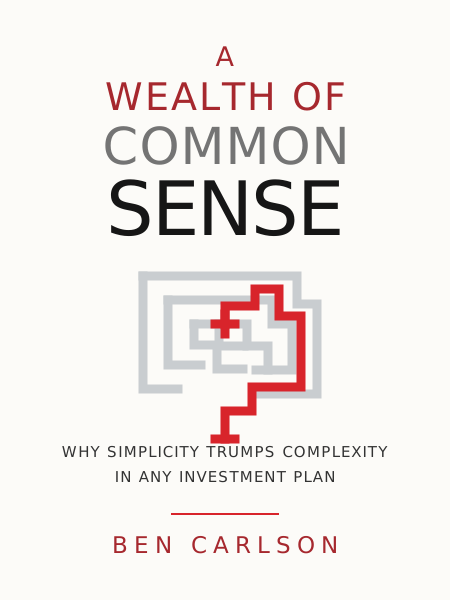
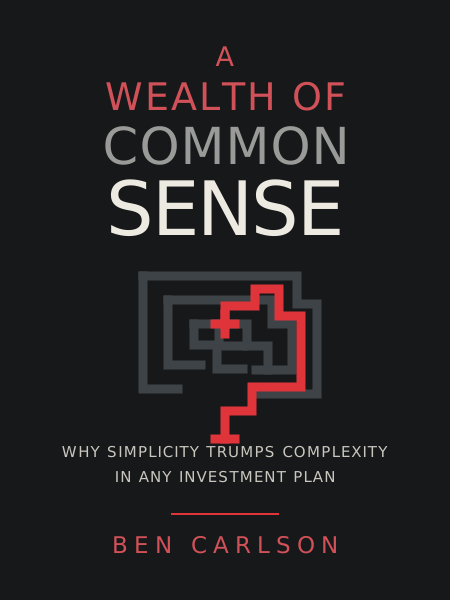
A Wealth of Common Sense
Ben Carlson · 2015
Editorial rating
- Evidence
- 7/10
- Actionability
- 8/10
- Originality
- 6/10
The thesis
Complex financial systems don't require complex strategies to navigate. Individual investors actually have advantages over professionals - longer time horizons, no career risk, no benchmarking pressure - and squander them by overcomplicating things. Simplicity isn't just adequate; it's optimal.
Who this is for
Individual investors overwhelmed by financial jargon and conflicting advice, professionals who suspect they're overthinking their personal portfolios, and anyone who needs permission to embrace boring, simple strategies.
My favorite quote
Everyone wants to outperform the market over every single time frame, both short term and long term. There's a name for this strategy - it's called impossible.
Why it matters
This reframes expectations. You can't win every period. Accepting that frees you from the anxiety of short-term underperformance and lets you stick with strategies that work over decades.
Do this
Review your portfolio. Identify any positions you hold because they "might outperform soon." Consider whether patience or pruning is the right move.
Start here
Negative knowledge beats positive knowledge. Instead of trying to be brilliant, focus on avoiding stupidity. Eliminate high fees, stop chasing performance, don't try to time the market, and ignore financial news. What remains after eliminating mistakes is a surprisingly good strategy - no genius required.
Critical summary
Ben Carlson, Director of Institutional Asset Management at Ritholtz Wealth Management, makes the case for simple investing. Drawing from his experience managing institutional portfolios - where he saw firsthand that complexity rarely helps - he argues individual investors should embrace what works: low-cost index funds, consistent saving, and patience.
The book covers the usual territory for this genre: behavioral biases, the failure of active management, the power of compounding, asset allocation basics. What distinguishes it is Carlson's practical voice - less academic than Bernstein, less crusading than Bogle, more like a sensible colleague explaining things over coffee.
What it gets right
- Individual investor advantages are real and underappreciated
- "Negative knowledge" framing is memorable and actionable
- Writing is accessible without being dumbed down
- Practical without prescribing a specific portfolio
What it misses
- Core ideas are familiar from Bogle, Bernstein, Malkiel, and others
- Some readers report it's too basic if you've read the classics
- One critic noted the "individual vs. professional" framing oversimplifies (investing isn't really a competition)
- U.S.-focused; less applicable for international investors
Evidence comes from academic research, historical data, and Carlson's professional experience. Sound, if not groundbreaking.
Key concepts
Negative Knowledge
Learning what doesn't work to discover what does. Avoid mistakes rather than seeking brilliance.
Individual Investor Advantage
Longer time horizons, no career risk, no forced selling - advantages professionals don't have.
Process Over Outcome
Short-term results are noisy. Focus on whether your process is sound, not whether it "worked" this quarter.
The Investment Policy Statement
A written plan that guides decisions and prevents emotional reactions. Your rulebook.
Complexity Premium Myth
The idea that sophisticated strategies must be better. They're not - they just cost more.
Rebalancing
Periodically returning to target allocation. Forces discipline by selling high and buying low.
Core insights
-
The best process is one you can stick with
A "suboptimal" strategy you follow beats an "optimal" one you abandon during volatility.
-
Diversification is admitting you don't know
It's not hedging - it's humility about predicting which asset class wins next.
-
Costs are the only reliable predictor
You can't know future returns, but you can control fees. Lower costs = higher returns.
-
Market timing is a sucker's game
Even buying at yearly highs versus buying on day one produces nearly identical long-term returns.
-
Complexity is sold, simplicity is earned
Wall Street profits from making things complicated. Your job is to resist.
Implementation steps
Today
- Calculate your total investment expenses (expense ratios + any advisor fees)
- List any positions you're holding because you expect them to "catch up"
This week
- Draft a simple Investment Policy Statement: goals, time horizon, target allocation, rebalancing rules
- Identify one complexity you can eliminate (extra funds, market-timing rules, etc.)
This month
- Consolidate to 3-5 low-cost index funds if you have more
- Set up automatic investing to remove decision fatigue
Ongoing
- Review IPS annually; rebalance when allocations drift 5%+ from target
- Ignore financial news except for policy changes affecting your plan
Suggested 30-day practice plan
An editorial application plan created by Monolithic Vault - an interpretation of the book's ideas, not part of the original book.
- Day 1
Calculate your all-in investment costs
- Day 2
Write your Investment Policy Statement (1 page max)
- Day 3
List every fund you own; flag any with expense ratios above 0.5%
- Day 7
Consolidate redundant positions; eliminate high-cost funds
- Day 14
Set up automatic monthly investing
- Day 21
Review your IPS - does it survive your emotional scrutiny?
- Day 30
Delete financial news apps from your phone
Free PDF summary
Take this analysis with you: a designed two-page field-notes sheet with the thesis, my favorite quote, the key concepts and core insights, and the full 30-day checklist. Print it or keep it - free, no signup.
Go deeper
If this analysis earned your attention, the full book goes further than any summary can. The original is always the primary source.