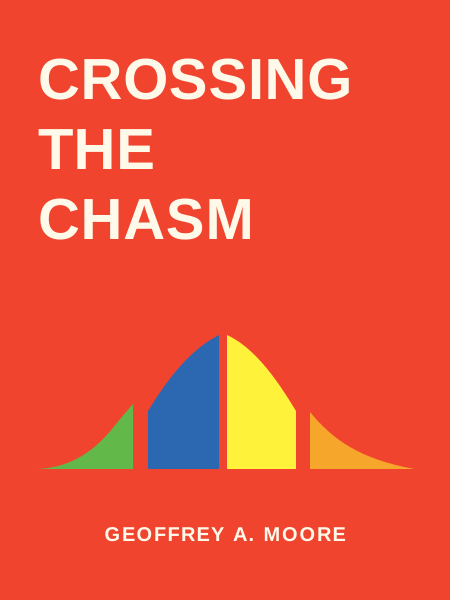
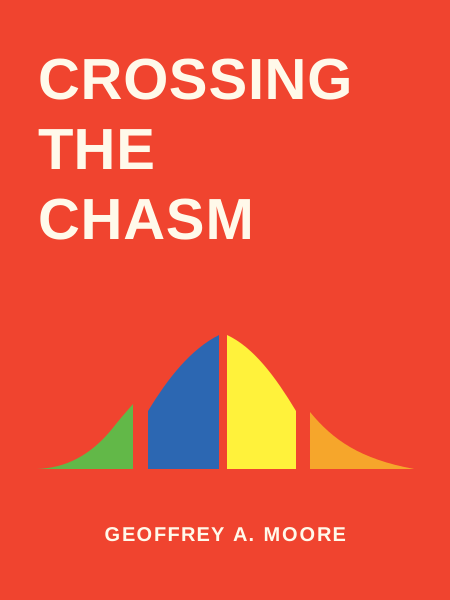
Crossing the Chasm
Geoffrey A. Moore · 1991
Editorial rating
- Evidence
- 7/10
- Actionability
- 9/10
- Originality
- 9/10
The thesis
Innovative tech products face a treacherous gap - the "chasm" - between early adopters (visionaries who tolerate bugs for competitive advantage) and the early majority (pragmatists who want proven, complete solutions). Most startups die in the chasm. Survival requires dominating a narrow niche before expanding.
Who this is for
B2B tech founders, product marketers, and VCs trying to understand why products with early traction suddenly stall. Anyone selling discontinuous innovations (products requiring behavior change).
My favorite quote
The only suitable reference for an early majority customer is another member of the early majority, but no upstanding member of the early majority will buy without first having consulted with several suitable references.
Why it matters
This is the catch-22 of the chasm - pragmatists won't buy without pragmatist references, but you can't get pragmatist references until pragmatists buy. Breaking this cycle requires focused beachhead strategy.
Do this
List your current customers. Are they visionaries (early adopters) or pragmatists (early majority)? If all visionaries, you're still in the chasm.
Start here
The chasm exists because early adopters and the early majority have fundamentally incompatible buying behaviors. Visionaries buy for strategic advantage, tolerate incompleteness, and don't reference each other. Pragmatists buy for productivity improvement, demand "whole product" solutions, and require extensive references from similar companies. Crossing requires picking ONE narrow segment, dominating it completely (becoming market leader with whole product), then using those pragmatist customers as references to adjacent segments.
Critical summary
Moore, a tech consultant in the 1980s-90s, adapted Everett Rogers's "diffusion of innovations" model into a go-to-market framework for discontinuous innovations (tech requiring behavioral change). Published 1991, revised 2014. The book became "the bible for entrepreneurial marketing" (Stanford professor Tom Byers, 2006) and has sold 1M+ copies.
Core insight: The technology adoption lifecycle (innovators → early adopters → early majority → late majority → laggards) has gaps between segments, but the chasm between early adopters and early majority is uniquely deadly. Why? Incompatible motivations. Early adopters are visionaries who want competitive advantage and will assemble solutions themselves. Early majority are pragmatists who want proven, complete, easy solutions. The gap between them is structural, not fixable by incremental marketing.
Crossing strategy: (1) Pick a narrow beachhead segment, (2) Assemble a "whole product" solution (core product + ecosystem of complementary offerings), (3) Dominate that niche (be #1 or #2), (4) Use that reference base to attack adjacent segments.
What it gets right
- Diagnostic power: Explains why products with great early traction suddenly flatline. This resonates deeply with practitioners - everyone has lived the chasm.
- Counter-intuitive strategy: "Go narrow" advice contradicts startup instinct to maximize TAM. But it works - dominate a niche, then expand.
- Whole product concept: Early adopters tolerate gaps ("we'll integrate it ourselves"). Pragmatists want turnkey solutions. This distinction clarifies why reference architecture, partnerships, and ecosystem matter.
- Reference-based selling: Pragmatists buy based on peer recommendations. Building reference base is THE priority in chasm-crossing.
- Still relevant: 33 years old, yet principles hold. SaaS, mobile apps, AI products all face similar chasm dynamics.
What it misses or overstates
- B2B bias: Primarily focused on enterprise tech sales. Consumer tech, marketplaces, and network effect businesses have different dynamics.
- Pre-internet era: Written for 1990s sales cycles (trade shows, field sales, channel partners). Digital marketing, PLG, virality weren't factors.
- Criticized by Rogers: Everett Rogers (creator of original diffusion model) said "past research shows no support for chasm between adopter categories... innovativeness is a continuous variable."
- Survivorship bias: Examples like Apple, Cisco, Oracle succeeded - but did they succeed because of Moore's framework or despite many other factors?
- Dense, academic: 300+ pages, very detailed. Could be 150 pages. Some chapters feel like consultant slide decks stretched into prose.
Evidence quality: Moderate. Mix of Moore's consulting case studies and citations of Rogers's diffusion research. Not peer-reviewed science, but battle-tested practitioner wisdom. The chasm concept resonates because it explains observed patterns, not because of rigorous empirical validation.
Critical reception: Classic. Considered essential reading for tech entrepreneurs. Stanford, Harvard, MIT entrepreneurship courses assign it. VCs reference it in board meetings. "Chasm management" became standard terminology. Critics note it's more descriptive than prescriptive - tells you the problem exists, less clear on guaranteed solutions.
Key concepts
The Chasm
Gap between early adopters (13.5% of market) and early majority (34% of market). Early adopters are visionaries who tolerate risk. Early majority are pragmatists who demand proof. Chasm represents the point where "visionary references don't work for pragmatists."
Whole Product
Core product + everything needed for customer to achieve buying objective. Example: iPhone (core) + App Store + carrier deals + accessories + Genius Bar support. Early adopters assemble whole product themselves. Pragmatists demand it be pre-assembled.
Beachhead Strategy
Pick ONE narrow segment, dominate it completely, then expand to adjacent segments. "Big enough to matter, small enough to lead, good fit with your crown jewels." Don't spread thin across multiple segments.
Bowling Alley Strategy
After dominating beachhead, attack adjacent segments sequentially (like bowling pins). Each segment knocked down makes the next easier. Don't jump to mass market prematurely.
Visionaries vs. Pragmatists
Visionaries want competitive advantage, buy future vision, tolerate incompleteness. Pragmatists want productivity improvement, buy proven solutions, demand completeness. Selling to both simultaneously fails - they have opposite requirements.
Reference Selling
Pragmatists buy based on peer recommendations. Early adopters don't reference each other (each thinks they're unique). Building pragmatist reference base is THE priority for crossing chasm.
Core insights
-
"Visionaries and pragmatists have very different expectations"
Visionaries want revolutionary change and will tolerate bugs. Pragmatists want evolutionary improvement and won't debug your product. Don't try to serve both - pick pragmatists to cross the chasm.
-
"The only suitable reference for early majority is another early majority"
Trying to use visionary customers as references for pragmatists fails. They're too different. You need pragmatist references, which means landing pragmatist customers first (chicken-and-egg problem).
-
"Big enough to matter, small enough to lead"
Chasm-crossing segment criteria. Too small and winning doesn't matter. Too large and you can't dominate. Sweet spot: segment you can become #1 in within 12-18 months.
-
"Most companies are sales-driven, not market-driven"
"We do not have, nor are we willing to adopt, any discipline that would ever require us to stop pursuing any sale at any time for any reason." This mentality guarantees chasm failure - you must focus.
-
"By contrast, the early majority want to buy a productivity improvement for existing operations. They want evolution, not revolution"
If your product requires massive process change, early majority won't buy it. Package it as incremental improvement.
-
"Time is your enemy in the chasm"
The longer you're stuck, the more capital you burn, the more competitors emerge, the more your early adopter momentum fades. Speed matters - pick segment, dominate, move on.
-
"The company failed because its managers were unable to recognize that there is something fundamentally different between a sale to an early adopter and a sale to the early majority"
Many startups misread early sales as proof of product-market fit. If all customers are visionaries, you haven't crossed yet.
Implementation steps
Today
- Audit your current customers: Are they visionaries (early adopters) or pragmatists (early majority)? List characteristics: risk tolerance, completeness demands, reference behavior.
- If 80%+ are early adopters, you're in danger - start planning chasm crossing immediately.
This week
- Identify 3-5 potential beachhead segments. For each, assess: (1) Is it big enough to matter? (2) Can you dominate it? (3) Does your product fit their needs well?
- Talk to 5 pragmatist customers in target segment. What's missing for them to buy? What "whole product" components are they cobbling together themselves?
This month
- Pick ONE beachhead segment. Commit. No hedging across multiple segments.
- Map the whole product: core offering + necessary integrations, support, documentation, training, implementation services. What gaps exist?
- Build partnerships to fill whole product gaps. You can't build everything - find complementary vendors.
- Launch focused campaign targeting beachhead segment only. Ignore other opportunities. Become known as "the solution" for this niche.
Ongoing
- Measure market share in beachhead segment. Are you #1 or #2? If not, double down - don't expand yet.
- Once you dominate beachhead, identify next adjacent segment (bowling pin). Repeat process.
- Build reference program: case studies, customer testimonials, analyst reports, industry awards - all focused on pragmatist validation.
Suggested 30-day practice plan
An editorial application plan created by Monolithic Vault - an interpretation of the book's ideas, not part of the original book.
- Day 1
Read Crossing the Chasm (Chapters 1-3 minimum: The High-Tech Marketing Model, Technology Adoption Life Cycle, The Chasm).
- Day 3
Customer audit - list all customers, classify as innovators/early adopters/early majority. Calculate percentages.
- Day 5
If 80%+ early adopters, you're pre-chasm. Start beachhead planning immediately.
- Day 7
Brainstorm 5-10 potential beachhead segments. Use Moore's criteria: big enough, small enough, good fit.
- Day 10
Narrow to top 3 segments. Interview 3-5 pragmatist prospects in each segment. Which has most pain?
- Day 14
Pick ONE beachhead segment. Get executive alignment. Commit publicly (internally at least).
- Day 17
Whole product mapping - what's missing? Integrations, support, training, consulting? Create gap analysis.
- Day 21
Partnership outreach - identify 3-5 partners who fill whole product gaps. Start conversations.
- Day 25
Develop segment-specific positioning and messaging. Tailored to pragmatist concerns (proof, references, low risk).
- Day 30
Launch focused campaign - landing page, case studies, pragmatist-friendly messaging. Measure first pragmatist conversions.
Free PDF summary
Take this analysis with you: a designed two-page field-notes sheet with the thesis, my favorite quote, the key concepts and core insights, and the full 30-day checklist. Print it or keep it - free, no signup.
Go deeper
If this analysis earned your attention, the full book goes further than any summary can. The original is always the primary source.