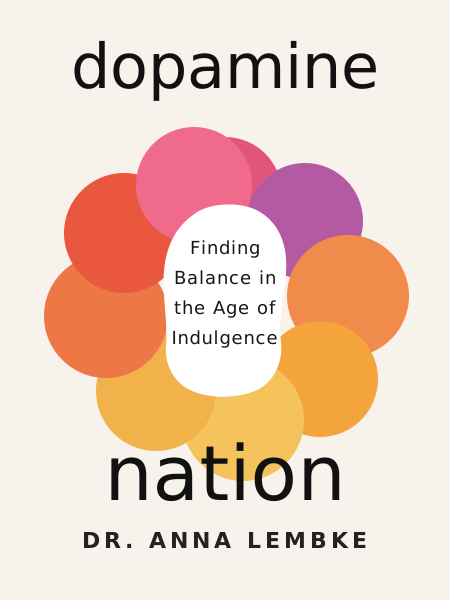
Dopamine Nation
Anna Lembke · 2021
Editorial rating
- Evidence
- 8/10
- Actionability
- 7/10
- Originality
- 7/10
The thesis
In a world of unprecedented access to pleasure-inducing stimuli, our brains' pain-pleasure balance has been hijacked. The path to contentment requires understanding this balance and using strategic abstinence and intentional discomfort to reset our reward systems.
Who this is for
Anyone who suspects their relationship with a substance, behavior, or technology has become compulsive - from obvious addictions to subtle dependencies on phones, food, shopping, or endless scrolling.
My favorite quote
The smartphone is the modern-day hypodermic needle, delivering digital dopamine 24/7 for a wired generation.
Why it matters
This reframes our devices as delivery mechanisms for addictive substances, making the stakes of compulsive use viscerally clear.
Do this
Identify your "digital dopamine" hit of choice (Instagram, Reddit, news). Track how often you reach for it today.
Start here
The pleasure-pain balance is your brain's seesaw. Every dopamine spike from pleasure triggers an equal and opposite response toward pain. Chronic overstimulation tips the balance so far that you need more stimulation just to feel normal - and ordinary life feels flat. The reset requires 4 weeks of abstinence from your substance/behavior of choice.
Critical summary
Dr. Anna Lembke, Stanford's addiction medicine chief, translates neuroscience into an accessible framework for understanding compulsive behavior. Her central model is the pleasure-pain balance: the brain maintains homeostasis by counteracting pleasure with pain. Overindulge repeatedly, and the balance tips permanently toward pain - requiring ever more stimulation to feel okay.
The book weaves patient case histories with neuroscience, making abstract concepts concrete. Lembke's DOPAMINE framework (Data, Objectives, Problems, Abstinence, Mindfulness, Insight, Next steps, Experiment) provides a practical structure for behavior change.
What it gets right
- The pleasure-pain balance is a powerful, intuitive model
- Case histories are gripping and diverse (not just substance abuse)
- Normalizes that everyone is vulnerable to addiction in an age of abundance
- The role of "prosocial shame" (accountability without judgment) is insightful
What it misses
- Some critics find the tone moralistic - pleasure itself isn't bad, context matters
- Patient stories sometimes feel cherry-picked and extreme
- The 4-week abstinence recommendation lacks nuance for different behaviors
- Doesn't deeply address underlying causes (trauma, mental health) that drive addictive behavior
- The "pain as the pathway to pleasure" message can be misinterpreted as self-punishment advocacy
Evidence is strong on neuroscience, weaker on specific intervention efficacy. Lembke draws from established addiction research, not her own controlled studies.
Key concepts
Pleasure-Pain Balance
Your brain maintains equilibrium by counteracting pleasure with pain. Chronic stimulation tips the balance toward persistent dissatisfaction.
Neuroadaptation
The brain adjusts to repeated stimulation by reducing dopamine receptors. You need more to feel the same effect.
4-Week Reset
Complete abstinence from a problematic behavior for 4 weeks allows the brain to restore dopamine homeostasis.
Self-Binding
Create physical and temporal barriers between yourself and the thing you're trying to moderate - Odysseus tying himself to the mast.
Prosocial Shame
Accountability within a supportive community. The AA model: acknowledge the problem without being shunned.
Hormesis
Controlled exposure to mild stressors (cold, exercise, fasting) can upregulate dopamine naturally.
Core insights
-
Abundance is the problem
Our brains evolved for scarcity. Unlimited access to pleasure-inducing stimuli overwhelms our reward systems.
-
Pain leads to pleasure (counterintuitively)
Mild, controlled discomfort (exercise, cold exposure) triggers a rebound dopamine increase without the addictive cycle.
-
Abstinence reveals the addiction
You don't know how dependent you are until you stop. The 4-week test is diagnostic.
-
Radical honesty accelerates recovery
Telling the truth - to yourself and others - about your behavior breaks shame's hold.
-
Connection is the opposite of addiction
Genuine human relationships provide sustainable dopamine in ways consumption cannot.
Implementation steps
Today
- Identify your primary "dopamine source" (the thing you reach for compulsively)
- Rate your current pleasure-pain balance: How satisfied do you feel with ordinary life?
This week
- Track usage of your dopamine source - frequency, triggers, duration
- Experiment with one "hormesis" activity: cold shower ending, moderate exercise, or brief fasting
This month
- Attempt a 4-week abstinence from your identified substance/behavior
- Find or create an accountability structure (friend, group, therapist)
Ongoing
- Maintain "self-binding" strategies for high-risk situations
- Build regular hormesis practices into your routine (exercise, cold exposure)
Suggested 30-day practice plan
An editorial application plan created by Monolithic Vault - an interpretation of the book's ideas, not part of the original book.
- Day 1
Identify your target behavior for abstinence, tell one person about your plan
- Day 2
Remove access where possible (delete apps, discard substances, avoid triggers)
- Day 3
Notice withdrawal symptoms - irritability, restlessness, cravings. This is normal.
- Day 7
First check-in - how intense are cravings? Energy levels? Mood?
- Day 14
Midpoint. Cravings typically peak around days 10-14, then decline.
- Day 21
Notice what's changed. How does ordinary life feel?
- Day 30
Decide: reintroduce with constraints, extend abstinence, or recognize you need more support
Free PDF summary
Take this analysis with you: a designed two-page field-notes sheet with the thesis, my favorite quote, the key concepts and core insights, and the full 30-day checklist. Print it or keep it - free, no signup.
Go deeper
If this analysis earned your attention, the full book goes further than any summary can. The original is always the primary source.