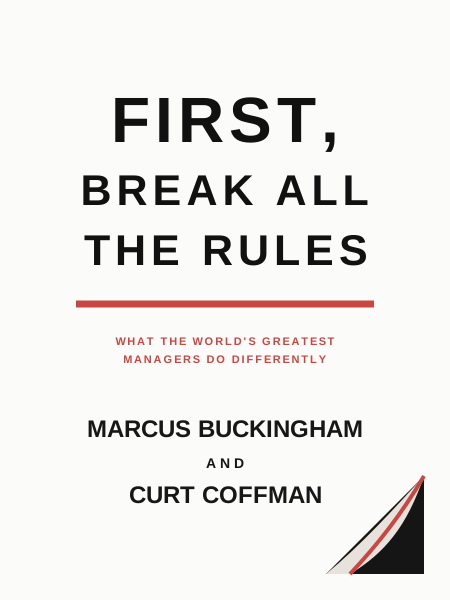
First, Break All the Rules
Marcus Buckingham & Curt Coffman · 1999
Editorial rating
- Evidence
- 9/10
- Actionability
- 7/10
- Originality
- 8/10
The thesis
Great managers don't follow conventional wisdom. They don't try to fix weaknesses - they build on strengths. They don't treat everyone equally - they treat each person as an individual. This isn't soft management; it's what the data from 80,000+ manager interviews reveals actually works.
Who this is for
First-time managers seeking evidence-based guidance, experienced managers frustrated with underperforming teams, and HR leaders questioning whether their management development programs actually develop managers.
My favorite quote
People leave managers, not companies. How long an employee stays and how productive he is while there is determined by his relationship with his immediate supervisor.
Why it matters
This finding, backed by massive Gallup research, shifts accountability for retention from HR programs to individual manager relationships.
Do this
Ask yourself: Would your best people follow you if you left? If not, what's missing in those relationships?
Start here
Focus on strengths, not weaknesses. Great managers discover what's unique about each person and capitalize on it. They don't try to fix people - they build support systems around weaknesses and invest time where it will create the most growth: in their stars, not their strugglers.
Critical summary
Buckingham and Coffman, Gallup consultants, synthesize findings from over 80,000 manager interviews conducted over 25 years. The result is a data-backed challenge to conventional management wisdom: stop treating everyone the same, stop trying to fix weaknesses, and stop assuming people can be anything they want to be.
The book introduces the Q12 - twelve questions that distinguish the strongest teams from the rest. These questions measure practical engagement (do you have the materials you need?) to relational factors (does someone at work care about you as a person?).
What it gets right
- Massive research base gives findings unusual credibility
- The Q12 provides a simple, powerful diagnostic
- Challenges feel-good management myths with data
- The "select for talent, not just skills" framework is foundational
What it misses
- Academic writing style makes it occasionally dry and repetitive
- Published in 1999 - some examples feel dated
- The strengths focus can be taken too far (some weaknesses do need addressing)
- Less practical guidance on how to implement the principles
- Gallup's business model (selling assessments) creates potential bias
Evidence quality is exceptional for a management book. Gallup's meta-analysis methodology is rigorous, and the Q12 has been validated across industries.
Key concepts
The Q12
Twelve questions that measure team engagement. Use them to diagnose your team's health.
Select for Talent
Hire for innate patterns of thought, feeling, and behavior - not just skills or experience.
Define Outcomes, Not Steps
Set clear expectations for what needs to be achieved, but let employees find their own path.
Focus on Strengths
Invest time developing what people do well, not remediating weaknesses.
Find the Right Fit
If someone isn't thriving, the problem may be role fit, not the person. Find where their talents align.
Spend Time with Stars
Great managers invest disproportionately in their best performers, not their strugglers.
Core insights
-
People don't change that much
Talent (recurring patterns of thought/behavior) is largely fixed. Stop trying to install what isn't there.
-
Every role requires talent
Even "unskilled" roles have star performers. The difference is talent, not just effort.
-
The manager is the climate
Team engagement varies dramatically by manager, even within the same company. You are the difference.
-
Conventional fairness backfires
Treating everyone the same is actually unfair - people need different things to succeed.
-
Invest in your best
Counterintuitive but data-backed - great managers spend most time with high performers, not struggling ones.
Implementation steps
Today
- List your team members. For each, identify their top 2-3 strengths and 1-2 weaknesses.
- Ask yourself: Am I spending more time trying to fix weaknesses or amplify strengths?
This week
- Have a brief 1:1 with each team member asking: "What do you most enjoy doing in your role?"
- Assess your team against the first 6 Q12 questions (the foundational "Base Camp")
This month
- For each team member, identify: Are they in a role that fits their talents?
- Design one "support system" to work around a key team member's weakness
Ongoing
- Quarterly strength conversations: "What are you doing when you're at your best?"
- Track your time: Are you investing in your stars or constantly rescuing strugglers?
Suggested 30-day practice plan
An editorial application plan created by Monolithic Vault - an interpretation of the book's ideas, not part of the original book.
- Day 1
Review the Q12 questions. Self-assess: How would your team answer?
- Day 2
Identify your top performer. Schedule time to understand what makes them great.
- Day 3
Identify your biggest struggler. Is the problem talent, role fit, or management?
- Day 7
Complete informal Q12 assessment with your team (or use official Gallup version)
- Day 14
For each team member, document their top 3 talents and primary weakness
- Day 21
Design one role adjustment or support system based on talent insights
- Day 30
Review: How has your time allocation shifted? More time with stars? Less time fixing?
Free PDF summary
Take this analysis with you: a designed two-page field-notes sheet with the thesis, my favorite quote, the key concepts and core insights, and the full 30-day checklist. Print it or keep it - free, no signup.
Go deeper
If this analysis earned your attention, the full book goes further than any summary can. The original is always the primary source.