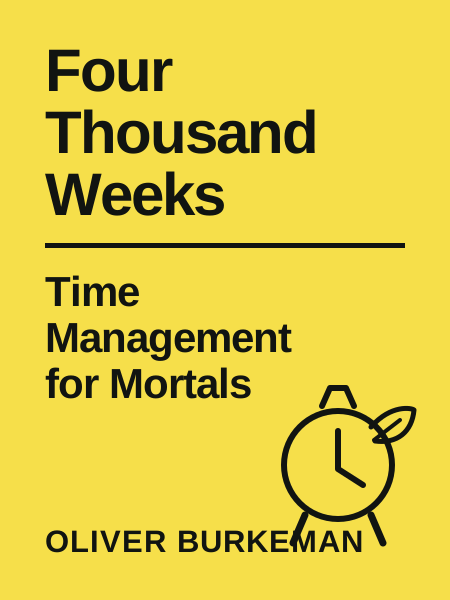
Four Thousand Weeks
Oliver Burkeman · 2021
Editorial rating
- Evidence
- 7/10
- Actionability
- 6/10
- Originality
- 9/10
The thesis
The average human lifespan is about four thousand weeks. You will never "get on top of everything" - the inbox will never be empty, the to-do list never cleared. True productivity isn't about cramming more in; it's about accepting your finite time and choosing deliberately what to neglect so you can do what matters.
Who this is for
Productivity addicts who've tried every system and still feel behind, ambitious professionals whose success strategies are making them miserable, and anyone exhausted by the hamster wheel of optimization.
My favorite quote
The more you try to manage your time with the goal of achieving a feeling of total control, and freedom from the inevitable constraints of being human, the more stressful, empty, and frustrating life gets.
Why it matters
Names the paradox: productivity systems promise control but deliver anxiety. The escape is acceptance, not optimization.
Do this
Today, consciously choose what you will NOT do. Write it down. Feel the relief.
Start here
Embrace finitude instead of fighting it. You have approximately 4,000 weeks if you live to 80. You will never complete everything you could do, see everything you could see, or become everything you could become. This isn't a problem to solve - it's the nature of existence. Once you accept this, you can stop feeling guilty about what you're not doing and start choosing deliberately what you will do.
Critical summary
Burkeman, a Guardian columnist and recovered productivity addict, argues that conventional time management fails because it misdiagnoses the problem. We don't need to get more done - we need to accept that we can't do everything and choose wisely.
The book draws on philosophy (Heidegger, Seneca), psychology, and Burkeman's own failed experiments with optimization. Core concepts include the "efficiency trap" (becoming more efficient just invites more demands), the importance of patience, and the freedom found in accepting limitation.
What it gets right
- Diagnoses the anxiety underlying productivity culture with precision
- Genuinely philosophical without being academic or inaccessible
- Contrarian premise supported by legitimate reasoning
- Practical appendix offers concrete tools despite philosophical focus
- Beautifully written - engaging, funny, profound
What it misses
- More philosophy than tactics - readers seeking step-by-step systems will be frustrated
- Core message could be stated in fewer pages - some find it repetitive
- One-size-fits-all message doesn't address diverse life circumstances
- The "cosmic insignificance therapy" may not land for everyone
- Limited guidance on how to actually choose what to neglect
Evidence is philosophical rather than empirical - draws on established thinkers rather than original research. The arguments are compelling but not scientifically validated in the way productivity studies might be.
Key concepts
Four Thousand Weeks
The average human lifespan. Putting a number on it makes finitude visceral. How many do you have left?
The Efficiency Trap
Becoming more efficient invites more demands. You can't get ahead - there's no finish line.
Cosmic Insignificance Therapy
Your life doesn't matter that much in the grand scheme. This is liberating, not depressing.
Atelic Activities
Activities valuable for their own sake, not for what they produce. Cultivate more of these.
Paying Yourself First
Do what matters before checking email, not after. The urgent will always crowd out the important.
Settling
Choosing one path means closing others. This isn't failure - it's how you make anything actually matter.
Core insights
-
You'll never clear the backlog
The to-do list expands to exceed available time. Acceptance beats optimization.
-
Productivity serves life, not the other way around
If your system makes you more anxious, it's failing regardless of output.
-
Patience is a competitive advantage
In a world of instant gratification, the ability to let things take the time they take is increasingly rare and valuable.
-
The future is not a place to get to
Living in preparation for "someday" means never actually living. Some of life happens now or not at all.
-
Choosing what to neglect is more important than choosing what to do
Every yes implies many nos. Make the nos explicit.
Implementation steps
Today
- Calculate your remaining weeks (80 minus your age, times 52). Feel it.
- Choose one task to deliberately neglect today - write it down
This week
- Identify three tasks you do only because you feel you "should"
- Schedule one atelic activity (valuable for itself, not for outcomes)
- Practice waiting in one line or traffic without checking your phone
This month
- Implement "paying yourself first" - work on what matters before checking email
- Limit work-in-progress to three significant projects maximum
- Have one conversation without any agenda or outcome in mind
Ongoing
- Weekly: What am I neglecting? Is it the right thing to neglect?
- Cultivate patience as a practice, not just an outcome
- Treat "not doing" as a legitimate choice, not a failure
Suggested 30-day practice plan
An editorial application plan created by Monolithic Vault - an interpretation of the book's ideas, not part of the original book.
- Day 1
Calculate remaining weeks. Journal your emotional response.
- Day 2
List everything you're "supposed to" do. Star the ones you actually want to do.
- Day 3
Choose 3 items to deliberately neglect this week. Write them down.
- Day 7
Implement "pay yourself first" - 90 minutes on important work before email
- Day 10
Schedule one activity purely for enjoyment, with no productive outcome
- Day 14
Review: Did the neglected items matter? Probably not.
- Day 18
Practice patience: sit with discomfort instead of filling time
- Day 21
Limit active projects to three. What gets cut?
- Day 25
Have one "being" conversation - no agenda, no outcome, just presence
- Day 30
Write your eulogy. What mattered? Does your current week reflect that?
Free PDF summary
Take this analysis with you: a designed two-page field-notes sheet with the thesis, my favorite quote, the key concepts and core insights, and the full 30-day checklist. Print it or keep it - free, no signup.
Go deeper
If this analysis earned your attention, the full book goes further than any summary can. The original is always the primary source.