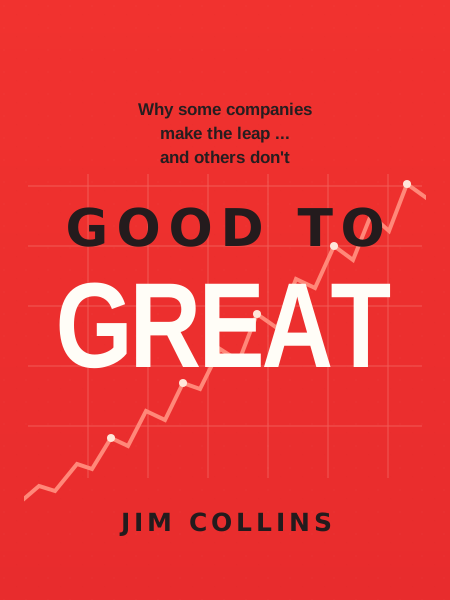
Good to Great
Jim Collins · 2001
Editorial rating
- Evidence
- 7/10
- Actionability
- 7/10
- Originality
- 8/10
The thesis
Good is the enemy of great. Companies that transform from good to great do so through disciplined people, disciplined thought, and disciplined action - not through a single dramatic moment or charismatic leader. The path requires humble leadership, getting the right people first, and relentless focus on what you can be best at.
Who this is for
CEOs and executives leading organizational transformation, leaders wanting to understand what separates sustainable success from mediocrity, and strategists seeking a research-based framework for long-term performance.
My favorite quote
Good is the enemy of great. And that is one of the key reasons why we have so little that becomes great.
Why it matters
Most organizations settle for good enough. This comfort zone prevents the painful changes needed to become truly great.
Do this
Identify one area where you've accepted "good" but could be "great." What's the first step to close that gap?
Start here
The Hedgehog Concept: Great companies find the intersection of three circles: What you can be the best in the world at, what drives your economic engine (profit per X), and what you're deeply passionate about. This isn't a goal or strategy - it's an understanding. Once you find it, ruthlessly focus on it and eliminate everything else.
Critical summary
Collins and his research team spent five years analyzing 28 companies, comparing 11 "good-to-great" companies against similar companies that failed to make the leap. The result is a framework for organizational transformation.
What it gets right
- Level 5 Leadership: Humble leaders with fierce resolve outperform celebrity CEOs
- First Who, Then What: Get the right people before defining strategy
- The Flywheel: Transformation is cumulative, not revolutionary
- Confronting brutal facts while maintaining faith (Stockdale Paradox)
- Discipline as culture, not bureaucracy
What it misses
- Several "great" companies have since failed (Circuit City, Fannie Mae, Wells Fargo scandals)
- Correlation ≠ causation: The study identifies what great companies did, not proven mechanisms
- Survivorship bias: What about companies that did these things and still failed?
- Evidence relies heavily on magazine articles (subject to halo effect)
- 1990s-2000s data may not apply to today's faster-moving markets
Evidence is extensive (10.5 person-years of research, 6,000 articles coded) but methodologically limited to retrospective analysis.
Key concepts
Level 5 Leadership
Personal humility + professional will. Not flashy - quietly resolute. In your next hiring decision, weight humility.
First Who, Then What
Get the right people on the bus before deciding where to drive. Fire the wrong people first.
Hedgehog Concept
Intersection of best-in-world capability, economic driver, and passion. Audit your business against all three circles.
The Flywheel
Transformation happens through consistent pushing, not one big breakthrough. Identify your flywheel.
Culture of Discipline
Disciplined people + disciplined thought + disciplined action = no need for bureaucracy.
Stockdale Paradox
Confront the brutal facts AND maintain unwavering faith you will prevail.
Core insights
-
Celebrity CEOs underperform
The most effective leaders are often unknown outside their companies - humble but fiercely determined.
-
Strategy follows people
Good-to-great companies first got the right people, then figured out where to go.
-
Focus beats diversification
Great companies say "no" to good opportunities that don't fit their Hedgehog Concept.
-
Technology accelerates, not creates
Tech is a fuel, not a spark. Great companies adopt tech that fits their Hedgehog Concept.
-
The Doom Loop
Companies that fail try to find the silver bullet, restructure constantly, and never build momentum.
-
Confronting reality enables faith
Acknowledging brutal facts (without losing hope) creates clearer paths forward.
Implementation steps
Today
- List three things you could potentially be "best in the world at" (start the Hedgehog exploration)
- Ask yourself: "What brutal fact am I avoiding?"
This week
- Evaluate your team: Who would you enthusiastically rehire? Who wouldn't you?
- Identify your economic denominator - profit (or value) per what?
This month
- Map your three circles. Where's the overlap?
- Stop one initiative that doesn't fit the emerging Hedgehog Concept
Ongoing
- Make decisions through the Hedgehog filter: Does this fit all three circles?
- Build the flywheel through consistent, aligned actions
Suggested 30-day practice plan
An editorial application plan created by Monolithic Vault - an interpretation of the book's ideas, not part of the original book.
- Day 1
Write down what you believe your organization could be best in the world at
- Day 2
Identify your key economic driver (profit per X)
- Day 3
List what your team is genuinely passionate about
- Day 7
Map the three circles - where do they overlap?
- Day 14
Audit current initiatives - which ones fit the Hedgehog? Which don't?
- Day 21
Eliminate or deprioritize one initiative outside the Hedgehog
- Day 30
Review: Is the Hedgehog clearer? What's still fuzzy?
Free PDF summary
Take this analysis with you: a designed two-page field-notes sheet with the thesis, my favorite quote, the key concepts and core insights, and the full 30-day checklist. Print it or keep it - free, no signup.
Go deeper
If this analysis earned your attention, the full book goes further than any summary can. The original is always the primary source.