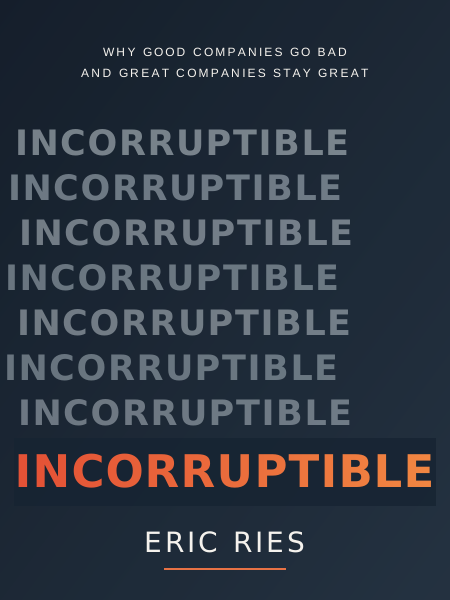
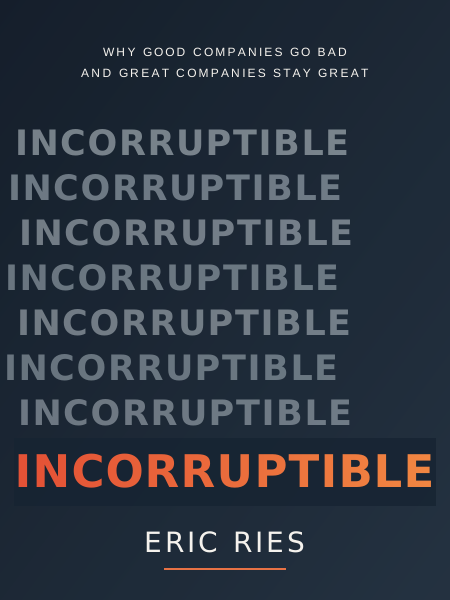
Incorruptible
Eric Ries · 2026
Editorial rating
- Evidence
- 5/10
- Actionability
- 6/10
- Originality
- 7/10
The thesis
Companies lose their soul and mission not because of bad people, but because success itself creates a "financial gravity" that pulls even well-intentioned leaders toward short-term thinking. Only deliberate governance design can resist it.
Who this is for
Founders, board members, and advisors building or protecting a company with a mission, not just an exit strategy.
My favorite quote
It's too early... until it's too late.
Why it matters
It captures the classic founder mistake, that governance and protective structures always feel unnecessary until it's too late to put them in place.
Do this
Ask today: if our company were offered a short-term, profitable choice that undermines the mission, what would stop us from taking it?
Start here
Build protection into the company's structure before it's needed, not after. Ries's point is that "best practices" like quarterly reporting and independent board members are often what drives mission drift, not what prevents it. The most important step is defining what's "non-negotiable" in the company while it's still cheap to protect.
Critical summary
Ries, known for "The Lean Startup", shifts focus from speed and experimentation to durability and governance. The book's central concept is "financial gravity," the systemic force by which success, investor expectations, and board dynamics gradually pull even principled leaders toward short-term, extractive behavior. He calls companies that resist this "mission-locked," using cases like Patagonia, Costco, Novo Nordisk, and Vanguard as examples.
What the book does well: it reframes a familiar problem (mission drift) as structural rather than moral. It's a healthy counterweight to the common "it was just bad people" explanation for corporate scandals, and it offers a vocabulary (mission-lock, financial gravity, director's oath) useful in board work and advisory settings. Reviewers particularly highlight the chapter on "best practices" as a critique of how things like quarterly reporting and standardized governance ratings often are the very mechanism that erodes a company's integrity.
What falls short: the evidence is predominantly case-based and anecdotal rather than systematic or quantitative. One reviewer notes that Ries's claim that founder integrity is "rarely" the cause of mission drift is a questionable generalization, in practice individual integrity still plays a role, even if structural forces are the dominant factor. The book is also more philosophical and governance-heavy than tactical, it doesn't offer as many concrete "do this today" tools as "The Lean Startup" did. For consultants outside the startup and venture world (your typical Danish SME client), many of the examples require translation, the cases are predominantly American, tech- and venture-heavy.
Key concepts
Financial Gravity
The systemic force that pulls even principled companies toward short-term, extractive behavior as they succeed. Use it as a diagnostic question in client workshops: "Where are your financial incentives pulling you away from the mission?"
Mission-Locked Companies
Companies structured specifically to resist mission drift over time, through ownership form, voting rights, or bylaws. Relevant when advising on corporate structure or ownership transitions.
Best Practices as Value Destroyers
Standardized "good" practices (quarterly reporting, independent boards) can in practice undermine long-term integrity. Challenge your clients' "that's just how it's done" assumptions.
Director's Oath
A proposal for a Hippocratic-style oath for board members, binding them to the mission. Can inspire formalizing core principles in board agreements.
Governance as a Design Problem
Ries insists on treating governance as a creative, strategic design choice, not bureaucracy. A relevant angle next time you help a client with corporate structure.
Core insights
-
It's too late once it's needed
Protective structures must be put in place while they're cheap and feel unnecessary. Consequence: raise governance questions early in client relationships, not only during a crisis.
-
Success is itself a risk factor
The more a company succeeds, the stronger the pull toward short-term behavior. Relevant when advising growth companies.
-
"Best practice" isn't the same as "right practice"
Widespread use of a practice isn't proof it creates value. Always ask "why do we do this" in client work, not just "what's the standard."
-
Trust is infrastructure, not a soft value
Ries argues that trust should be built into governance and operations from the start, not treated as a cultural side effect.
-
The book's weakness is its generalizations
The claim that founder integrity is "rarely" the problem should be nuanced yourself when advising clients, structural and individual factors typically interact.
Implementation steps
Today
- Write down three things that are "non-negotiable" in your own business or a current client project.
- Ask yourself which of your current "best practices" have actually been tested for value, and which are just copied.
This week
- Review a client's governance structure (board, ownership, reporting) and identify where "financial gravity" could pull the company away from its mission.
- Discuss the "mission-lock" concept with a client who has a strong mission but a loose structure.
This month
- Draft principles or bylaws that structurally protect a client's core values, not just on paper.
- Test the "director's oath" idea as a conversation opener in a board meeting or advisory engagement.
Ongoing
- Build a standing checkpoint into your advisory process: "What does this structure protect the company against once it becomes successful?"
Suggested 30-day practice plan
An editorial application plan created by Monolithic Vault - an interpretation of the book's ideas, not part of the original book.
- Day 1
Read the chapters on "financial gravity" and "best practices," note three examples from your own experience.
- Day 3
Identify one "best practice" at a client that's never been challenged.
- Day 7
Map a client's current governance structure.
- Day 14
Formulate three "non-negotiable" principles for a client's business.
- Day 21
Present the mission-lock concept to a client or colleague.
- Day 30
Evaluate whether the principles can actually be translated into bylaws, ownership form, or board agreements.
Free PDF summary
Take this analysis with you: a designed two-page field-notes sheet with the thesis, my favorite quote, the key concepts and core insights, and the full 30-day checklist. Print it or keep it - free, no signup.
Go deeper
If this analysis earned your attention, the full book goes further than any summary can. The original is always the primary source.