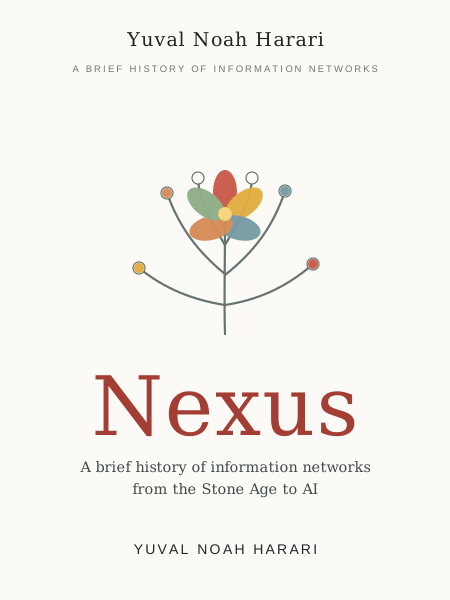
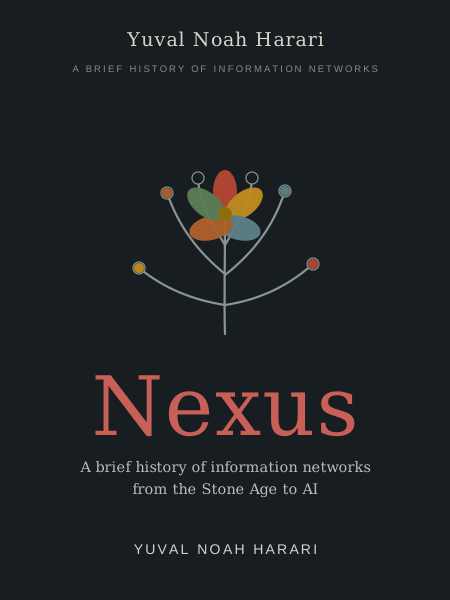
Nexus
Yuval Noah Harari · 2024
Editorial rating
- Evidence
- 8/10
- Actionability
- 6/10
- Originality
- 9/10
The thesis
Human power comes from information networks that coordinate large groups, but those networks optimize for order and connection more readily than truth. AI raises the stakes because information systems can now make decisions and generate ideas without human direction.
Who this is for
Executives deploying AI, policymakers shaping digital rules, technologists building automated systems, and citizens trying to understand why more information has not produced wiser institutions.
My favorite quote
Why are we so good at accumulating more information and power, but far less successful at acquiring wisdom?
Why it matters
The question exposes the book's central gap between the capacity of a network and the judgment guiding its use.
Do this
Identify one decision where your team gathers more data but has no explicit process for challenging assumptions or correcting errors.
Start here
Information is not synonymous with truth. Networks often succeed because they connect people through stories, rules, records, and bureaucracies, even when those shared structures distort reality. Judge an information system by its self-correcting mechanisms, not by how much content it produces.
Critical summary
Yuval Noah Harari traces information networks from oral myth and religious canon to bureaucracy, mass media, totalitarian surveillance, social platforms, and artificial intelligence. His argument rejects the naive view that collecting and distributing more information naturally produces truth or wisdom. Information mainly creates connections, and connections create power by coordinating people at scale. Myths provide shared meaning, bureaucracies classify reality into manageable boxes, and computers process those classifications at speeds humans cannot match. Every network therefore balances truth against order, and the decisive question is whether it contains institutions capable of discovering and correcting mistakes.
What it gets right
- Separates information from truth, explaining why false stories can coordinate millions more effectively than complex facts
- Uses self-correcting mechanisms to distinguish resilient democracies and scientific institutions from rigid totalitarian systems
- Treats AI as an agent that can decide and create, not merely a passive tool controlled at every step by humans
What it overstates or misses
- Sweeping comparisons across religion, empire, democracy, and software sometimes flatten major historical differences
- The AI chapters emphasize catastrophic possibilities more than measurable probabilities or competing technical views
- Policy guidance remains broad, leaving organizations with principles but few concrete governance designs
Harari's evidence is wide rather than deep. He moves quickly through examples such as religious texts, witch hunts, Stalinist files, recommender systems, and the role of algorithms in amplifying outrage. That range makes the pattern memorable but also invites disputes about selection and causation. His strongest contribution is the network lens: individual intelligence cannot rescue a system whose incentives reward fiction, suppress dissent, or centralize every channel of information. Democracies work slowly because courts, journalists, researchers, opposition parties, and elections create costly correction loops. AI can weaken those loops by flooding attention, impersonating people, and concentrating decisions inside systems nobody fully understands. Yet the future is not presented as fixed. Networks are designed, and societies can require accountability, transparency, human identity, and room for correction. The verdict: a powerful framework for information and AI, weakened by historical compression and thin implementation detail.
Key concepts
Information Networks
Systems of people, stories, documents, institutions, and machines that coordinate behavior by moving and processing information.
The Naive View
The mistaken belief that more information automatically creates more truth, knowledge, and better decisions.
Mythology and Bureaucracy
Stories create shared purpose while administrative systems classify people and events so large organizations can act.
Self-Correcting Mechanisms
Independent courts, science, journalism, audits, and opposition channels that expose errors and permit a network to change course.
AI as Agent
Unlike earlier tools, AI can generate ideas and make decisions, allowing the information network itself to become an active participant.
Core insights
-
Connection can defeat accuracy
A simple fiction that aligns behavior may spread farther than a complicated truth, so popularity is not evidence.
-
Power sits at the nexus
Whoever controls the channels where information converges can shape decisions without issuing every command directly.
-
Correction is deliberately expensive
Reliable truth requires institutions, time, expertise, and protected disagreement rather than unrestricted information flow.
-
Centralization changes AI risk
Concentrated networks enable control and efficiency but create a single point where manipulation or error can scale rapidly.
-
Machines can join the conversation
Once AI produces persuasive language and relationships, societies must distinguish human participants from synthetic agents.
Implementation steps
Today
- Map one important decision and mark where its information originates, converges, and can be challenged.
- Add a human verification step before acting on one AI-generated recommendation or document.
This week
- Audit one automated workflow for hidden incentives, missing appeal routes, and unclear accountability.
- Require team members to separate source facts, interpretations, and generated content in decision notes.
This month
- Create an AI governance checklist covering ownership, data provenance, human review, monitoring, and correction.
- Establish an independent red-team review for one high-impact model, dashboard, or recommendation system.
Ongoing
- Measure systems by error detection and recovery, not only speed, engagement, or output volume.
- Protect channels where employees, customers, experts, and affected groups can challenge automated decisions.
Suggested 30-day practice plan
An editorial application plan created by Monolithic Vault - an interpretation of the book's ideas, not part of the original book.
- Day 1
Select one high-impact information system and document its purpose, users, inputs, and decision authority.
- Day 3
Trace where data can be distorted, omitted, fabricated, or rewarded for engagement rather than truth.
- Day 7
Identify the current self-correcting mechanisms and the people empowered to stop or reverse an error.
- Day 14
Add provenance, human review, and an appeal route to the weakest point in the system.
- Day 21
Run a red-team scenario involving confident false output, impersonation, or concentrated control.
- Day 30
Publish a governance standard with named owners, monitoring measures, escalation rules, and a review date.
Free PDF summary
Take this analysis with you: a designed two-page field-notes sheet with the thesis, my favorite quote, the key concepts and core insights, and the full 30-day checklist. Print it or keep it - free, no signup.
Go deeper
If this analysis earned your attention, the full book goes further than any summary can. The original is always the primary source.