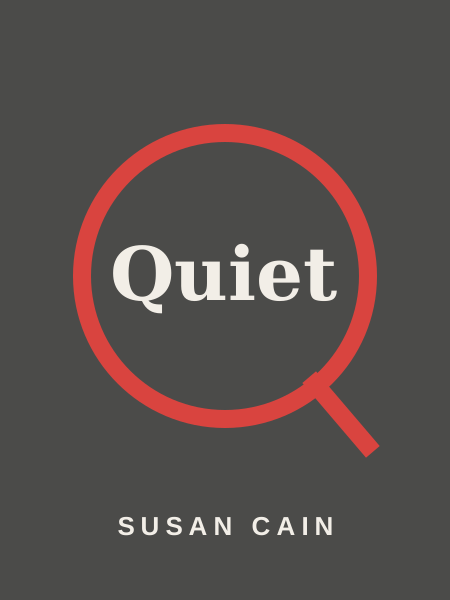
Quiet
Susan Cain · 2012
Editorial rating
- Evidence
- 8/10
- Actionability
- 6/10
- Originality
- 8/10
The thesis
Western culture - especially American business culture - is built around an "Extrovert Ideal" that systematically undervalues introverts. This isn't just unfair; it's counterproductive. Introverts bring crucial strengths (deep thinking, careful listening, focused work) that organizations desperately need but routinely suppress.
Who this is for
Introverts who've spent their lives feeling like something is wrong with them, extroverts who want to understand their quieter colleagues and partners, managers designing team structures, and parents raising introverted children in an extrovert-celebrating school system.
My favorite quote
There's zero correlation between being the best talker and having the best ideas.
Why it matters
In meetings, the most confident voice often wins - not the most insightful. This is a systemic design flaw in how most organizations make decisions.
Do this
In your next meeting, explicitly ask for input from quieter team members before making a decision. Better: collect written input beforehand.
Start here
Understand the difference between introversion and shyness. Introversion is about where you get energy (solitude vs. social interaction) and preference for stimulation levels. Shyness is fear of social judgment. You can be an outgoing introvert or a shy extrovert. Stop treating introversion as a problem to fix - it's a temperament with distinct advantages.
Critical summary
Cain, a former Wall Street lawyer and self-described introvert, spent seven years researching this book. She traces how American culture shifted from a "Culture of Character" (valuing integrity, seriousness, honor) to a "Culture of Personality" (valuing charisma, magnetism, being "interesting") in the early 20th century - and the price we've paid.
The book blends neuroscience (introverts have more active amygdalas, making them more reactive to stimulation), psychology (the Big Five traits, the "orchid/dandelion" hypothesis), and cultural analysis (comparing American extroversion bias to Asian cultures that value quiet contemplation).
What it gets right
- Open-plan offices and groupthink-driven brainstorming actively harm introverted workers' productivity
- Many celebrated "introverted leaders" (Gandhi, Eleanor Roosevelt, Rosa Parks) transformed the world through quiet persistence
- Introverts often make better leaders of proactive teams because they listen rather than dominate
- The "restorative niche" concept: introverts performing extroverted roles need recovery time
What it misses or overstates
- Occasionally oversimplifies the introvert-extrovert binary; most people are ambiverts
- Some research cited (like the orchid hypothesis) is suggestive rather than conclusive
- Can feel like it's creating an "introverts vs. extroverts" battle when the book argues for valuing both
- The "introverts are smarter" undertone, while flattering to introverts, reinforces unhelpful stereotypes
- Heavy on diagnosis, lighter on concrete workplace solutions
- American-focused; some cultural analysis may not apply globally
The book is more manifesto than manual - excellent for understanding and validation, less strong on "what do I do Monday morning?"
Key concepts
The Extrovert Ideal
Cultural bias equating charisma with competence. Notice when you're conflating "speaks confidently" with "knows what they're talking about."
Restorative Niches
Environments where introverts can recharge between social demands. Build these into your schedule proactively.
High Reactivity
Introverts' nervous systems respond more strongly to stimulation. This isn't weakness - it enables deep processing.
Free Trait Theory
We can act "out of character" for things we care deeply about (introverts giving speeches, extroverts doing solitary work). But it costs energy.
Soft Power
Introverts' influence style - persistence, preparation, deep expertise - that accumulates slowly but often prevails. Gandhi's model.
The Rubber Band Theory
You can stretch beyond your temperament, but you'll always snap back. Know your limits and plan recovery time.
Core insights
-
Solitude is a catalyst for creativity
Wozniak invented the personal computer alone. Solitary practice produces mastery. Protect your alone time.
-
Groupthink punishes introverts twice
Open offices destroy their productivity AND silence their better ideas. Advocate for quiet spaces and written input.
-
Introverts don't hate people - they hate shallow interaction
Deep conversations energize; small talk drains. Structure social time around meaningful exchanges.
-
Leadership isn't about dominance
Introverted leaders often outperform with proactive teams because they actually listen and implement good ideas.
-
"Fake it till you make it" has real costs
Acting extroverted depletes introverts. Budget social energy like money - you can overspend.
Implementation steps
Today
- Identify your "restorative niches" - places and activities that recharge you
- Audit your calendar: how much recovery time exists between socially demanding events?
This week
- Negotiate at least one meeting to be an email instead
- Schedule 30 minutes of true solitude daily (not just being alone while checking phone)
- If managing others, ask for written input before your next team discussion
This month
- Redesign your workspace for fewer interruptions (headphones, "do not disturb" signals)
- Have the conversation with your partner/family about your need for alone time (use Cain's language)
- Identify one area where you're stretching beyond your temperament - plan compensating recovery
Ongoing
- Protect your "core personal projects" - work that matters enough to stretch for
- Build social energy into your weekly planning like any other resource
- Notice and interrupt the thought "I should be more outgoing" - question the assumption
Suggested 30-day practice plan
An editorial application plan created by Monolithic Vault - an interpretation of the book's ideas, not part of the original book.
- Day 1
Take an introversion assessment (MBTI, Big Five, or similar); journal about what resonates
- Day 2
Map your energy patterns - when do you feel most drained? Most recharged?
- Day 3
Create a restorative niche: designate space and time that's yours alone
- Day 7
Audit your work environment; identify the top 3 energy drains and potential solutions
- Day 14
Have one "deep conversation" instead of multiple shallow ones; notice energy difference
- Day 21
Practice the "stretch and recover" cycle: take on one extroverted challenge, then schedule recovery
- Day 30
Write a personal "Introvert Operating Manual" - share it with key people in your life
Free PDF summary
Take this analysis with you: a designed two-page field-notes sheet with the thesis, my favorite quote, the key concepts and core insights, and the full 30-day checklist. Print it or keep it - free, no signup.
Go deeper
If this analysis earned your attention, the full book goes further than any summary can. The original is always the primary source.