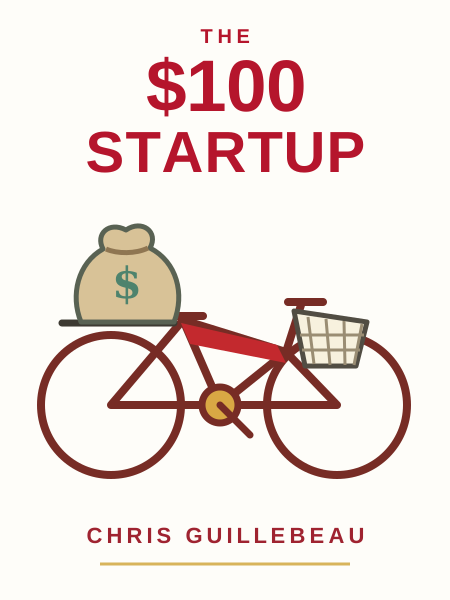
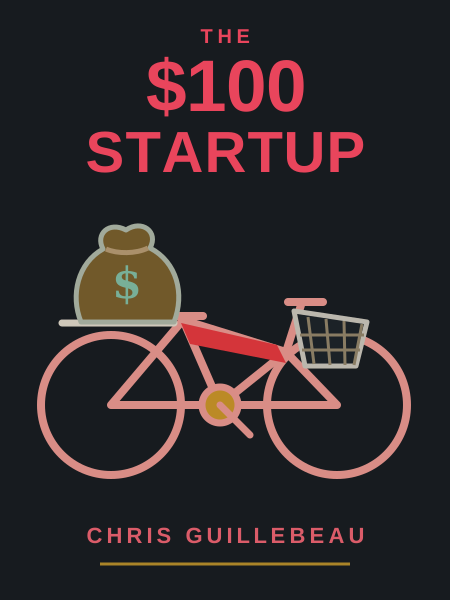
The $100 Startup
Chris Guillebeau · 2012
Editorial rating
- Evidence
- 5/10
- Actionability
- 7/10
- Originality
- 5/10
The thesis
You don't need business school, venture capital, or a revolutionary idea to start a profitable business. Many successful enterprises start with under $100 investment by combining something you're good at with something people will pay for. Skills + usefulness = micro-business opportunity.
Who this is for
Side-hustlers, corporate escapees, and anyone curious about self-employment but intimidated by the startup mythology. Particularly suited for service-based, online, or creative businesses rather than capital-intensive ventures.
My favorite quote
Value means helping people. If you're trying to build a micro-business and you begin your efforts by helping others, you're on the right track.
Why it matters
The book's core insight is that businesses exist to create value for others, not to "follow your passion." This reframe makes opportunity identification clearer.
Do this
List three skills you have that others have asked for help with. Research if anyone is paying for those skills online (check Upwork, Fiverr, or Google "[skill] consultant").
Start here
Convergence: Your business exists at the intersection of what you love, what you're good at, and what others will pay for. Most people only have two of three - passion projects that don't make money, or skills they hate using. Map your own intersection: list your skills, then identify which ones solve problems people actively pay to solve.
Critical summary
Guillebeau studied 1,500 individuals earning $50K+ from businesses started with minimal investment, focusing on 50 detailed case studies. The book is essentially a pattern-recognition exercise across these stories, extracting common strategies.
The core framework positions micro-businesses at the intersection of skills and market needs. Guillebeau emphasizes speed to market, keeping costs minimal, and iteration over planning.
What it gets right
- Democratizing message: you don't need MBA or VC to start
- 50 diverse case studies provide tactical patterns
- Emphasis on testing before perfecting
- One-page business plan keeps things actionable
- Practical frameworks for pricing and launch
What it misses
- Many case studies weren't actually $100 startups (some had significant prior capital or infrastructure)
- Heavy bias toward information products and online businesses
- Survivorship bias: we don't see the failed $100 startups
- Feels like blog posts compiled into book (repetitive, surface-level)
- Oversells ease of entrepreneurship - most small businesses fail
- Limited guidance on scaling or when to quit
Evidence is primarily anecdotal (case studies). The selection criteria favor success stories, creating an optimistic picture that may not reflect actual small business survival rates.
Key concepts
Skill Transformation
Applying skills from one context to another market. Identify skills you take for granted that others would pay to learn.
Convergence
Passion + Skill + Market need. All three must be present. Map your own intersection.
The One-Page Business Plan
What you sell, who buys it, how they pay - on one page. Write yours in 30 minutes, not weeks.
The Instant Gratification Model
Reduce time from customer desire to fulfilled need. Faster = more valuable.
Launch Timing
The product is ready when it's good enough, not when it's perfect. Test with real customers early.
Core insights
-
The $100 is a mindset, not a limit
Start with minimal investment to validate, then reinvest profits. Capital efficiency forces creativity.
-
Follow-up beats first sale
Much of the revenue in case studies came from repeat customers and referrals. Customer relationships compound.
-
Help people first
The most successful stories started by genuinely helping others, then discovered people would pay for that help.
-
Offer transformation, not information
People don't pay for knowledge - they pay for outcomes. Package your expertise as results.
-
Launch ≠ perfect
Every successful entrepreneur launched something unfinished. The market provides better feedback than your imagination.
Implementation steps
Today
- List 10 skills you have (including ones you take for granted)
- Identify which 3 skills others have paid for or asked help with
- Research if anyone sells services/products around these skills
This week
- Talk to 5 people in your network about problems they'd pay to solve
- Draft a one-page business plan for one idea
- Calculate minimum viable price using: cost × 2 or value × 0.2 (whichever is higher)
This month
- Create simplest possible version of your product/service
- Find 3 potential customers and pitch directly
- Launch and make first sale (even at discount)
Ongoing
- Iterate based on customer feedback
- Build email list from day one
- Reinvest profits into higher-leverage opportunities
Suggested 30-day practice plan
An editorial application plan created by Monolithic Vault - an interpretation of the book's ideas, not part of the original book.
- Day 1
Complete skills inventory and market overlap analysis
- Day 2
Research 3 competing products/services in your potential space
- Day 3
Draft one-page business plan
- Day 7
Create landing page or simple sales document describing your offer
- Day 14
Reach out to 20 potential customers personally
- Day 21
Deliver first version to early customer(s), gather feedback
- Day 30
Refine offer based on feedback, establish pricing, plan sustainable customer acquisition
Free PDF summary
Take this analysis with you: a designed two-page field-notes sheet with the thesis, my favorite quote, the key concepts and core insights, and the full 30-day checklist. Print it or keep it - free, no signup.
Go deeper
If this analysis earned your attention, the full book goes further than any summary can. The original is always the primary source.