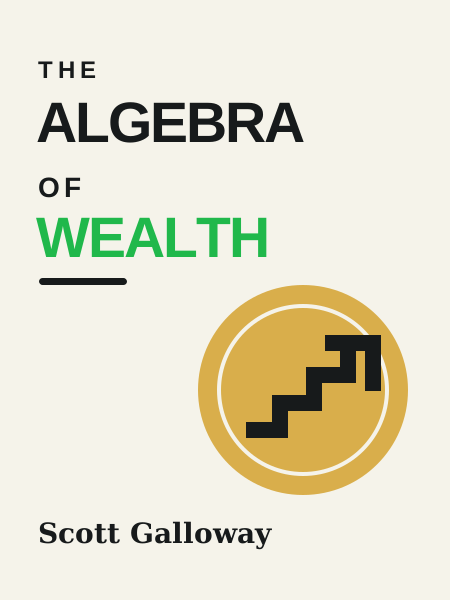
The Algebra of Wealth
Scott Galloway · 2024
Editorial rating
- Evidence
- 6/10
- Actionability
- 8/10
- Originality
- 5/10
The thesis
Wealth = Focus + (Stoicism × Time × Diversification). Financial security isn't about getting lucky or finding a secret formula - it's about developing character, concentrating on your career, giving your money time to compound, and spreading risk across asset classes. The formula is simple; execution is hard.
Who this is for
Twenty- and thirty-somethings navigating early career decisions, professionals who've been earning well but not building wealth, and anyone seeking a no-BS framework that integrates life philosophy with financial mechanics.
My favorite quote
Follow your talent, not your passion. The accoutrements that accompany being great at something will make you passionate about whatever 'it' is.
Why it matters
The "follow your passion" advice is for people who are already rich. Most passions don't pay. But if you get great at something valuable, you'll develop passion for it through mastery and the rewards that follow.
Do this
List your top 3 marketable skills. Which has the highest earning potential? Invest more time there, regardless of initial passion.
Start here
Stoicism is the foundation. Character determines behavior, and behavior determines outcomes. Before worrying about investment strategies, develop the temperance to spend less than you earn and the discipline to stay the course when markets panic. The ancient Stoics figured this out 2,000 years ago; modern self-help just repackages it.
Critical summary
Scott Galloway - NYU professor, podcast host, and serial entrepreneur - delivers his framework for building financial security. The book is part career advice, part life philosophy, part investing primer, all delivered in Galloway's characteristic blunt, anecdote-heavy style.
The "algebra" is Wealth = Focus + (Stoicism × Time × Diversification). Stoicism covers character and spending discipline. Focus addresses career strategy - Galloway argues strongly for talent over passion and certifications over credentials. Time emphasizes compounding. Diversification is a crash course in asset classes and portfolio construction.
What it gets right
- "Talent over passion" is refreshing counterpoint to typical career advice
- Strong on the behavioral/character foundations most finance books skip
- Accessible introduction to asset classes for financial novices
- Galloway's voice is engaging and no-BS
What it misses
- Kirkus called it "unoriginal" - synthesizes familiar ideas without much new
- Light on actual investing tactics for those past the basics
- Advice assumes a certain level of income and stability that not everyone has
- Some career advice feels dated or applicable mainly to knowledge workers
Evidence is primarily anecdotal (Galloway's life, his students, general observations). The book is more motivational than empirical, but the framework is sound for those who need it.
Key concepts
Stoicism
Ancient philosophy focused on character, discipline, and accepting what you can't control. The foundation for all financial behavior.
Focus
Career strategy. Get certified, develop expertise, ride economic waves, and don't confuse talent with passion.
Time
The magic of compounding. Starting early matters more than starting big.
Diversification
Spreading risk across asset classes (stocks, bonds, real estate, etc.) to survive what you can't predict.
Talent Over Passion
Build skills in areas that pay, not areas you fantasize about. Mastery creates passion.
Economic Stalking
Positioning yourself in growing industries and companies rather than fighting declining ones.
Core insights
-
Character is the foundation of wealth
All the investment knowledge in the world doesn't matter if you can't control spending or maintain discipline during downturns.
-
Marry well
Your spouse is the most important financial decision you'll ever make. Divorce destroys wealth.
-
Get certified
In a credential-hungry world, logos on your resume (universities, certifications, prestigious employers) open doors that talent alone cannot.
-
Ride waves, don't fight them
Individual achievement matters less than the industry or company you're in. A rising tide lifts all boats.
-
Time is your most valuable asset
Every dollar saved in your 20s is worth far more than one saved in your 50s. Urgency matters.
Implementation steps
Today
- Calculate your current savings rate. Is it at least 20% of income?
- List your marketable skills; identify which are most valuable
This week
- Identify 3 certifications or credentials that could increase your earnings
- Open (or max out) a tax-advantaged retirement account
This month
- Set up automatic investing - remove the decision from your hands
- Evaluate your industry: growing, stable, or declining? Position accordingly
Ongoing
- Spend less than you earn; increase the gap annually
- Rebalance portfolio annually to maintain diversification
Suggested 30-day practice plan
An editorial application plan created by Monolithic Vault - an interpretation of the book's ideas, not part of the original book.
- Day 1
Calculate your net worth and savings rate
- Day 2
List your skills and identify the highest-value ones to develop
- Day 3
Set up automatic savings/investing if you haven't already
- Day 7
Research one certification that could boost your career
- Day 14
Review your asset allocation; identify gaps in diversification
- Day 21
Evaluate your industry trajectory - should you stay or pivot?
- Day 30
Create a one-page "algebra of wealth" plan: character habits, career focus, time horizon, diversification targets
Free PDF summary
Take this analysis with you: a designed two-page field-notes sheet with the thesis, my favorite quote, the key concepts and core insights, and the full 30-day checklist. Print it or keep it - free, no signup.
Go deeper
If this analysis earned your attention, the full book goes further than any summary can. The original is always the primary source.