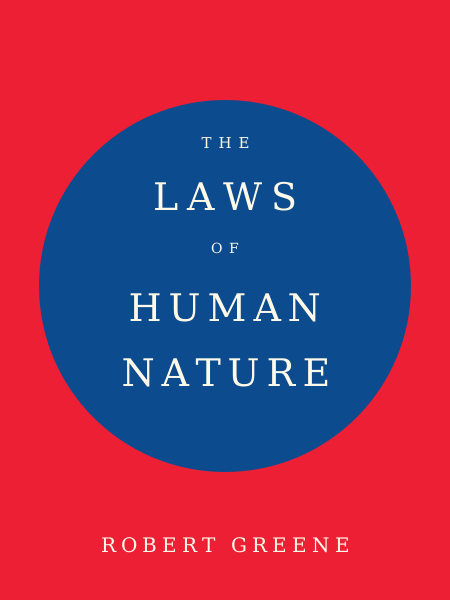
The Laws of Human Nature
Robert Greene · 2018
Editorial rating
- Evidence
- 6/10
- Actionability
- 7/10
- Originality
- 8/10
The thesis
Human behavior is governed by patterns we rarely recognize in ourselves but can learn to see in others. By understanding these "laws" - our tendencies toward irrationality, narcissism, envy, shortsightedness, and conformity - we can master our impulses, anticipate others' actions, and navigate social dynamics with strategic clarity.
Who this is for
Professionals who want to understand office politics, leaders navigating complex stakeholder relationships, and anyone tired of being blindsided by others' behavior - or their own self-sabotage.
My favorite quote
The greatest power you possess is your ability to resist your emotions.
Why it matters
Most mistakes stem from emotional reactivity. The ability to pause, observe, and respond rationally is the fundamental skill everything else builds on.
Do this
Today, when you feel a strong emotion arise, pause for 5 seconds before responding. Name the emotion. Then choose your response.
Start here
Develop radical self-awareness about your own shadow - the parts of yourself you deny or suppress. Every trait you criticize in others likely exists in you. By acknowledging your capacity for envy, aggression, and irrationality, you gain power over these tendencies rather than being unconsciously controlled by them.
Critical summary
Greene's magnum opus synthesizes psychology, history, and philosophy into 18 "laws" of human nature. Unlike his earlier Machiavellian works (The 48 Laws of Power), this book focuses on self-mastery as much as social strategy.
Each chapter follows Greene's signature structure: a historical case study illustrating the law, an explanation of the psychological dynamics, and practical strategies for applying the insight. The result is a 600-page exploration of why people do what they do.
What it gets right
- Deep integration of historical examples with psychological principles
- Honest engagement with humanity's darker tendencies (envy, grandiosity, aggression)
- Practical applications for professional and personal contexts
- Encourages self-examination rather than just observing others
- Carl Jung's "shadow" concept made actionable
What it misses
- 600 pages is excessive; could be tighter without losing substance
- Some "laws" feel like post-hoc rationalizations from cherry-picked examples
- Evidence base is historical anecdote, not psychological research
- The Machiavellian undertone - treating relationships as strategic games - may feel manipulative
- Limited acknowledgment of cultural variation in human behavior
Evidence is historical and biographical, drawing from figures like Queen Elizabeth I, Martin Luther King Jr., and Michael Eisner. Not rigorous science, but compelling pattern recognition.
Key concepts
The Shadow
Carl Jung's term for the parts of ourselves we deny. Acknowledge your shadow to avoid projecting it onto others.
Narcissism Spectrum
Everyone is on it. Recognize healthy self-regard vs. destructive grandiosity in yourself and others.
Social Mask
The persona we present differs from our true self. Learn to see behind masks - including your own.
Generational Patterns
Each generation develops a collective character in response to the previous one. Understand these cycles.
Death Ground Strategy
Confronting mortality creates urgency and clarity. Use finite time as motivation.
Core insights
-
Irrationality is the default
We believe we're rational but are driven by emotions we rationalize after the fact. Assume irrationality in yourself and others.
-
Envy is ubiquitous and hidden
People rarely admit envy but act on it constantly. Look for it in colleagues who suddenly become critical of your success.
-
Character is destiny
Past behavior predicts future behavior far better than stated intentions. Judge people by their history, not their promises.
-
Grandiosity follows success
Success creates a feeling of specialness that leads to overreach. The bigger the success, the more dangerous the grandiosity that follows.
-
Groups make us stupid
In groups, we regress toward emotional contagion and conformity. Cultivate independence of mind.
Implementation steps
Today
- Write down three traits you criticize most in others. Consider: Do these exist in you?
- Notice one instance where you rationalized an emotional reaction
This week
- Identify one person whose behavior consistently surprises you. What pattern might explain it?
- Practice observing group dynamics in a meeting without getting pulled into the emotion
This month
- Map your own narcissistic tendencies: Where do you seek validation? Where are you blind to criticism?
- Read about one historical figure's rise and fall; identify which laws were at play
Ongoing
- Default to observing before reacting in charged situations
- Assess new people by their past actions, not their words
- Periodically audit your own shadow - what are you denying?
Suggested 30-day practice plan
An editorial application plan created by Monolithic Vault - an interpretation of the book's ideas, not part of the original book.
- Day 1
Read the law on irrationality; identify three recent irrational decisions you made
- Day 2
Observe your emotional reactions throughout the day; note triggers
- Day 3
Practice the 5-second pause before responding in one conversation
- Day 7
Complete a "shadow audit" - what do you criticize in others that exists in you?
- Day 14
Observe group dynamics in one meeting; note conformity pressure
- Day 21
Assess one key relationship: What patterns in their behavior have you been ignoring?
- Day 30
Review: What have you learned about yourself? What behaviors will you change?
Free PDF summary
Take this analysis with you: a designed two-page field-notes sheet with the thesis, my favorite quote, the key concepts and core insights, and the full 30-day checklist. Print it or keep it - free, no signup.
Go deeper
If this analysis earned your attention, the full book goes further than any summary can. The original is always the primary source.