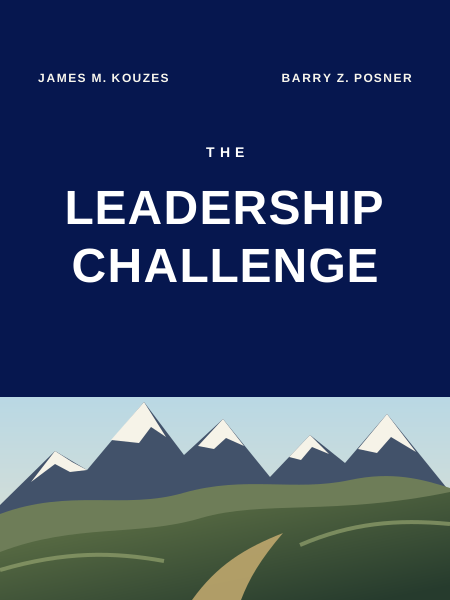
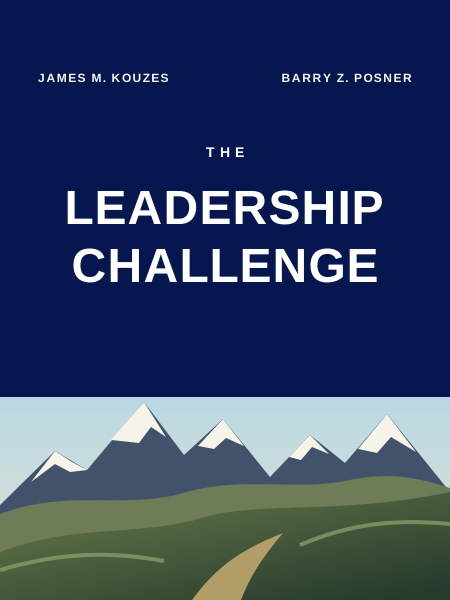
The Leadership Challenge
James Kouzes & Barry Posner · 1987
Editorial rating
- Evidence
- 7/10
- Actionability
- 7/10
- Originality
- 5/10
The thesis
Leadership is not about position or personality - it's about behavior. Through research on thousands of "personal best" leadership experiences, five practices emerge that anyone can learn: Model the Way, Inspire a Shared Vision, Challenge the Process, Enable Others to Act, and Encourage the Heart.
Who this is for
New managers seeking a framework for leadership development, HR leaders designing leadership programs, and anyone who believes leadership is a learnable skill rather than an innate trait.
My favorite quote
The best leaders are the best learners.
Why it matters
This democratizes leadership - it's not about charisma you're born with but habits you develop.
Do this
Identify one leadership practice you're weakest at. Commit to one specific behavior change this week.
Start here
Master Model the Way: Leadership starts with clarity about your own values and the courage to act consistently with them. Before you can lead others, you must be credible - and credibility comes from doing what you say. Start by clarifying your values, then align your actions. When there's a gap between your espoused values and your behavior, others notice and trust erodes.
Critical summary
Kouzes and Posner, leadership researchers at Santa Clara University, built their framework from analyzing thousands of "personal best leadership experiences" - moments when leaders felt they were at their most effective. From this research emerged five practices, each with two commitments, creating a comprehensive model for leadership development.
The book has been influential in corporate leadership programs for decades, now in its seventh edition. Its strength is accessibility - the five practices are memorable and each comes with concrete behaviors. The Leadership Practices Inventory (LPI) assessment provides a diagnostic tool for development.
What it gets right
- Research-based framework with decades of validation
- Practical, behavior-focused - not abstract traits
- The five practices are memorable and teachable
- Strong emphasis on leadership as learnable, not innate
- Each practice includes specific, actionable commitments
What it misses
- The research methodology (personal best experiences) creates survivorship bias
- Lacks nuance for different contexts - what works in one culture may fail in another
- Can feel generic and corporate-training-ish
- The "encourage the heart" practice feels forced compared to others
- Light on the shadow side of leadership - conflict, difficult decisions, failure
- Not particularly original - synthesizes existing leadership research
The book is a solid entry point for leadership development but lacks the edge for advanced practitioners who need more than motivational frameworks.
Key concepts
Model the Way
Clarify values and set the example. People follow credibility first, position second.
Inspire a Shared Vision
Envision the future and enlist others. Paint a compelling picture of what's possible.
Challenge the Process
Search for opportunities and experiment. Leadership means change; maintain means management.
Enable Others to Act
Foster collaboration and strengthen others. Give power away to multiply impact.
Encourage the Heart
Recognize contributions and celebrate values/victories. Emotional connection sustains effort.
The Five Practices
The complete framework - model, inspire, challenge, enable, encourage. Each practice has two commitments.
Core insights
-
Credibility is the foundation
Leadership is personal. People must believe in you before they believe in your vision.
-
Values must be lived, not posted
Espoused values are meaningless. Leadership credibility comes from consistent action over time.
-
Leadership is about change
If you're maintaining status quo, you're managing, not leading. Leaders challenge the process.
-
Giving power multiplies power
The more you enable others, the more influential you become. Hoarding control diminishes impact.
-
Celebration is strategic, not soft
Recognizing contributions reinforces values and sustains motivation through difficulty.
Implementation steps
Today
- Write down your top three personal values; assess if your recent actions reflect them
- Identify one person whose contributions you haven't recognized recently; recognize them today
This week
- Share your vision for the team's future with one person; note their reaction and refine
- Delegate one decision you've been holding; coach instead of directing
This month
- Create a "values in action" exercise: identify three specific behaviors that embody your top value
- Challenge one process that "has always been done this way" - propose an experiment
Ongoing
- Before major decisions, ask: "Does this align with our stated values?"
- Celebrate wins explicitly and connect them to values and effort
Suggested 30-day practice plan
An editorial application plan created by Monolithic Vault - an interpretation of the book's ideas, not part of the original book.
- Day 1
Write your personal leadership credo - what you stand for and why
- Day 2
Share your credo with one trusted colleague; ask if your actions match
- Day 3
List three ways you could better "model the way" in the next month
- Day 7
Draft your vision for the team's future; practice articulating it
- Day 14
Identify one process ripe for challenge; design a small experiment
- Day 21
Enable someone by delegating a meaningful decision to them
- Day 30
Celebrate a team win; explicitly connect it to values and individual contributions
Free PDF summary
Take this analysis with you: a designed two-page field-notes sheet with the thesis, my favorite quote, the key concepts and core insights, and the full 30-day checklist. Print it or keep it - free, no signup.
Go deeper
If this analysis earned your attention, the full book goes further than any summary can. The original is always the primary source.