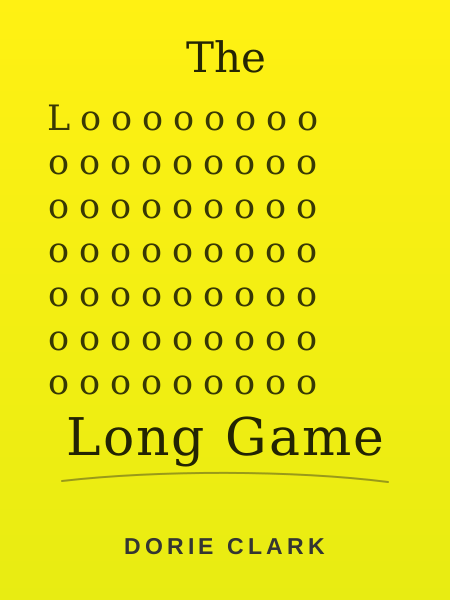
The Long Game
Dorie Clark · 2021
Editorial rating
- Evidence
- 6/10
- Actionability
- 8/10
- Originality
- 6/10
The thesis
Meaningful career success requires strategic patience - eschewing short-term gratification to work toward uncertain but worthy future goals. In a world that rewards busyness and quick wins, the real competitive advantage is having the discipline to think and act for the long term.
Who this is for
Professionals feeling trapped by constant busyness who know they should be thinking more strategically, ambitious people frustrated by slow progress, and anyone who needs permission to stop chasing short-term wins.
My favorite quote
What I've come to love about patience is that, ultimately, it's the truest test of merit: Are you willing to do the work, despite no guaranteed outcome?
Why it matters
This reframes patience from passive waiting to active commitment. The long game isn't about luck - it's about sustained effort without immediate validation.
Do this
Identify one goal you've abandoned because results were too slow. Reassess: was the goal wrong, or just your timeline?
Start here
Decide what to be bad at. You can't optimize everything. Choose what you'll deliberately neglect so you have time for strategic work. Every "yes" is a "no" to something else - make those trade-offs explicit rather than letting them happen by default.
Critical summary
Dorie Clark, a Duke and Columbia business school professor and prolific consultant, makes the case for long-term thinking in a short-term world. The book emerged from a striking paradox: 97% of senior leaders say strategic thinking is critical, but 96% say they don't have time for it.
Clark's framework moves through three phases: creating white space for strategic thinking, focusing on the right goals, and sustaining belief during the inevitable plateau periods. She offers practical tactics: the "no asks for a year" networking strategy, the "four career waves" model (learning, creating, connecting, reaping), and the concept of "strategic patience."
What it gets right
- The "no asks for a year" networking approach is genuinely distinctive
- Practical chapter-ending exercises (next day, next week, next month)
- Honest about how long meaningful achievement actually takes
- Accessible writing with relatable examples
What it misses
- Core message ("think long-term") isn't revolutionary
- Some sections feel like extended blog posts
- Heavy on anecdotes, lighter on research
- Privilege isn't fully acknowledged - long-term thinking is easier with financial stability
Evidence is primarily anecdotal - stories from Clark's coaching clients and personal experience. Useful, but not rigorous.
Key concepts
Strategic Patience
Acknowledging that meaningful progress takes time while actively working toward goals. Patience as discipline, not passivity.
No Asks for a Year
Don't request anything requiring political capital from new contacts for 12 months. Build relationship first.
Career Waves
Four phases that cycle: Learning, Creating, Connecting, Reaping. Know which phase you're in.
Decide What to Be Bad At
Explicitly choose what you'll neglect. You can't do everything well.
Distance to Empty
How long can you step away before things collapse? Build systems for sustainability.
Infinite Horizon Networking
Pure, no-agenda relationship building with no specific payoff in mind.
Core insights
-
Busyness is a choice, not a condition
Most "busy" people are choosing comfort of activity over discomfort of strategic thinking.
-
Ideas take shape through experience
Don't wait for clarity before acting. Explore widely, then let patterns emerge.
-
"Optimize for interesting"
Better than following passion. Choose work that keeps you curious, not work that matches a predetermined passion.
-
Raindrops of recognition
Success comes through many small validations, not one breakthrough. Accumulate steadily.
-
Your long game isn't someone else's
Comparison kills. Others' timelines are irrelevant to your journey.
Implementation steps
Today
- Block 30 minutes this week for strategic thinking (non-negotiable)
- Write down one thing you'll deliberately be bad at
This week
- Identify which career wave you're currently in (Learning, Creating, Connecting, Reaping)
- Reach out to one person with no ask - just genuine connection
This month
- Create a "not-to-do" list alongside your to-do list
- Calculate your "distance to empty" - how long can you step away?
Ongoing
- Protect strategic thinking time ruthlessly
- Practice "no asks for a year" with all new professional relationships
- Review quarterly: are your activities aligned with long-term goals?
Suggested 30-day practice plan
An editorial application plan created by Monolithic Vault - an interpretation of the book's ideas, not part of the original book.
- Day 1
Block 30 minutes for strategic thinking; protect it
- Day 2
List everything you're currently "being bad at" by default
- Day 3
Choose 2-3 things to deliberately neglect; accept the trade-off
- Day 7
Identify your current career wave; what would progress look like?
- Day 14
Reach out to two people with no agenda - just genuine curiosity
- Day 21
Audit your calendar: what percentage is reactive vs. strategic?
- Day 30
Write your 3-year vision (even if uncertain); review monthly
Free PDF summary
Take this analysis with you: a designed two-page field-notes sheet with the thesis, my favorite quote, the key concepts and core insights, and the full 30-day checklist. Print it or keep it - free, no signup.
Go deeper
If this analysis earned your attention, the full book goes further than any summary can. The original is always the primary source.