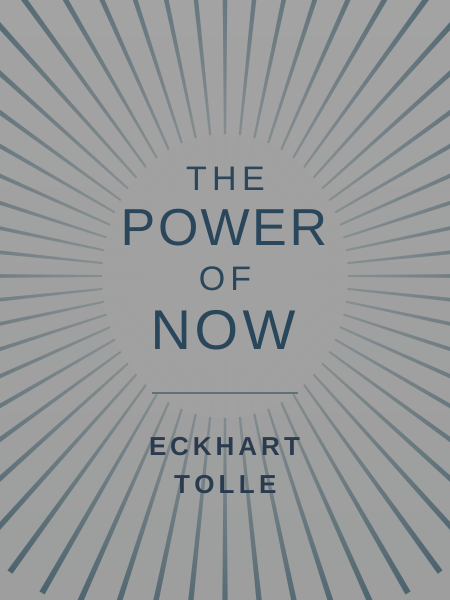
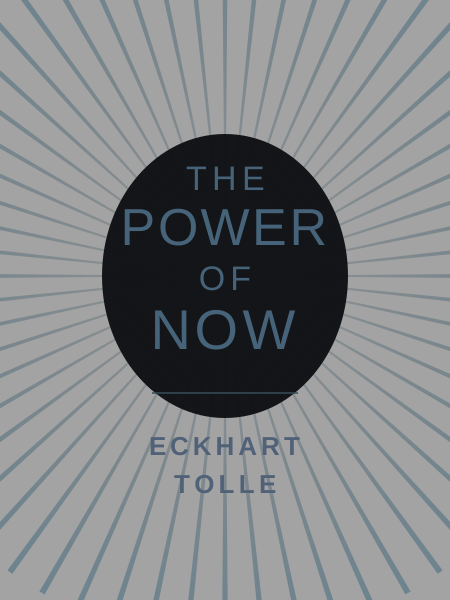
The Power of Now
Eckhart Tolle · 1997
Editorial rating
- Evidence
- 4/10
- Actionability
- 6/10
- Originality
- 8/10
The thesis
Suffering is caused by identification with your mind - the constant stream of thoughts about past and future. Freedom comes from disidentifying from thought and anchoring in the present moment, the only thing that actually exists. The ego is an illusion. Presence is reality.
Who this is for
People trapped in cycles of anxiety, depression, or chronic overthinking. Those searching for spiritual awakening outside organized religion. Anyone tired of living entirely in their head and wanting to reconnect with direct experience.
My favorite quote
The past has no power over the present moment.
Why it matters
This simple statement demolishes the tyranny of regret, shame, and trauma. The past is a memory - a thought in the present. It only has power if you give it attention.
Do this
When anxiety about past or future arises today, ask yourself: "Is there a problem right now, in this moment?" Almost always, the answer is no.
Start here
You are not your mind - you are the awareness observing your thoughts. The "voice in your head" narrating, judging, and worrying is the ego, an illusory sense of self. Suffering arises when you identify with this voice. Liberation comes from presence: anchoring your attention in the Now, where problems don't exist. When anxiety hits, ask: "What problem do I have right now?" Usually, none. The problem is in your head, projected into past or future.
Critical summary
Tolle, a German-born spiritual teacher, wrote this after a profound existential crisis at age 29. After years of anxiety and suicidal depression, he had a radical experience where the thought "I cannot live with myself any longer" split into two - "I" and "the self I cannot live with." He realized there were two entities: the observer and the observed. This insight triggered an awakening into sustained peace.
The book is written in Q&A format, blending Buddhist non-dualism, Christian mysticism, Advaita Vedanta, and Tolle's own insights. The core teaching: the present moment is the only reality. Past and future exist only as thoughts in the present. The ego - your false sense of self built from memories, roles, and mental constructs - keeps you trapped in time. Presence dissolves the ego and reveals your true nature: awareness itself.
What it gets right
- The ego is the source of suffering: Tolle's description of the ego - constantly comparing, judging, defending, seeking - resonates. Most psychological pain comes from mental narratives, not present-moment reality.
- Presence is always available: You don't need to change circumstances to access peace. Simply shift attention from thought to sensory awareness (breath, body, sounds). This is profoundly simple and genuinely works.
- The pain-body is real: Tolle's concept of accumulated emotional pain that periodically "takes over" describes something many people experience (recurring bouts of anger, sadness, or anxiety that feel autonomous).
- The mind is a tool, not who you are: Most people are completely identified with thinking. Tolle teaches you can observe thoughts without being them - a Copernican shift for the psyche.
What it misses
- Dense, repetitive, spiritually loaded: Tolle's writing is meandering and abstract. Concepts like "Being," "Presence," and "the Unmanifested" are vague. It reads like translated mysticism because it essentially is.
- Privilege blind spot: "Just be present" works better when you're not in immediate physical danger, poverty, or systemic oppression. Tolle acknowledges suffering exists but doesn't engage with structural causes - everything is reduced to ego/presence dynamics.
- Can enable spiritual bypassing: Emphasis on "accept what is" and "the Now has no problems" can morph into passivity or denial. If your relationship is toxic, "accepting" it isn't enlightenment - it's avoidance. Tolle addresses this but not emphatically enough.
- Minimal practical instruction: The book is philosophically rich but tactically sparse. How do you become present? "Focus on your breath" and "feel your inner body" are the main techniques. Works for some, insufficient for others.
- No evidence base: Tolle makes empirical claims (presence heals physical ailments, transforms relationships) without evidence. It's experiential wisdom, not science. Some will find it liberating; others will find it unfalsifiable woo.
Evidence quality: None in the scientific sense. This is phenomenological - based on direct experience and ancient contemplative traditions. Tolle isn't citing studies; he's pointing at a way of being. Judge it by whether it works for you, not peer review.
Key concepts
The Ego
The illusory sense of self built from thoughts, memories, roles, possessions. It thrives on past and future, never the present. Apply: Notice when you're defending an identity ("I'm a [role]") - that's ego.
Presence
Full attention to the present moment without mental commentary. The state of pure awareness. Apply: Focus on your breath for 30 seconds - that's presence.
The Pain-Body
Accumulated emotional pain from your past that lives as an energy field in your body, periodically reactivating. Apply: When disproportionate emotion arises, recognize it's the pain-body, not the present moment.
The Inner Body
The felt sense of aliveness in your body (tingling, warmth, energy). Focusing on it anchors you in the Now. Apply: Close your eyes and feel your hands from the inside - that sensation is the inner body.
Surrender
Accepting what is without mental resistance. Not resignation, but non-resistance to reality. Apply: When stuck in traffic, notice the urge to resist - then let it go and simply be present.
Core insights
-
The present moment is all you have
Past and future are mental constructs. They exist only as thoughts now. Anxiety is future-focused; regret is past-focused. Neither is real.
-
Observe the thinker
You are not the voice in your head - you are the awareness noticing it. This shift dissolves identification with thought and creates space.
-
Resistance creates suffering
Pain is inevitable; suffering is optional. Suffering = pain + resistance. When you stop resisting what is, suffering ends even if pain remains.
-
The ego loves problems
Your mind creates drama to feel important. Without problems, the ego weakens. That's why people unconsciously seek conflict.
-
Time is an illusion
Clock time is useful for practical purposes. Psychological time - living in past or future - is the source of all neurosis. Stay in the Now, use time as a tool when needed.
Implementation steps
Today
- Set 3 alarms throughout the day labeled "Are you present?" When they go off, pause, take 3 breaths, and notice where your attention was (past, future, or present).
- Practice "inner body awareness": sit quietly for 2 minutes and feel the aliveness in your hands, arms, legs. This anchors you in Now.
This week
- Morning practice: 5 minutes of presence upon waking (feel your body, listen to sounds, watch breath) before engaging with thoughts
- Notice how often you're mentally time-traveling: replaying the past or rehearsing the future. Just notice - no judgment.
- When anxious, ask: "What problem do I have right now?" Distinguish between actual present-moment problems and mental narratives.
This month
- Read or listen to one chapter daily (the book is dense - small doses work better)
- Practice surrender in minor annoyances: traffic, waiting in line, tech glitches. Notice the urge to resist, then let it go.
- Experiment with stopping thought: During routine activities (washing dishes, walking), see if you can be fully present without narration.
Ongoing
- Make presence your default: instead of thinking about life, directly experience it
- Use pain and problems as reminders to return to Now - suffering is the alarm clock that you're lost in thought
- Practice "conscious breathing" throughout the day - even one conscious breath is a portal to presence
Suggested 30-day practice plan
An editorial application plan created by Monolithic Vault - an interpretation of the book's ideas, not part of the original book.
- Day 1
Read introduction and Chapter 1. Set intention to be more present.
- Day 2
Practice inner body awareness - 5 minutes feeling the energy field of your body
- Day 3
Notice the voice in your head narrating your experience. Observe it without engagement.
- Day 7
Check-in: How often are you caught in past or future? Celebrate moments of presence.
- Day 10
Practice surrender in one frustrating situation - accept it fully without mental resistance
- Day 14
Ask "What problem do I have right now?" 10 times throughout the day. Notice the answer is usually "none."
- Day 21
Three weeks in. Is there more space between you and your thoughts? More peace?
- Day 30
Reflect on shifts in anxiety, reactivity, or peace. Presence is a lifelong practice - commit to the path.
Free PDF summary
Take this analysis with you: a designed two-page field-notes sheet with the thesis, my favorite quote, the key concepts and core insights, and the full 30-day checklist. Print it or keep it - free, no signup.
Go deeper
If this analysis earned your attention, the full book goes further than any summary can. The original is always the primary source.