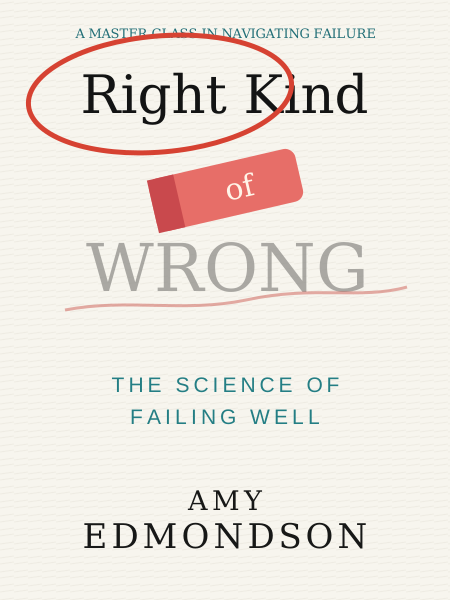
The Right Kind of Wrong
Amy Edmondson · 2023
Editorial rating
- Evidence
- 9/10
- Actionability
- 8/10
- Originality
- 8/10
The thesis
Failure is useful only when it produces new knowledge under controlled conditions. Leaders should celebrate intelligent experiments, prevent basic mistakes, and study complex breakdowns without reaching for a single culprit.
Who this is for
Executives running innovation portfolios, managers whose teams hide mistakes, and professionals deciding whether a setback deserves correction, investigation, or another attempt.
My favorite quote
A healthy failure culture rewards intelligent failure.
Why it matters
The line separates thoughtful experimentation from the lazy advice to fail more often.
Do this
Label one recent setback as basic, complex, or intelligent before deciding what to do about it.
Start here
Classify the failure before reacting to it. An intelligent failure happens in new territory, pursues a meaningful opportunity, is informed by existing knowledge, and stays small enough to learn from; everything else needs a different response. That distinction prevents both blame-heavy cultures and reckless experimentation.
Critical summary
Amy Edmondson built her career studying psychological safety after an early research result seemed backward: stronger hospital teams reported more errors, not fewer. Further investigation showed they were more willing to speak up, which made mistakes visible and learnable. The Right Kind of Wrong extends that work into a taxonomy of failure. Basic failures have a known cause and are usually preventable through attention, training, or sound process. Complex failures emerge from several interacting factors in uncertain systems, so hunting for one guilty person usually teaches the wrong lesson. Intelligent failures are unsuccessful experiments in genuinely new territory, designed to answer a valuable question at a tolerable cost. Edmondson pairs this taxonomy with three capabilities: self-awareness to resist shame and overconfidence, situation awareness to notice uncertainty and stakes, and system awareness to see relationships beyond the nearest error.
What it gets right
- Replaces the vague slogan "fail fast" with criteria that distinguish learning from negligence
- Explains why psychological safety requires candor and accountability rather than comfort or low standards
- Gives leaders a usable language for matching prevention, investigation, and experimentation to different failures
What it overstates or misses
- Moves quickly from research findings to broad historical and business stories that vary in evidentiary strength
- Offers less help when leaders disagree over whether an experiment was genuinely novel or merely poorly prepared
- Treats learning as the goal without spending enough time on incentives that reward concealment, speed, or blame
The evidence base is stronger than in most management books because Edmondson draws on decades of field research, especially in healthcare and team learning. Still, the later examples sometimes illustrate the framework more neatly than real organizations behave, and the categories can blur after the fact. Its best contribution is not permission to fail but permission to judge failures differently. The verdict: use this book to make experimentation stricter and blame less automatic.
Key concepts
Basic Failure
A preventable error in familiar territory caused by a clear deviation from known practice; correct the process instead of romanticizing the lesson.
Complex Failure
A breakdown produced by multiple interacting factors in a system; reconstruct the sequence before assigning responsibility.
Intelligent Failure
A small, informed experiment in uncertain territory that pursues a valuable opportunity; define the question and downside before acting.
Psychological Safety
A climate where people can report mistakes, ask for help, and challenge assumptions without interpersonal punishment; pair it with demanding standards.
System Awareness
The habit of widening attention from the visible error to the relationships and downstream effects around it; ask who else and what later will be affected.
Core insights
-
Not all failure deserves applause
Celebrate information-producing experiments, prevent routine errors, and investigate system breakdowns instead of using one slogan for all three.
-
Small failures protect against large ones
Design experiments so a wrong hypothesis costs little while still producing evidence that changes the next decision.
-
Blame narrows the investigation
Naming a culprit too early stops people from examining the conditions that made the error likely or hard to detect.
-
Reporting can make good teams look worse
A high error count may reflect visibility rather than incompetence, so measure correction and learning alongside incidents.
-
Learning requires emotional discipline
Separate the facts of what happened from the story you tell about your competence, intent, or future.
Implementation steps
Today
- Classify one recent setback as basic, complex, or intelligent and write one sentence explaining why.
- Rewrite one blame-focused question from "Who caused this?" to "What conditions allowed this to happen?"
This week
- Review one team failure using a timeline of actions, assumptions, signals, and system conditions.
- Before each experiment, record the hypothesis, expected learning, maximum downside, and stopping rule.
This month
- Create different response protocols for preventable errors, complex incidents, and intelligent experiments.
- Add a ten-minute learning review to projects where uncertainty is high and consequences are reversible.
Ongoing
- Reward early reporting and useful evidence, not failure itself.
- Track whether lessons lead to changed behavior, process, or resource allocation.
Suggested 30-day practice plan
An editorial application plan created by Monolithic Vault - an interpretation of the book's ideas, not part of the original book.
- Day 1
Categorize three recent failures and identify where your first reaction mismatched the type.
- Day 3
Draft a one-page intelligent failure checklist for experiments in your work.
- Day 7
Run a blame-free review of one complex failure using a factual timeline.
- Day 14
Ask the team which errors feel unsafe to report and remove one concrete barrier.
- Day 21
Audit an active experiment for novelty, prior knowledge, downside, and learning value.
- Day 30
Publish a simple failure policy defining what to prevent, investigate, and encourage.
Free PDF summary
Take this analysis with you: a designed two-page field-notes sheet with the thesis, my favorite quote, the key concepts and core insights, and the full 30-day checklist. Print it or keep it - free, no signup.
Go deeper
If this analysis earned your attention, the full book goes further than any summary can. The original is always the primary source.