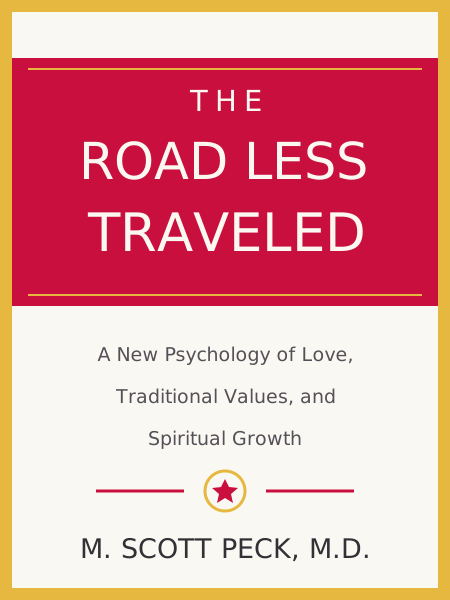
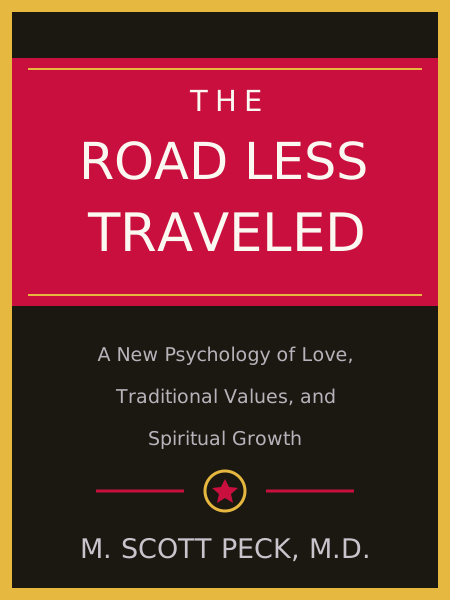
The Road Less Traveled
M. Scott Peck · 1978
Editorial rating
- Evidence
- 7/10
- Actionability
- 7/10
- Originality
- 8/10
The thesis
Life is difficult - and once you accept this, it stops being difficult. Psychological health requires four disciplines (delaying gratification, accepting responsibility, dedication to truth, balancing), genuine love (not "falling in love"), and spiritual growth through confronting suffering rather than avoiding it.
Who this is for
People exhausted by shallow positivity, therapists and counselors seeking depth, readers willing to confront uncomfortable truths about themselves, and anyone seeking integration of psychology and spirituality.
My favorite quote
Until you value yourself, you won't value your time. Until you value your time, you will not do anything with it.
Why it matters
Self-worth isn't narcissism - it's the foundation for meaningful action. Without it, you drift through life reacting rather than creating.
Do this
Track how you spend tomorrow. Circle activities that reflect self-worth. If the page is mostly empty, you have your answer.
Start here
Life is difficult - accept it: Most suffering comes from resisting this truth. Once you stop expecting ease, problems become puzzles to solve rather than injustices to endure. Today, when something hard arises, say: "Of course this is difficult. Life is difficult." Watch how acceptance reduces suffering.
Critical summary
Peck, a psychiatrist writing from decades of clinical practice, blends psychology with spirituality in ways that feel both deeply insightful and occasionally frustrating. He argues that mental health requires discipline, love (defined as extending oneself for spiritual growth), and confronting reality rather than constructing comfortable illusions.
The book's structure covers four major sections: Discipline, Love, Growth and Religion, and Grace. The Discipline section is the strongest - Peck's four tools (delaying gratification, accepting responsibility, dedication to truth, balancing) form a practical framework for psychological maturity.
What it gets right
- Discipline as loving action toward oneself, not punishment
- Love as action, not feeling - "falling in love" is not love
- Responsibility: distinguishing what is/isn't your problem (boundaries)
- Integration of psychology and spirituality without preaching
What it misses
- Verbose and repetitive - editors were asleep
- Some therapeutic case studies feel exploitative (patient confidentiality concerns)
- Spiritual sections (Grace, Religion) feel less grounded than psychological ones
- 1978 gender norms: some language hasn't aged well
CRITICAL PROBLEMS
The book drags. Peck repeats points exhaustively. The Grace section ventures into metaphysical speculation (unconscious as God) that won't land for secular readers. His case examples, while illustrative, sometimes feel like he's displaying patient struggles for rhetorical effect.
More problematically, Peck's "dedication to truth" can edge toward rigidity. He acknowledges withholding truth when appropriate but doesn't fully address power dynamics - whose truth, whose reality? His individualistic frame underplays systemic forces shaping people's lives.
Evidence: clinical observation across decades of practice, no controlled research. Peck draws heavily on his own therapy work and personal spiritual journey.
Key concepts
Delaying Gratification
Schedule pain early, pleasure later. Build capacity to do hard things before rewarding yourself. Apply to one task today.
Accepting Responsibility
You are responsible for solving problems, even when you didn't cause them. Ask "What's my part?" in every complaint.
Dedication to Truth
Painful honesty with yourself creates mental health. Self-deception creates neurosis. Where are you lying to yourself?
Balancing
Flexibility to respond appropriately to changing circumstances. Rigid rules breed dysfunction. Practice contextual judgment daily.
Love as Extension
Love means working for someone's (including your own) spiritual growth. Not emotion, action. Apply in your hardest relationship.
Bracketing
Temporarily setting aside assumptions to truly hear another person. Use in next difficult conversation.
Core insights
-
Neurosis is avoiding legitimate suffering
Mental illness emerges from dodging necessary pain. Growth requires confronting what hurts. Face one avoided difficulty today.
-
Falling in love is temporary ego-boundary collapse, not love
The "high" of new romance is biological, designed to get you to commit before reality hits. Real love is disciplined choice.
-
Love and discipline are inseparable
You can't love yourself while being undisciplined, nor love others without self-discipline. Self-care enables other-care.
-
Dependency is anti-love
Clinging to others for rescue perpetuates childhood patterns. Mature love emerges between self-sufficient people choosing interdependence.
-
Problems don't disappear - they require work
Hoping difficulties resolve themselves guarantees escalation. Address problems when small, or they become catastrophes.
Implementation steps
Today
- Identify one task you're avoiding because it's unpleasant - do it first thing tomorrow
- Ask yourself: "Where am I blaming someone else for a problem I need to solve?"
This week
- Delay gratification practice: choose one pleasure (coffee, social media, dessert) and schedule it AFTER completing difficult work
- Truth audit: write down three uncomfortable truths you've been avoiding about yourself
This month
- Practice balancing: identify one area where you're too rigid, one where you're too loose - adjust
- Love practice: choose one person and commit to one action per week that serves their growth (including yourself)
- Read Discipline section - apply all four tools daily
Ongoing
- Morning question: "What legitimate suffering am I avoiding today?"
- Responsibility check: "What's my part in this problem?"
- Weekly bracket practice: one conversation where you fully suspend your assumptions to truly hear someone
Suggested 30-day practice plan
An editorial application plan created by Monolithic Vault - an interpretation of the book's ideas, not part of the original book.
- Day 1
Read Discipline section, identify which of four tools feels hardest
- Day 2
Delay gratification - schedule hard task before any pleasure today
- Day 3
Responsibility practice - list three problems, identify your part in each
- Day 7
Truth audit - write uncomfortable realities you've been denying
- Day 14
Love vs. falling in love - examine one relationship honestly
- Day 21
Balancing practice - identify where you need more flexibility
- Day 30
Integration reflection - which discipline improved most?
Free PDF summary
Take this analysis with you: a designed two-page field-notes sheet with the thesis, my favorite quote, the key concepts and core insights, and the full 30-day checklist. Print it or keep it - free, no signup.
Go deeper
If this analysis earned your attention, the full book goes further than any summary can. The original is always the primary source.