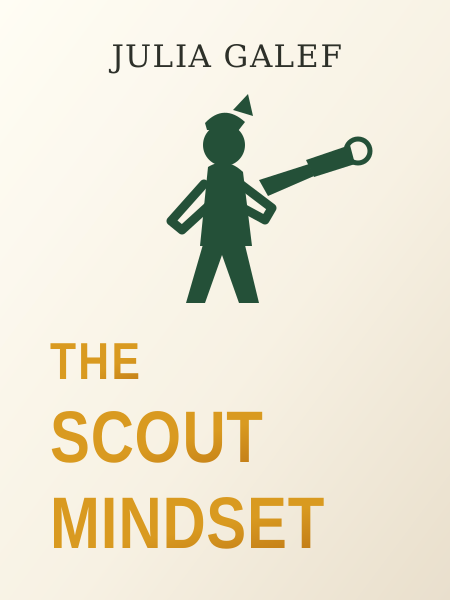
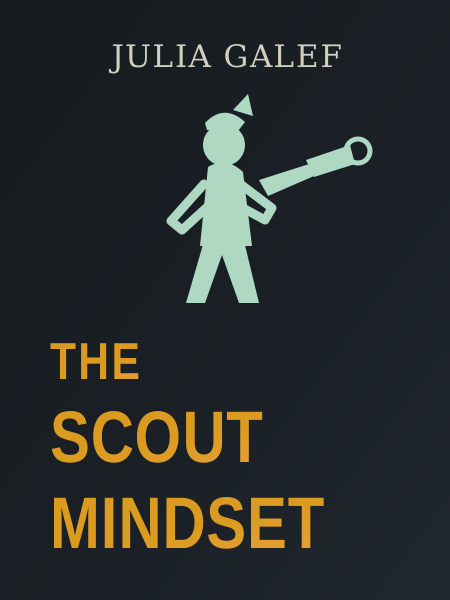
The Scout Mindset
Julia Galef · 2021
Editorial rating
- Evidence
- 7/10
- Actionability
- 8/10
- Originality
- 7/10
The thesis
Most of us reason like soldiers - defending our beliefs against threats. Better thinkers reason like scouts - seeking accurate maps of reality regardless of what they hope to find. This shift from motivated reasoning to truth-seeking is learnable and makes you more effective, not less.
Who this is for
Decision-makers who suspect their judgment is clouded by bias, leaders who need to see situations clearly before acting, and anyone tired of the "just learn about biases" approach that doesn't actually change behavior.
My favorite quote
The scout asks: Is this true? The soldier asks: Can I believe this?
Why it matters
The difference between these questions determines whether you update your beliefs based on evidence or defend them against it.
Do this
Before your next important decision, ask yourself: "Am I looking for the truth, or for reasons to believe what I already think?"
Start here
Adopt Scout Mindset by changing your relationship with being wrong. Soldiers see changing their mind as defeat; scouts see it as map improvement. The key insight: being wrong doesn't feel like anything - it feels exactly like being right. So instead of trusting your feelings of certainty, cultivate genuine curiosity about whether you might be wrong. Ask: "What would change my mind about this?"
Critical summary
Julia Galef, co-founder of the Center for Applied Rationality and host of the Rationally Speaking podcast, spent five years writing this book after realizing that simply teaching people about biases doesn't help much. Her core insight: the problem isn't knowledge of biases, it's motivation. We defend our beliefs because it feels good - the scout mindset offers a different source of satisfaction.
The book distinguishes "soldier mindset" (reasoning as warfare, defending positions) from "scout mindset" (reasoning as mapmaking, seeking accuracy). Galef argues persuasively that scouts are more effective in the long run, even in domains where confidence seems advantageous.
What it gets right
- Reframes rationality as emotional, not emotionless - scouts find satisfaction in truth
- Practical techniques: the "double standard test," "outsider test," "selective skeptic test"
- Demolishes the myth that self-deception is necessary for success (with Bezos/Musk examples)
- Distinguishes social confidence from epistemic confidence - you can act boldly while acknowledging uncertainty
What it misses
- Some ideas will feel familiar to anyone who's read rationality literature
- Could use more on when soldier mindset genuinely is appropriate
- Lighter on evidence than Superforecasting - more conceptual framework than empirical research
- The "hold your identity lightly" advice is easier said than done
Evidence is a mix of psychological research, case studies, and logical argument. It's intellectually rigorous but not as empirically grounded as Tetlock's work on forecasting.
Key concepts
Scout Mindset
The motivation to see things as they are, not as you wish. Cultivate curiosity about being wrong.
Soldier Mindset
Reasoning as defense - seeking to protect beliefs rather than test them. Notice when you're doing this.
Motivated Reasoning
Finding reasons to believe what you want to believe. Ask: "Would I accept this evidence if it pointed the other way?"
The Double Standard Test
Am I applying different standards of evidence to ideas I like vs. dislike? Check yourself.
Holding Identity Lightly
Don't make beliefs part of who you are - it makes them harder to update. Say "I think X" not "I am an X-ist."
Social vs. Epistemic Confidence
You can project confidence in your actions while remaining uncertain about outcomes. Separate them.
Core insights
-
Being wrong feels like being right
You can't trust your feeling of certainty. Build systems to check your reasoning instead.
-
Changing your mind is a skill, not a weakness
Scouts see updating beliefs as map improvement. Make "I was wrong" feel like progress.
-
Self-deception doesn't help success
Successful entrepreneurs like Bezos and Musk assigned low probabilities to their ventures - and tried anyway.
-
Identity is the enemy of accuracy
The more a belief becomes part of "who you are," the harder it is to update. Hold identity lightly.
-
Rationality is emotional, not emotionless
Scouts aren't suppressing emotions - they've cultivated different emotional satisfactions (accuracy over validation).
Implementation steps
Today
- Notice one belief you're defending rather than testing. Ask: "What would change my mind?"
- Apply the double standard test to a recent judgment you made
This week
- Identify one belief tied to your identity. Practice saying "I currently think X" instead of "I am an X-ist"
- When you encounter evidence against a view, notice your first reaction - defensive or curious?
This month
- Keep a "belief update" log - track times you changed your mind and what triggered it
- Practice separating social confidence from epistemic confidence in one high-stakes situation
Ongoing
- Cultivate the emotional satisfaction of updating beliefs, not just defending them
- Build relationships with people who will tell you when you're wrong
Suggested 30-day practice plan
An editorial application plan created by Monolithic Vault - an interpretation of the book's ideas, not part of the original book.
- Day 1
Read Part I on the scout/soldier distinction
- Day 2
Identify 3 beliefs you hold with soldier mindset - what would change your mind?
- Day 3
Apply the double standard test to a current disagreement
- Day 7
Notice when you're seeking validation vs. seeking truth in conversations
- Day 14
Practice separating social and epistemic confidence in a presentation or meeting
- Day 21
Review your belief update log - are you changing your mind? On what?
- Day 30
Teach the scout/soldier distinction to someone else
Free PDF summary
Take this analysis with you: a designed two-page field-notes sheet with the thesis, my favorite quote, the key concepts and core insights, and the full 30-day checklist. Print it or keep it - free, no signup.
Go deeper
If this analysis earned your attention, the full book goes further than any summary can. The original is always the primary source.