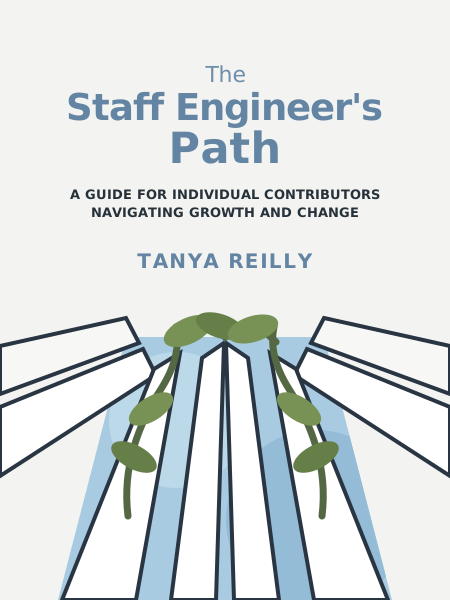
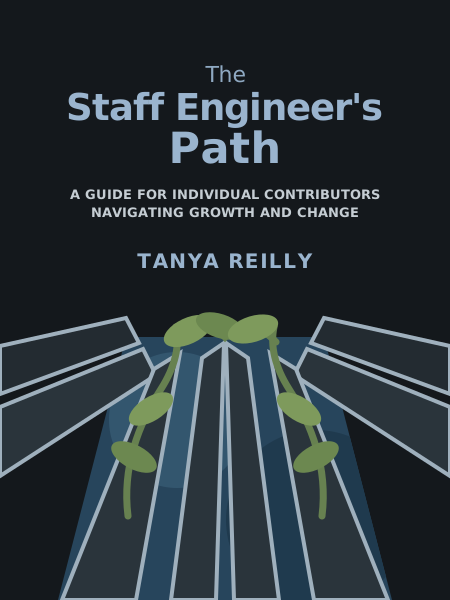
The Staff Engineer's Path
Tanya Reilly · 2022
Editorial rating
- Evidence
- 6/10
- Actionability
- 9/10
- Originality
- 8/10
The thesis
Staff engineer is not "senior engineer but more senior." It's a different job with different scope, skills, and measures of success. Staff engineers lead through influence without authority, own technical direction across teams, and make the organization better - not just the code.
Who this is for
Senior engineers eyeing the staff+ track, newly promoted staff engineers feeling lost without direct reports, and engineering managers wanting to understand what their staff engineers should actually be doing.
My favorite quote
Your job is to make the organization better by solving bigger problems, not to be the best coder.
Why it matters
This reframes staff engineering away from code heroics toward organizational impact.
Do this
Identify one cross-team technical problem that nobody owns. That might be your job now.
Start here
Understand your scope and ownership: Staff engineers typically own something bigger than a single team. Your scope might be a technical domain (API platform), a cross-cutting concern (reliability), or a strategic initiative (migration). If you don't know what you own, figure that out first - it's the foundation of everything else.
Critical summary
Reilly, a Principal Engineer at Squarespace (previously Google), wrote the missing manual for technical leadership without management responsibility. The staff+ track is poorly understood - companies create these roles but rarely define them well. This book fills that gap.
The core insight is that staff engineering requires a fundamentally different orientation. Individual contributors optimize their own work. Staff engineers optimize the organization's technical work. This means influencing without authority, building consensus across teams, and thinking in longer time horizons.
What it gets right
- Fills a genuine gap in technical leadership literature
- Concrete frameworks for scope, sponsorship, and influence
- Honest about the ambiguity of the role
- Practical advice on project selection, communication, and organizational navigation
- Based on real experience at large tech companies
What it misses
- Primarily relevant to larger companies with staff+ tracks
- Less applicable to startups or small companies where everyone does everything
- Some advice is Google/big-tech specific
- Light on the technical mentoring and design aspects of the role
- Doesn't deeply address the politics of influence without authority
- Could benefit from more case studies and examples
The book is essential reading for anyone on or considering the staff+ track, but less relevant for smaller organizations.
Key concepts
Scope
What you're responsible for. Staff engineers typically own something bigger than a single team - a domain, a system, or a cross-cutting concern.
Impact vs. Activity
Success is measured by organizational impact, not lines of code or hours worked.
Influence Without Authority
Staff engineers lack direct reports but must still drive alignment and change across teams.
Sponsored vs. Unsupervised Work
Some work is explicitly assigned; some you must identify and advocate for yourself.
Technical Vision
The long-term direction for your domain. Staff engineers create and communicate this vision.
Being Glue
The valuable but often invisible work of connecting people, information, and systems. Essential but easy to undervalue.
Core insights
-
Staff is a different job
Not "more coding." It's organizational work that happens to require deep technical knowledge.
-
Pick your problems carefully
At staff level, you can work on almost anything. Choose work that matters to the organization, not just work you find interesting.
-
Your job is to create clarity
Staff engineers turn ambiguous situations into clear direction. When teams are stuck, you unstick them.
-
Influence requires investment
You don't have authority. Build relationships, earn trust, and create alignment through communication and demonstrated competence.
-
Make others successful
Your leverage comes through others. The best staff engineers multiply the effectiveness of multiple teams.
Implementation steps
Today
- Write down what you own. If you can't articulate it, ask your manager.
- Identify one cross-team technical problem that nobody owns.
This week
- Map your stakeholders: Who needs to be aligned for you to be effective?
- Have a scope conversation with your manager: What are the boundaries of your responsibility?
This month
- Create or update a technical vision document for your domain
- Identify one "glue" activity you're doing that deserves visibility
Ongoing
- Evaluate opportunities against organizational impact, not personal interest
- Build relationships before you need them; influence requires trust
Suggested 30-day practice plan
An editorial application plan created by Monolithic Vault - an interpretation of the book's ideas, not part of the original book.
- Day 1
Write your scope in one sentence; validate with your manager
- Day 2
List the top 3 problems in your domain that nobody owns
- Day 3
Map your stakeholders and your relationship quality with each
- Day 7
Draft a technical vision for your domain (even rough is fine)
- Day 14
Share the draft with key stakeholders; gather feedback
- Day 21
Identify one initiative you should sponsor that creates organizational value
- Day 30
Assess: Is your work creating impact beyond your immediate team?
Free PDF summary
Take this analysis with you: a designed two-page field-notes sheet with the thesis, my favorite quote, the key concepts and core insights, and the full 30-day checklist. Print it or keep it - free, no signup.
Go deeper
If this analysis earned your attention, the full book goes further than any summary can. The original is always the primary source.