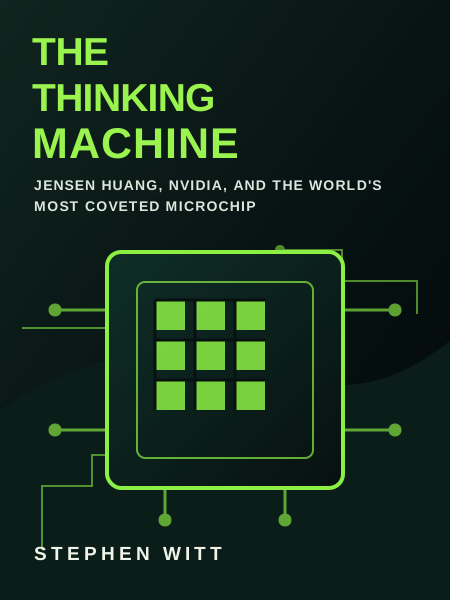
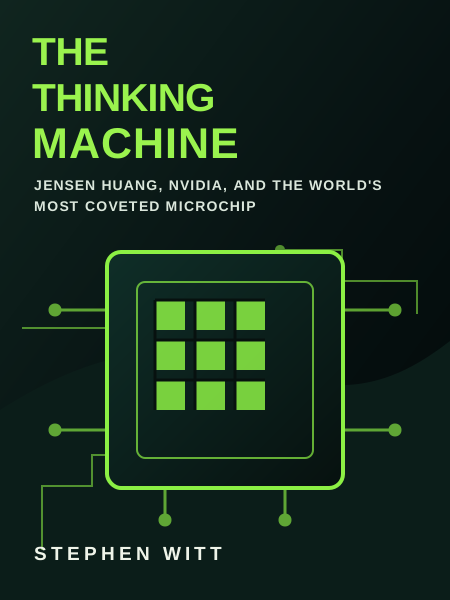
The Thinking Machine
Stephen Witt · 2024
Editorial rating
- Evidence
- 6/10
- Actionability
- 6/10
- Originality
- 7/10
The thesis
Nvidia's dominance in AI computing is not accidental luck but the result of Jensen Huang's contrarian 30-year bet on parallel processing and GPUs when Silicon Valley was focused elsewhere. Strategic vision, manufacturing partnerships, and developer ecosystem lock-in - not just innovation - created the AI infrastructure monopoly worth trillions.
Who this is for
Tech executives making long-term platform bets, investors trying to understand moat-building in hardware, and anyone needing to understand the AI supply chain beyond ChatGPT hype. Essential context for anyone making strategic decisions about technology infrastructure.
My favorite quote
The more you buy, the more you save.
Why it matters
Jensen Huang's sales pitch during the AI boom flipped traditional volume discounting into a scarcity premium. When you're the only supplier of critical infrastructure, economics invert.
Do this
Identify where you have similar leverage in your own work - specialized skills or relationships where demand exceeds supply - and price accordingly.
Start here
Moats are built during unprofitable years, not profitable ones. Nvidia spent 6 years and $500M+ on CUDA (their developer platform) with no revenue model. By the time AI exploded, competitors couldn't catch up because 4M+ developers already knew CUDA. Switching would require rewriting millions of lines of code. The lesson: strategic investment during unprofitable periods creates insurmountable advantages when the market arrives.
Critical summary
Stephen Witt traces Nvidia's evolution from struggling 3D graphics card maker in 1993 to $3+ trillion AI infrastructure monopolist of 2024. The central argument: Nvidia's dominance stems from three interconnected decisions: (1) committing to general-purpose GPU computing (CUDA) in 2006 when it made no financial sense, (2) maintaining vertical integration across chip design and software ecosystems while competitors fragmented, and (3) building deep partnerships with TSMC for manufacturing.
The CUDA bet is presented as the critical inflection point - spending hundreds of millions on developer tools for a market that didn't exist created the installed base that made Nvidia irreplaceable when AI exploded.
What it gets right
- Clear explanation of how gaming GPUs accidentally became AI accelerators (neural networks require massive parallel matrix multiplications)
- Proper attention to TSMC relationship and fabless manufacturing strategy
- Valuable historical context on the "GPU winter" of 2008-2012 when CUDA seemed like a failed experiment
What it misses
- Analytical shallowness: describes Nvidia's moat but never rigorously examines why competitors failed to replicate it
- Superficial treatment of manufacturing strategy - needed 50 pages on fabless vs. integrated model, got 10
- Problematic portrayal of Huang - papers over autocratic management style and strategic errors (cryptocurrency distraction, failed mobile chips)
- Missing chapter: "How Nvidia Could Lose" - no framework for evaluating switching costs or moat durability
- Underdeveloped geopolitical angle: China revenue (20%+) and US export controls barely addressed
Evidence is adequate but not investigative. Relies on public filings and interviews - reads like extended Bloomberg feature, not forensic business history.
Key concepts
CUDA
Nvidia's proprietary parallel computing platform. Created developer lock-in - switching to AMD/Intel requires rewriting millions of lines of code.
Tensor Cores
Specialized processing units optimized for matrix multiplication (core of neural network training). Gave Nvidia 5-10x performance advantage.
Fabless Design
Design chips but outsource manufacturing to foundries (TSMC). Allows faster iteration and capital efficiency; trade-off is dependency on foundry capacity.
NVLink
Proprietary high-speed interconnect for multi-GPU communication. Creates system-level lock-in - can't mix Nvidia + AMD GPUs effectively.
The Platform Play
Building ecosystem (hardware + software + tools) where value accrues through network effects. Each CUDA developer increases value to every other user.
Inference vs. Training
Training = teaching AI models (compute-intensive). Inference = running trained models (less intensive). Nvidia dominates training (90%+ share).
Core insights
-
Developer ecosystems create stronger lock-in than hardware performance
AMD has built GPUs with comparable specs for years - irrelevant because 4M developers know CUDA. Switching costs are code, not benchmarks.
-
"Asset-light" is competitive advantage in rapid technological change
Nvidia's fabless model let them switch process nodes as technology evolved. Intel's $50B in fabs became anchors when process leadership stalled.
-
Platform businesses require irrational-seeming commitment before inflection points
Board members questioned CUDA annually for 6 years. Huang's willingness to look financially irresponsible created the 70%+ margin business of 2023-2024.
-
Windfall revenue from adjacent markets is strategic distraction
Cryptocurrency mining demand (2017-2018) spiked revenue 40% and crashed inventory. Revenue from customers who don't care about your long-term platform is dangerous validation.
-
Gross margin expansion signals moat strength
Nvidia's margins grew from 58% (2019) to 75%+ (2023). This isn't gouging - it's system-level value capture that funds R&D widening the gap further.
Implementation steps
Today
- Map your professional ecosystem dependencies: List every tool/platform in your stack and estimate hours to migrate to alternatives. Where are you locked in vs. portable?
- Audit current projects for "CUDA-like" investments: Identify skills with low current demand but high future potential (Microsoft Fabric, advanced Power Query, BC API integrations)
This week
- Review your last 5 proposals: Are you selling components (hourly reports) or systems (integrated BI solution with pipeline, refresh, and training)? Calculate margin difference.
- Identify your "crypto trap": Revenue sources misaligned with long-term strategy that feel good but pull you away from strategic positioning
This month
- Block 3 hours/week for 6 months on one strategic skill with low current demand - accept zero immediate revenue, build expertise before market arrives
- Systematically bundle adjacent services to move from component to system pricing
Ongoing
- Schedule 30-min quarterly "moat review": (1) What unique skills/relationships can't competitors replicate? (2) What investments should I make that won't pay off for 12+ months? (3) What looks profitable today but commoditizes my expertise tomorrow?
Suggested 30-day practice plan
An editorial application plan created by Monolithic Vault - an interpretation of the book's ideas, not part of the original book.
- Day 1
Map ecosystem dependencies; identify top 3 lock-ins and top 3 portable skills
- Day 2
List skills with high future potential but low current demand; choose one to invest in
- Day 3
Review last 5 proposals for component vs. system positioning
- Day 7
Identify "crypto trap" revenue; make explicit keep/reduce/exit decision
- Day 14
Design first bundled service offering (component → system shift)
- Day 21
Complete first strategic skill investment session (3 hours minimum)
- Day 30
Conduct first quarterly moat review; document findings and Q2 investment plan
Free PDF summary
Take this analysis with you: a designed two-page field-notes sheet with the thesis, my favorite quote, the key concepts and core insights, and the full 30-day checklist. Print it or keep it - free, no signup.
Go deeper
If this analysis earned your attention, the full book goes further than any summary can. The original is always the primary source.