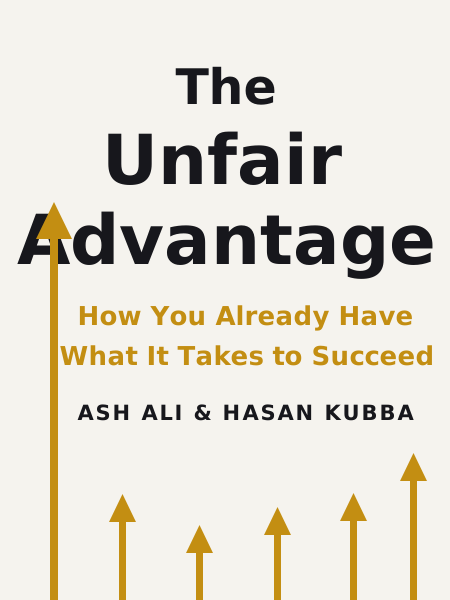
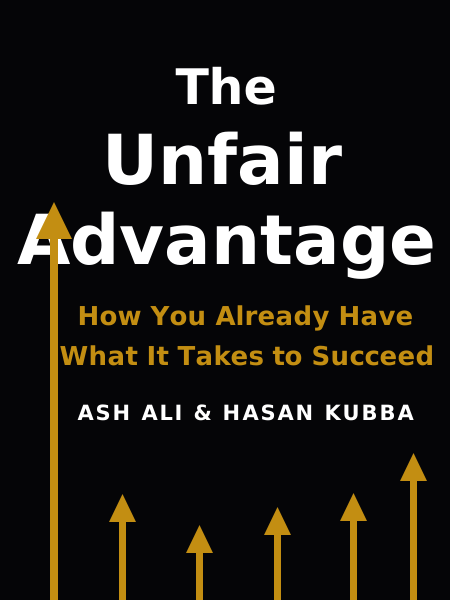
The Unfair Advantage
Ash Ali & Hasan Kubba · 2020
Editorial rating
- Evidence
- 6/10
- Actionability
- 8/10
- Originality
- 8/10
The thesis
Startup success isn't just about hustle and grit - it's about leveraging your unique combination of advantages that others can't easily replicate. Everyone has unfair advantages based on factors both within and outside their control. The key is identifying yours and building a venture that exploits them rather than fighting battles where you're disadvantaged.
Who this is for
Aspiring entrepreneurs evaluating business ideas, founders wondering why competitors seem to have it easier, and anyone who suspects that "work harder" isn't the complete success formula. Especially valuable for those without traditional startup advantages (money, connections, elite credentials).
My favorite quote
It's not just about the cards you're dealt, but how you play them.
Why it matters
This reframes advantages from fixed constraints to strategic opportunities - everyone has cards to play.
Do this
List three things that make you different from typical founders in your space. How could each become a competitive advantage?
Start here
Use the MILES Framework to audit your unfair advantages: Money (financial resources), Intelligence and Insight (book smarts, creativity, domain expertise), Location and Luck (where you are, who you know, timing), Education and Expertise (formal credentials, practical skills), Status (social capital, brand, connections). Everyone has different strengths across these dimensions. Build ventures that leverage your strongest advantages.
Critical summary
Ash Ali, the first Marketing Director of Just Eat who helped achieve a $2.44 billion IPO, teams with Hasan Kubba to expose the myths behind startup success. The book argues that the "hustle and grit" narrative obscures the real reasons some founders succeed: they leverage advantages others don't have.
The MILES Framework provides a systematic way to identify advantages you might not realize you have, while acknowledging that some factors (like family wealth or being in Silicon Valley) genuinely matter.
What it gets right
- Refreshingly honest about the role of privilege, luck, and circumstance
- Holistic approach going beyond money to explore location, education, status, and insight
- Encourages self-reflection to identify unique strengths
- Practical insights from Ash Ali's Just Eat experience
- "Reality Growth Mindset": feet on ground, head in clouds
What it misses
- Some concepts repeated excessively (unicorn companies defined thirteen times, almost half the book)
- Last section "The Startup Quick-Start Guide" feels like an appendix - core value is in parts one and two
- Primarily focused on startup world, though concept is universal
- Framework is useful for analysis but less clear on how to build advantages you lack
- Evidence is mostly anecdotal case studies
The book won UK Business Book of Year 2021 and was featured in Forbes, Fortune, and BBC.
Key concepts
MILES Framework
Five categories of unfair advantage - Money, Intelligence/Insight, Location/Luck, Education/Expertise, Status. Audit yourself across all five.
Reality Growth Mindset
Combining Dweck's growth mindset with realistic assessment of your situation. Neither pure optimism nor cynicism.
Stacking Advantages
Combining multiple moderate advantages can be more powerful than one extreme advantage. Identify combinations unique to you.
Mindset as Advantage
How you think about setbacks and opportunities is itself an advantage that can be developed.
Leveraged vs. Generic Businesses
Some ventures leverage your specific advantages; others require advantages you don't have. Choose the former.
Core insights
-
Hard work is necessary but not sufficient
The "anyone can make it with enough hustle" narrative ignores structural advantages that make some paths easier.
-
Advantages can be built
While some advantages are inherited (wealth, connections), others can be developed (expertise, insight, certain types of status).
-
Disadvantages can be reframed
Being an outsider, lacking credentials, or coming from an unexpected background can become advantages in the right context.
-
Location matters more than founders admit
Proximity to customers, talent, and capital significantly affects startup outcomes.
-
Insight is the great equalizer
Deep understanding of a problem space - especially from personal experience - can overcome lack of money, status, or credentials.
Implementation steps
Today
- Complete a MILES audit: Rate yourself 1-10 on each dimension
- Identify your strongest unfair advantage - the thing that differentiates you most
This week
- For your strongest advantage, list three ways you could leverage it in a business
- For your weakest dimension, identify one action that could improve it
This month
- Evaluate your current or planned venture against your MILES profile - are you leveraging or fighting your advantages?
- Network with one person who has complementary advantages
Ongoing
- Reassess your MILES profile quarterly - advantages change
- When evaluating opportunities, explicitly consider advantage fit
- Build relationships that expand your Location and Status dimensions
Suggested 30-day practice plan
An editorial application plan created by Monolithic Vault - an interpretation of the book's ideas, not part of the original book.
- Day 1
Complete detailed MILES self-assessment with specific evidence for each rating
- Day 2
Identify three potential business ideas; map each against your MILES profile
- Day 3
For your top business idea, identify which advantages you'd leverage and which you'd lack
- Day 7
Research successful founders with similar MILES profiles - what did they do?
- Day 14
Take action to strengthen one buildable advantage (Insight, Education, or aspects of Status)
- Day 21
Have a conversation with someone whose advantages complement yours
- Day 30
Revise business idea based on MILES analysis; commit to a direction that leverages your strengths
Free PDF summary
Take this analysis with you: a designed two-page field-notes sheet with the thesis, my favorite quote, the key concepts and core insights, and the full 30-day checklist. Print it or keep it - free, no signup.
Go deeper
If this analysis earned your attention, the full book goes further than any summary can. The original is always the primary source.