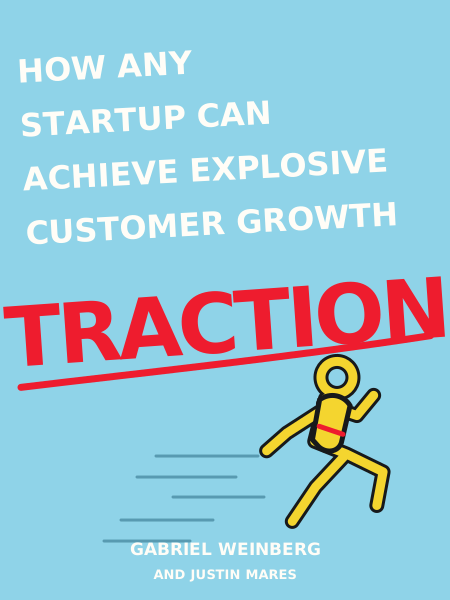
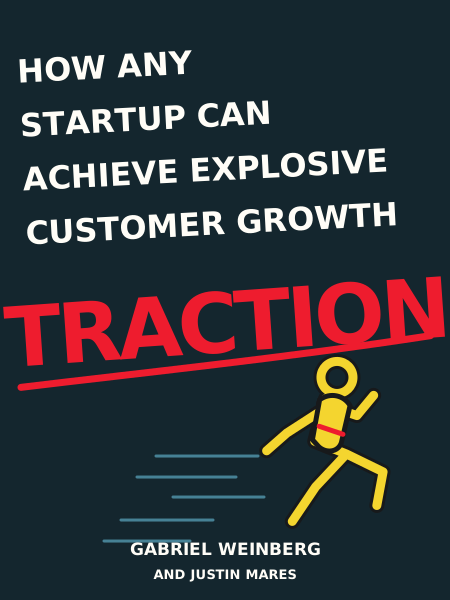
Traction
Gino Wickman · 2011
Editorial rating
- Evidence
- 6/10
- Actionability
- 9/10
- Originality
- 6/10
The thesis
Most businesses fail not from lack of great ideas but from inability to execute. The Entrepreneurial Operating System (EOS) provides a complete set of simple, practical tools to help leadership teams get what they want from their businesses by strengthening six key components: Vision, People, Data, Issues, Process, and Traction.
Who this is for
Owners and leadership teams of businesses with 10-250 employees who feel overwhelmed, lack control, or hit growth ceilings. Particularly valuable for companies that have outgrown founder intuition but aren't large enough for complex enterprise systems.
My favorite quote
Vision without traction is merely hallucination.
Why it matters
This crystallizes why so many visionary entrepreneurs fail - they excel at seeing possibilities but lack systematic execution.
Do this
Identify one strategic priority that's been "floating" without progress and assign it as a 90-day Rock with clear ownership and measurable outcome.
Start here
Implement Rocks: Set 3-7 quarterly priorities for the company and each leadership team member. These 90-day goals must be SMART (Specific, Measurable, Achievable, Realistic, Timely) and owned by one person. The discipline of identifying what truly matters each quarter - and what to ignore - creates the focus that transforms good companies into great ones.
Critical summary
Wickman, a third-generation entrepreneur who turned around his family business before selling it, distilled twenty years of consulting into EOS - a comprehensive operating system designed for entrepreneurial companies.
The framework addresses six key components: Vision (where you're going), People (right people in right seats), Data (running on numbers), Issues (solving problems), Process (documenting the way), and Traction (executing discipline). The tools include the V/TO (Vision/Traction Organizer), Accountability Chart, Scorecard, Level 10 Meetings, and the Issues List with IDS (Identify, Discuss, Solve) methodology.
What it gets right
- Comprehensive yet simple - covers all major operational elements
- Extremely practical with ready-to-use templates
- Rocks and Level 10 Meetings create real accountability
- The Accountability Chart forces role clarity
What it misses
- Book reads somewhat like an advertisement for EOS Worldwide's consulting services
- Leadership development and culture-building receive inadequate treatment
- Too focused on structure, light on the human dynamics that often derail execution
- May be too simplistic for complex business models like manufacturing
- Vision/Values section is weakest - doesn't go deep enough on identifying authentic values
Evidence is primarily anecdotal from Wickman's consulting practice. The system has been adopted by thousands of companies, though formal research validating outcomes is limited.
Key concepts
EOS (Entrepreneurial Operating System)
Complete set of tools addressing six components - Vision, People, Data, Issues, Process, Traction. Implement one component at a time.
Rocks
Quarterly priorities (3-7 per person) that must be completed in 90 days. Set yours this week.
Level 10 Meetings
Weekly 90-minute meetings following strict agenda including scorecard review and IDS. Replace your current status meetings.
Accountability Chart
Org chart defining roles by function, not people. Clarify who owns what in your team.
Scorecard
5-15 weekly numbers that give pulse of business. Identify your critical metrics today.
IDS (Identify, Discuss, Solve)
Problem-solving methodology - identify root cause, discuss openly, solve decisively. Use in your next team meeting.
Core insights
-
Right People, Right Seats
"Right people" share your core values; "right seats" means they GWC (Get it, Want it, Capacity to do it) their role. Misalignment on either creates friction.
-
Organizational health predicts success
Score your company quarterly on 20-point checklist - companies over 80 are truly great, most hover around 50-60.
-
Most businesses tolerate too many issues
The discipline of surfacing and solving problems weekly prevents small issues from becoming crises.
-
Numbers don't lie
A weekly scorecard of 5-15 activity-based metrics gives early warning signals before problems hit the P&L.
-
Document your core processes
Most companies have 6-8 core processes. Documenting them eliminates variance and enables scaling.
Implementation steps
Today
- Download the V/TO template from eosworldwide.com
- List your company's 3-7 most important 90-day priorities
- Draft your Accountability Chart with clear functional roles
This week
- Share V/TO draft with leadership team for input
- Identify your 5-15 scorecard metrics
- Schedule first Level 10 Meeting with strict 90-minute agenda
This month
- Complete full V/TO including 10-year target, 3-year picture, 1-year plan
- Run four Level 10 Meetings and refine the format
- Evaluate each team member against Right Person/Right Seat criteria
Ongoing
- Hold weekly Level 10 Meetings without exception
- Set and review Rocks quarterly
- Review Scorecard weekly and address missed numbers immediately
Suggested 30-day practice plan
An editorial application plan created by Monolithic Vault - an interpretation of the book's ideas, not part of the original book.
- Day 1
Read Traction, download all free EOS tools
- Day 2
Draft your company's core values and core focus
- Day 3
Create first draft of Accountability Chart
- Day 7
Hold first Level 10 Meeting with leadership team, introduce IDS process
- Day 14
Complete V/TO with leadership team input, establish Scorecard
- Day 21
Set first quarterly Rocks for company and each leader
- Day 30
Review first month - what's working, what needs adjustment? Document findings
Free PDF summary
Take this analysis with you: a designed two-page field-notes sheet with the thesis, my favorite quote, the key concepts and core insights, and the full 30-day checklist. Print it or keep it - free, no signup.
Go deeper
If this analysis earned your attention, the full book goes further than any summary can. The original is always the primary source.