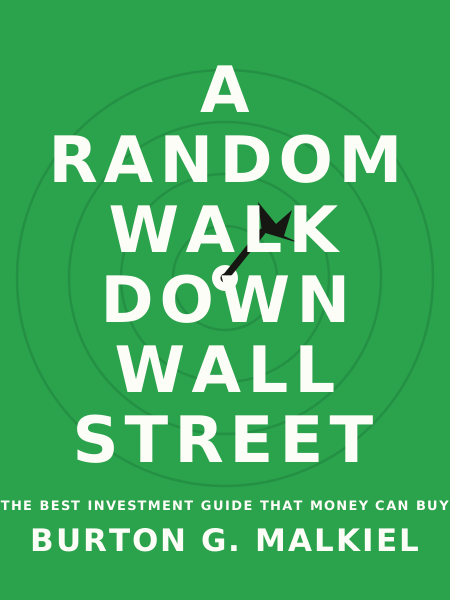
A Random Walk Down Wall Street
Burton Malkiel · 1973
Editorial rating
- Evidence
- 10/10
- Actionability
- 9/10
- Originality
- 9/10
The thesis
Stock prices follow a "random walk" - past performance can't predict future returns. Therefore, you can't consistently beat the market. The optimal strategy: buy low-cost, broad-based index funds and hold forever. Active management is expensive, tax-inefficient, and usually underperforms.
Who this is for
Investors skeptical of index funds, people paying high fees to active managers, and anyone who thinks they can pick winning stocks or time the market.
My favorite quote
A blindfolded chimpanzee throwing darts at the Wall Street Journal could select a portfolio that performs as well as those managed by the experts.
Why it matters
This demolishes the myth that professional stock pickers add value. If a chimp can match experts, why pay 1%+ in fees?
Do this
Check your portfolio's expense ratios. If any fund charges >0.20%, research low-cost index alternatives. You're likely getting ripped off.
Start here
The Efficient Market Hypothesis (EMH): Markets efficiently incorporate all available information into stock prices. By the time you hear about a hot tip, it's already priced in. This means: (1) Technical analysis (charting past prices) doesn't work, (2) Fundamental analysis (picking undervalued stocks) rarely works consistently, (3) Active fund managers underperform index funds 2/3 of the time annually, 90%+ over 10+ years. Solution: Buy VTSAX (or equivalent total market index fund) and never sell.
Critical summary
Malkiel, a Princeton economist and 28-year Vanguard board member, published the first edition in 1973 - before index funds existed. He advocated for their creation, arguing that if you can't beat the market, you should become the market. Jack Bogle launched Vanguard's first index fund in 1975, vindicating Malkiel's thesis.
The book is now in its 13th edition (2023, 50th anniversary), updated regularly but core message unchanged: markets are highly efficient, active management is a loser's game, index funds win. Malkiel systematically demolishes popular investing methods - technical analysis, fundamental analysis, mutual fund picking - with decades of data.
What it gets right
- Overwhelming evidence: 2/3 of active managers underperform annually, 90%+ over decades
- Fees matter enormously: 1% annual fee costs $2M over 40 years vs. 0.04% index fund
- Tax efficiency: Index funds have low turnover, deferring capital gains. Active funds generate short-term gains taxed as income.
- Self-cleansing indexes: Winners rise (Tesla 2010), losers fall (GM bankruptcy 2009). You automatically own what succeeds.
- Markets trend toward efficiency long-term even if short-term inefficient
- Random Walk: past prices can't predict future. Momentum strategies unreliable.
What it misses or understates
- EMH not perfectly true: Bubbles exist (dot-com 2000, housing 2008). Malkiel acknowledges but says you can't reliably time them.
- Some active managers do outperform (Buffett, Lynch), but identifying them in advance is nearly impossible
- Behavioral biases (overconfidence, herd mentality, loss aversion) cause inefficiencies. Malkiel discusses but still concludes beating market is too hard.
- International diversification: Malkiel recommends but less emphasis than some (like Paul Merriman's 4-fund portfolio)
- Factor investing (value, small-cap) sometimes works but unreliable. Underperformed last 15 years.
Evidence quality: Exceptional. 50 years of data, S&P SPIVA reports, academic research from University of Chicago (Lorie & Fisher, CRSP database). Malkiel's own background: Princeton professor, Vanguard board member. This is rigorous, peer-reviewed economics, not self-help fluff.
Key concepts
Random Walk
Stock prices change randomly; history can't predict future. Past performance ≠ indicator of future results.
Efficient Market Hypothesis (EMH)
All available information is already priced in. You can't outsmart the market consistently.
Index Funds
Buy entire market (VTSAX = 3,600+ companies). Guarantee market return minus tiny fee (0.04%).
Active vs. Passive
Active managers pick stocks, trade frequently, charge high fees (1%+), underperform 90% long-term. Passive index funds hold everything, trade rarely, charge almost nothing, outperform.
Expense Ratios Kill
1% annual fee vs. 0.04% = $2M difference over 40 years. Compounding works against you.
Self-Cleansing
Indexes automatically drop losers (GM bankrupt -> out of index) and add winners (Tesla IPO -> into index). No thinking required.
Core insights
-
You can't beat the market consistently
Even professionals fail. 2/3 underperform annually, 90%+ over 10+ years.
-
Fees are the enemy
Every 1% fee costs $2M over 40 years. Index funds charge 0.04%. Active funds charge 1%+. Math wins.
-
Technical analysis is astrology
Charting past prices to predict future is pseudoscience. Momentum unreliable.
-
Fundamental analysis rarely works
Even if you find undervalued stocks, market may take years to correct (or never). Transaction costs and taxes eat gains.
-
Time in market > timing the market
Greenspan called bubble in 1996. If you sold then and missed 1996-2000 run, you lost massive gains. Stay invested.
-
Bubbles exist but can't be timed
Yes, dot-com bubble popped (2000), housing bubble popped (2008). But knowing when is impossible. Hedge fund Melvin Capital went bankrupt shorting GameStop - meme stock bubble, but wrong timing = death.
-
Index funds are not mediocre - they beat most active funds
The "guaranteed mediocrity" criticism is backwards. Index performance exceeds typical active manager.
Implementation steps
Today
- Check your portfolio's expense ratios. Any fund >0.20%? Research Vanguard/Fidelity/Schwab index alternatives.
- Calculate fees paid last year. Multiply by 40 to see lifetime cost.
This week
- If paying advisor 1%+, question value. Can robo-advisor (Wealthfront, Rebalance) do it for 0.25-0.50%?
- Open Vanguard/Fidelity/Schwab account if you don't have one
This month
- Transition high-fee funds to low-cost index funds (VTSAX, FSKAX, SWTSX - all equivalent)
- Set up automatic monthly contributions to index fund
Ongoing
- Annual rebalancing: adjust stock/bond allocation back to target
- Ignore market noise: Don't sell in crashes, don't buy hot stocks. Stay the course.
- Holding period: Forever. Malkiel's index fund holding period is forever.
Suggested 30-day practice plan
An editorial application plan created by Monolithic Vault - an interpretation of the book's ideas, not part of the original book.
- Day 1
Read about Efficient Market Hypothesis. Understand why you can't beat the market.
- Day 3
List all investments, expense ratios, annual fees paid. Face reality.
- Day 7
Research low-cost index funds: VTSAX (Vanguard), FSKAX (Fidelity), SWTSX (Schwab)
- Day 10
Open account at Vanguard/Fidelity/Schwab if needed
- Day 14
Transfer high-fee funds to low-cost index funds (be mindful of tax implications)
- Day 21
Set up automatic monthly contribution (dollar-cost averaging)
- Day 30
Commit to never selling. Write "holding period = forever" on sticky note, put on monitor.
Free PDF summary
Take this analysis with you: a designed two-page field-notes sheet with the thesis, my favorite quote, the key concepts and core insights, and the full 30-day checklist. Print it or keep it - free, no signup.
Go deeper
If this analysis earned your attention, the full book goes further than any summary can. The original is always the primary source.