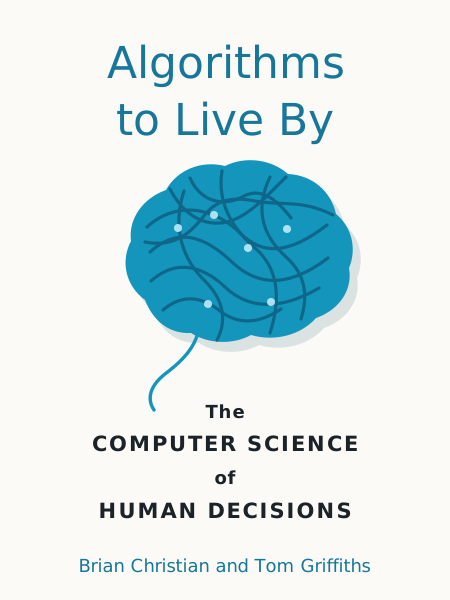
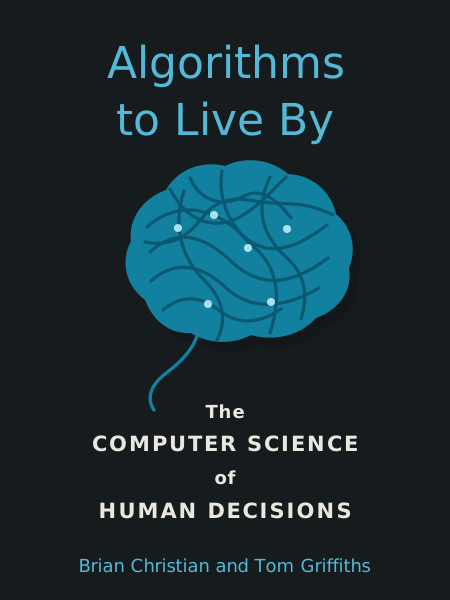
Algorithms to Live By
Brian Christian & Tom Griffiths · 2016
Editorial rating
- Evidence
- 9/10
- Actionability
- 7/10
- Originality
- 9/10
The thesis
Computer scientists have spent decades solving the same problems humans face daily - when to stop searching, how to sort priorities, when to explore vs. exploit. Their algorithms aren't just for machines; they're optimal solutions to fundamental decision-making problems that can guide human choices.
Who this is for
Analytical thinkers who want frameworks for everyday decisions, from hiring to apartment hunting to managing their time. Particularly valuable for consultants, analysts, and knowledge workers who appreciate structured approaches to ambiguous problems.
My favorite quote
In an increasingly unpredictable world, the best algorithm is the one that gives you the best expected outcome - not the guaranteed best outcome.
Why it matters
This captures the book's core philosophy: optimal decision-making isn't about perfection, it's about maximizing expected value under uncertainty.
Do this
Identify one decision you've been delaying because you're waiting for "enough information." Apply the 37% rule: sample options for 37% of your available time, then commit to the first option that beats your best sample.
Start here
Use the 37% Rule for any "optimal stopping" problem (hiring, apartment hunting, dating). Spend the first 37% of your search purely gathering information - don't commit to anything. Then choose the first option that's better than everything you've seen. This strategy finds the best option 37% of the time - which is mathematically optimal when you can't go back.
Critical summary
Christian, a science writer, and Griffiths, a Princeton cognitive scientist, translate algorithms from computer science into decision-making heuristics for everyday life. Each chapter takes a computational problem - optimal stopping, sorting, caching, scheduling - and shows how the solution applies to human dilemmas.
The book is genuinely interdisciplinary, drawing on computer science, cognitive psychology, and behavioral economics. The explanations are accessible without being dumbed down, and the practical applications are often surprising.
What it gets right
- The 37% rule and explore/exploit tradeoff are immediately applicable
- Makes computational thinking accessible to non-technical readers
- Avoids the "life hack" trap - acknowledges that algorithms provide guidance, not guarantees
- Strong research foundation (Griffiths is a serious cognitive scientist)
What it misses
- Some applications feel forced (not every life problem maps to a known algorithm)
- The book assumes rational optimization is the goal - doesn't engage with "satisficing" literature deeply
- Can be dense in places; not ideal for audiobook consumption
- Limited discussion of when algorithmic thinking is inappropriate (relationships, ethics)
- The dating/marriage chapter is a bit gimmicky and gets disproportionate attention
Evidence quality is excellent - the book draws on peer-reviewed research and explains the mathematics clearly. The challenge is application: knowing the optimal algorithm doesn't always help when the real world is messier than the problem formulation.
Key concepts
Optimal Stopping / 37% Rule
For secretary problems (hire the best from a sequence), sample 37% then commit to the first candidate who beats your sample. Use for hiring, apartments, dating.
Explore vs. Exploit
Early in any domain, explore widely. As time runs out, exploit what you've learned. Young = explore; old = exploit.
Least Recently Used (LRU) Cache
When deciding what to keep, discard whatever you haven't used longest. Applies to closets, files, relationships.
Scheduling by Weighted Shortest Job First
Prioritize tasks by (importance ÷ time required). Quick important tasks first.
Overfitting
Having too many rules for too little data. Simpler models generalize better. Applies to life rules, not just machine learning.
Randomness as Strategy
When stuck, introduce randomness. Random restarts prevent getting trapped in local optima.
Core insights
-
Stop earlier than feels right
Humans typically search too long. The mathematically optimal stopping point feels uncomfortably early.
-
Exploration has declining returns
When you're young or new to a field, explore widely. As time passes, double down on what works.
-
Mess can be efficient
Perfect organization has costs. Sometimes a messy desk (LRU cache) is more efficient than a filing system.
-
Simple rules beat complex ones
With limited data, simple heuristics outperform sophisticated models. Don't overfit your life.
-
Procrastination is a scheduling problem
If you're avoiding tasks, you're probably optimizing for the wrong objective function.
Implementation steps
Today
- Identify one decision you're delaying. Estimate how many options you'll realistically consider. Set your 37% threshold.
- List your top 3 priorities for the week. Sort by (importance ÷ time required). Do the highest ratio task first.
This week
- Apply LRU to one cluttered space: anything you haven't used in 6 months goes to the "consider discarding" pile
- Notice one area where you're over-exploring (too many options) and force a commitment
This month
- For one recurring decision (restaurants, meeting formats, tools), deliberately introduce randomness to break out of local optima
- Audit your "life rules": are any of them overfitted to past experiences that no longer apply?
Ongoing
- Use explore/exploit framing for career decisions: how much of your time is exploration vs. exploitation?
- When stuck, try a random restart before adding more optimization
Suggested 30-day practice plan
An editorial application plan created by Monolithic Vault - an interpretation of the book's ideas, not part of the original book.
- Day 1
Identify a current search problem (job, apartment, vendor). Define your 37% threshold.
- Day 2
List this week's tasks. Sort by importance ÷ time. Work in that order.
- Day 3
Apply LRU to your email inbox: archive anything older than 30 days that hasn't been referenced
- Day 7
Reflect on your explore/exploit balance. Are you exploring too much or too little for your career stage?
- Day 14
Simplify one decision rule you've been overcomplicating. Test the simpler version.
- Day 21
Introduce randomness into one habitual choice (lunch spot, meeting structure) to break patterns
- Day 30
Review: Which algorithmic frame proved most useful? Which felt forced?
Free PDF summary
Take this analysis with you: a designed two-page field-notes sheet with the thesis, my favorite quote, the key concepts and core insights, and the full 30-day checklist. Print it or keep it - free, no signup.
Go deeper
If this analysis earned your attention, the full book goes further than any summary can. The original is always the primary source.