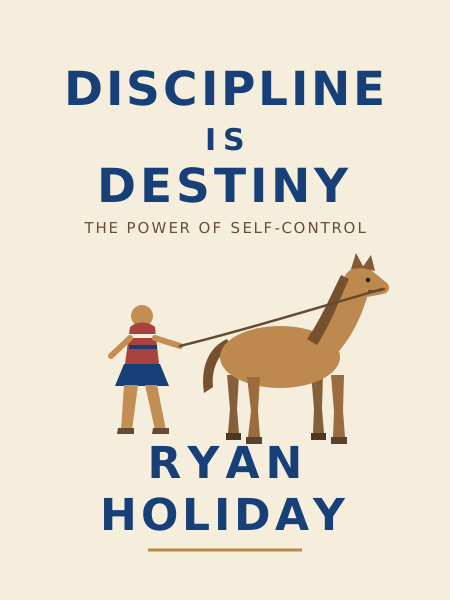
Discipline Is Destiny
Ryan Holiday · 2022
Editorial rating
- Evidence
- 5/10
- Actionability
- 7/10
- Originality
- 4/10
The thesis
Self-control is the ultimate form of power - not control over others, but mastery over yourself. Discipline isn't restriction; it's freedom from being jerked around by impulses, emotions, and external pressures.
Who this is for
High achievers sabotaged by their own lack of restraint, people whose talent is undermined by poor habits, and anyone feeling enslaved by impulses (spending, scrolling, eating, reacting) they know they should control.
My favorite quote
Love the discipline you know, and let it support you." - Marcus Aurelius
Why it matters
Discipline isn't punishment - it's infrastructure. When you have systems and routines you trust, you're freed from constant decision-making and willpower depletion.
Do this
Identify one area where lack of discipline undermines you (sleep, diet, focus). Set one non-negotiable boundary today.
Start here
Discipline is choosing what you want most over what you want now. Every time you resist an impulse (scrolling when you should be working, eating when you're not hungry, yelling when you're angry), you're practicing self-control. Start with one domain: sleep, diet, or focus. Set one non-negotiable rule (bed by 10pm, no snacking after 8pm, phone off during work). Follow it for 7 days. Willpower is trainable; consistency builds capacity.
Critical summary
Discipline Is Destiny is the second book in Holiday's Stoic Virtues Series, focusing on temperance (self-control). The structure mirrors Courage Is Calling: three parts (Mastering the Body, Mastering Desires, Mastering the Mind), dozens of short chapters, each built around a historical figure paired with Stoic wisdom.
Holiday argues that discipline is upstream of everything: without self-control, talent is wasted, relationships crumble, and ambition collapses into chaos. The book celebrates figures who embodied restraint (Lou Gehrig, Queen Elizabeth II, Toni Morrison) and warns against those who didn't (Napoleon, Babe Ruth, F. Scott Fitzgerald).
The thesis is straightforward: external success without internal discipline leads to ruin. You can have wealth, fame, and power, but without self-mastery, they'll eventually destroy you. Discipline is both prerequisite and protection.
What it gets right
- Strong on consequences: shows how lack of discipline destroyed talented people (Fitzgerald's alcoholism, Ruth's gluttony, Napoleon's overreach)
- Body-mind integration: recognizes that physical discipline (exercise, sleep, diet) enables mental discipline
- Timely message: in an age of infinite stimulation and instant gratification, restraint is countercultural and necessary
What it misses
- Repeats Holiday's formula: anecdote + quote + brief moral = 300 pages of sameness
- Cherry-picks examples: ignores disciplined failures and undisciplined successes (Steve Jobs was notoriously volatile; Hemingway was an alcoholic genius)
- Assumes discipline is always good: sometimes rigidity is worse than flexibility, and perfectionism masquerades as discipline
- No discussion of when to break rules: discipline without discernment is dogma
CRITICAL PROBLEMS
The book conflates discipline with virtue without addressing moral complexity. Nazis were disciplined. Wall Street fraudsters wake up early and exercise daily. Discipline in service of bad ends isn't virtue - it's just effective evil. Holiday rarely asks: "Discipline toward what purpose?"
Like Courage Is Calling, this suffers from surface-level treatment. You get 50 mini-biographies but no practical framework. How do you build discipline? What do you do when willpower fails? How do you recover from breaking your own rules? The book inspires but doesn't instruct.
Holiday's personal brand increasingly strains credibility. He preaches restraint while aggressively expanding his Stoicism empire (books, courses, merchandise, a bookstore, speaking tours, podcasts). His business model is the opposite of temperance - it's maximalist capitalism wrapped in Stoic aesthetics. This doesn't invalidate the ideas, but the messenger-message disconnect is glaring.
Evidence is purely anecdotal. We get stories of disciplined winners and undisciplined losers, but no controlled studies, no discussion of survivor bias (disciplined people who still failed), and no acknowledgment that correlation isn't causation. Maybe Gehrig succeeded despite extreme discipline, not because of it.
Key concepts
Delayed Gratification
Choose long-term rewards over immediate pleasure. Marshmallow test for adults. Use when tempted.
Routine as Freedom
Structure eliminates decision fatigue - you don't debate whether to work out; you just do it at 6am daily. Build non-negotiable routines.
Physical Discipline Enables Mental Discipline
Control your body (sleep, exercise, diet) and your mind follows. Start with the body; it's easier.
Restraint vs. Indulgence
Stoics enjoy pleasures but aren't enslaved by them. Have the wine, don't need the wine. Practice light enjoyment.
Small Leaks Sink Ships
One Netflix episode becomes three. One skip becomes a broken habit. Discipline is guarding against first violations.
Temperance as Strength, Not Weakness
Saying no to dessert isn't deprivation - it's power over yourself. Reframe restraint as freedom.
Core insights
-
You can't outsource self-control
No app, coach, or system replaces personal discipline. You must do the reps yourself. Shortcuts don't exist.
-
Discipline is trainable like a muscle
Start small, add gradually. If you can't resist scrolling for 5 minutes, don't try for an hour. Build capacity through incremental practice.
-
Success without discipline is temporary
Talent, luck, and opportunity might create initial success, but without self-control, you can't sustain it. Discipline is maintenance.
-
Physical discipline unlocks mental discipline
If you can wake up early, exercise daily, and eat clean, you can write daily, focus deeply, and control your temper. The body teaches the mind.
-
Indulgence is expensive
Every moment of lost control - overeating, overspending, overreacting - costs something. Small costs compound into bankruptcy (health, financial, relational).
Implementation steps
Today
- Identify one area where lack of discipline undermines you (sleep, focus, spending, reacting)
- Set one non-negotiable rule and follow it today (no phone in bed, no snacking after 8pm, etc.)
This week
- Build one keystone routine: morning exercise, evening reflection, daily writing - something that anchors discipline
- Track adherence: did you follow your rule? If not, why? What pattern emerges?
This month
- Practice delayed gratification: when you want something, wait 48 hours before deciding
- Eliminate one source of temptation: delete an app, remove junk food, cancel a subscription
Ongoing
- Use "if-then" rules: "If I feel like scrolling, then I'll do 10 pushups first"
- Review monthly: which disciplines are holding? Which are slipping? Adjust.
Suggested 30-day practice plan
An editorial application plan created by Monolithic Vault - an interpretation of the book's ideas, not part of the original book.
- Day 1
Identify three areas lacking discipline (body, mind, relationships)
- Day 2
Set one non-negotiable rule in your weakest area (e.g., bed by 10pm)
- Day 3
Follow the rule. When tempted, say out loud: "I'm choosing what I want most over what I want now"
- Day 7
Reflect on first week - when did discipline feel hard? When did it feel good? What's the pattern?
- Day 14
Add a second rule in a different domain (e.g., no phone during meals if first rule was sleep-related)
- Day 21
Practice recovery - if you break your rule, restart immediately. No self-flagellation, just return to discipline.
- Day 30
Evaluate which disciplines stuck, which didn't. Commit to 1-2 permanent practices.
Free PDF summary
Take this analysis with you: a designed two-page field-notes sheet with the thesis, my favorite quote, the key concepts and core insights, and the full 30-day checklist. Print it or keep it - free, no signup.
Go deeper
If this analysis earned your attention, the full book goes further than any summary can. The original is always the primary source.