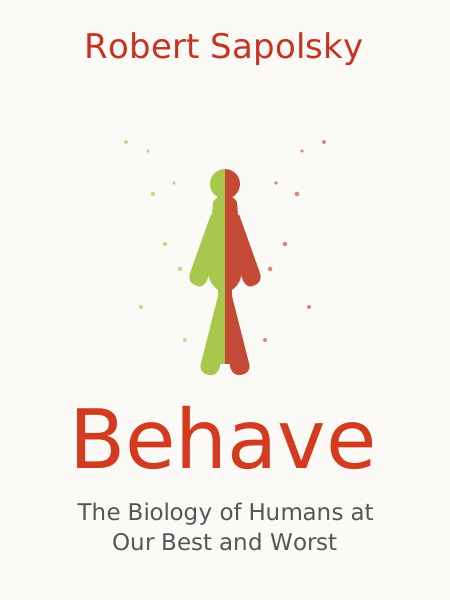
Behave
Robert Sapolsky · 2017
Editorial rating
- Evidence
- 9/10
- Actionability
- 5/10
- Originality
- 9/10
The thesis
No single hormone, gene, brain region, childhood event, or culture explains human behavior. Every action emerges from interacting causes operating milliseconds to millennia before it occurs.
Who this is for
Leaders, clinicians, educators, policy professionals, and serious general readers who need a richer explanation of aggression, empathy, tribalism, stress, punishment, and moral judgment.
My favorite quote
You don't have to choose between being scientific and being compassionate.
Why it matters
Better causal explanations can reduce moral certainty without excusing harm or abandoning protection.
Do this
Before judging one troubling action today, list three biological or environmental factors that may have shaped it.
Start here
Analyze behavior backward through time. Ask what happened in the brain one second before, which hormones and sensory cues mattered minutes before, how learning and stress shaped the previous months, and which developmental, cultural, and evolutionary forces built the person who acted. The point is not to excuse behavior but to replace single-cause stories with layered explanations.
Critical summary
Robert Sapolsky organizes an enormous range of behavioral science around one elegant device: begin with an action and travel backward through its causes. Neural activity in the preceding second sits inside hormonal conditions from earlier minutes, which sit inside recent stress and learning, childhood development, prenatal conditions, genes, culture, ecology, and evolution. Each layer changes the meaning of the others. Testosterone does not simply cause aggression, oxytocin is not a universal kindness chemical, and the amygdala is not merely a fear button. Effects depend on the person, the social setting, previous experience, and who counts as Us or Them.
What it gets right
- Uses time scale as a clear structure for connecting neuroscience, endocrinology, psychology, anthropology, and evolution
- Repeatedly dismantles seductive one-variable explanations without replacing them with another simplistic answer
- Links scientific uncertainty to compassion, especially around stress, development, violence, and impaired self-control
What it overstates or misses
- The scale produces an exhausting book whose details can bury the framework readers are meant to retain
- Some studies discussed as illuminating examples come from fields affected by replication problems and rapidly changing interpretations
- Sapolsky's skepticism about free will appears before the philosophical argument is fully developed and sometimes outruns the evidence presented
The evidential range is exceptional, with extensive references and frequent warnings about causal ambiguity, small effects, context, and contested findings. Breadth is also the liability: no author can evaluate every discipline with equal depth, and readers may mistake an impressive accumulation of studies for a settled account of human nature. Sapolsky is strongest when showing interactions, continua, and feedback loops, not when pushing from causal explanation toward a total rejection of agency. Still, the book permanently raises the standard for explaining why people act as they do. The verdict: difficult, sprawling, and worth the effort because it makes simple explanations of behavior look permanently inadequate.
Key concepts
Backward Time Layers
Explain an action by moving from immediate neural events through hormones, experience, development, culture, and evolution.
Context Dependence
A biological factor changes behavior differently depending on the individual, environment, learned associations, and social target.
Us Versus Them
Humans rapidly sort people into groups, increasing empathy and cooperation within groups while enabling hostility toward outsiders.
Stress and Control
Chronic stress can weaken executive function, strengthen habitual responses, and narrow the behavioral options available in difficult moments.
Biological Continua
Many traits treated as categories are gradual distributions, so boundaries such as normal and abnormal are often practical rather than natural.
Core insights
-
Causes Interact Across Time
The neural trigger for an action cannot be understood separately from the life history that shaped that neural response.
-
Hormones Amplify More Than Command
Testosterone often supports status-seeking behavior, which can mean aggression in one culture and generosity in another.
-
Empathy Has Borders
Oxytocin and group loyalty can increase care for insiders while worsening suspicion and aggression toward outsiders.
-
Self-Control Is Unequally Distributed
Development, stress, injury, poverty, and prior learning change how much behavioral restraint a person can deploy.
-
Understanding Is Not Permission
Explaining harmful conduct can improve prevention and response without pretending the harm is acceptable.
Implementation steps
Today
- Choose one behavior you recently judged and write causes from at least three different time scales.
- Replace one categorical label such as lazy or aggressive with a description of the specific behavior and context.
This week
- Track when stress, sleep loss, hunger, or social threat changes your own patience and decision quality.
- In one conflict, ask what the other person perceived immediately before acting rather than assuming a stable character flaw.
This month
- Build a behavior map for one recurring team, family, or personal problem using biological, developmental, situational, and cultural factors.
- Redesign one environment so the desired action is easier before relying on motivation or punishment.
Ongoing
- Treat confident single-cause claims about human behavior as hypotheses that require context and competing explanations.
- Separate the need to prevent harm from the emotional desire to declare someone fundamentally bad.
Suggested 30-day practice plan
An editorial application plan created by Monolithic Vault - an interpretation of the book's ideas, not part of the original book.
- Day 1
Select one recurring behavior and describe it without moral or personality labels.
- Day 3
Map immediate triggers, recent stressors, learned patterns, and longer developmental influences.
- Day 7
Identify which explanation is supported by evidence and which parts remain speculation.
- Day 14
Change one environmental cue or incentive and observe whether the behavior shifts.
- Day 21
Compare the outcome with your original character-based explanation.
- Day 30
Create a reusable checklist for analyzing difficult behavior across multiple time scales before intervening.
Free PDF summary
Take this analysis with you: a designed two-page field-notes sheet with the thesis, my favorite quote, the key concepts and core insights, and the full 30-day checklist. Print it or keep it - free, no signup.
Go deeper
If this analysis earned your attention, the full book goes further than any summary can. The original is always the primary source.