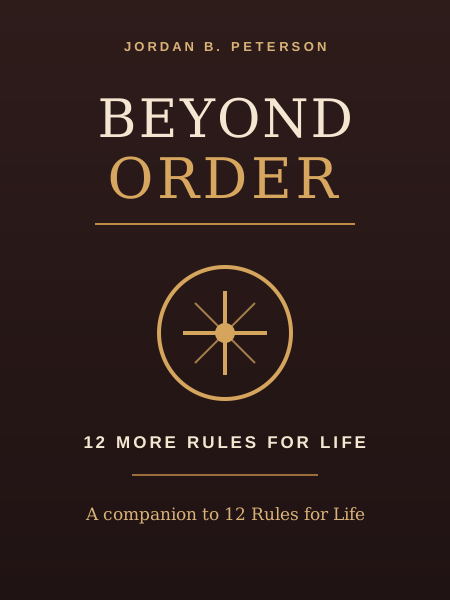
Beyond Order
Jordan Peterson · 2021
Editorial rating
- Evidence
- 5/10
- Actionability
- 7/10
- Originality
- 6/10
The thesis
A stable life requires both order and renewal: preserve the institutions, habits, and relationships that keep you grounded, but confront neglected problems before rigidity, resentment, or fear turns stability into stagnation.
Who this is for
People recovering from disruption, professionals carrying responsibilities they quietly resent, and readers who liked the moral seriousness of 12 Rules for Life but want more emphasis on creativity, adaptation, and unresolved pain.
My favorite quote
That which you most need to find will be found where you least wish to look.
Why it matters
Avoidance often marks the exact conversation, memory, responsibility, or ambition that has gained the most power over you.
Do this
Name one subject you keep pushing into the fog and write the first uncomfortable fact about it today.
Start here
Use Peterson's fog test: if a recurring problem stays vague because naming it would force a decision, write it down precisely. Clarity will not remove the cost, but it stops avoidance from quietly choosing the outcome for you.
Critical summary
Jordan Peterson wrote Beyond Order as a companion to 12 Rules for Life, shifting attention from the need to impose structure toward the equally important need to revise structures that have become brittle. The twelve rules move across social institutions, creativity, ambition, responsibility, ideology, beauty, memory, romance, resentment, and gratitude. Peterson's recurring model is a tension between order and chaos. Order provides shared expectations, habits, identity, and security, while chaos contains uncertainty, threat, possibility, and renewal. A workable life needs both. Preserve inherited practices long enough to understand what they solve, but do not use convention as an excuse to suppress talent or avoid change. Imagine a stronger future self, accept abandoned responsibility, refuse work that corrodes your integrity, and bring vague conflicts into language before they harden into bitterness. Later chapters turn toward unresolved memories, neglected relationships, and gratitude in the presence of unavoidable suffering.
What it gets right
- Treats responsibility as a source of meaning rather than merely a burden imposed by other people
- Gives unusually direct advice on resentment, hidden conflict, unfinished memories, and maintaining a long-term relationship
- Balances respect for functional institutions with the need for creative rebellion and personal renewal
What it overstates or misses
- Long excursions through mythology, religion, clinical stories, and cultural criticism often obscure the practical rule under discussion
- Psychological observations are frequently presented with more certainty than the evidence or anecdotal source warrants
- Structural constraints and legitimate political grievances receive less attention than individual responsibility and moral reform
The evidence comes from Peterson's clinical experience, personality research, religious interpretation, literature, and personal stories rather than a consistent empirical program. Some rules translate well into behavior, especially writing about disturbing memories, naming hidden problems, and maintaining romance deliberately. Others function more as philosophical provocations than testable guidance. The book is also repetitive, and readers hostile to Peterson's wider politics may struggle to separate useful psychological advice from his cultural arguments. The verdict: several powerful rules buried inside an overgrown and uneven book.
Key concepts
Order and Chaos
Order offers stability while chaos brings danger and possibility. Protect enough structure to function, then enter uncertainty deliberately where growth requires it.
The Fog
Problems remain powerful when they stay vague. Put the feared fact, conflict, or desire into exact words so a decision becomes possible.
Abdicated Responsibility
Neglected work creates openings for contribution and meaning. Look for a useful task everyone notices but nobody owns.
Creative Renewal
Healthy systems need people who can challenge rules without destroying the cooperation those rules support. Understand before you rebel.
Resentment Audit
Resentment can signal immaturity, exploitation, or an unspoken refusal. Identify which one applies before blame becomes your identity.
Core insights
-
Do Not Despise What You Depend On
Institutions are imperfect but often encode hard-won solutions. Learn their function before deciding they deserve demolition.
-
Aim Before You Optimize
A clear image of who you could become organizes effort better than scattered self-improvement. Choose a direction that demands growth.
-
Responsibility Reveals Opportunity
Where others have stepped back, useful work is waiting. Taking ownership can produce skill, authority, and meaning together.
-
Unspoken Problems Compound
Avoided conversations do not remain neutral; they become distance, fantasy, and resentment. State small truths before they become dramatic truths.
-
Gratitude Is Defiance
Suffering does not require pretending life is fair. Gratitude keeps pain from turning into contempt for everything that remains good.
Implementation steps
Today
- Write one avoided problem as a factual sentence without excuses, diagnosis, or blame.
- Identify one neglected responsibility at home or work that you can complete in under fifteen minutes.
This week
- Draft a one-page description of the person you are trying to become and the behaviors that would make it visible.
- Have one calm conversation about a recurring irritation before it becomes another week of silent resentment.
This month
- Take ownership of one useful project that lacks a clear owner, then define its scope and completion criteria.
- Improve one room or workspace so it supports attention, dignity, and the activity performed there.
Ongoing
- Review resentment as information: decide whether to mature, renegotiate, set a boundary, or leave.
- Protect routines and relationships that work while scheduling deliberate experiments that prevent them from becoming rigid.
Suggested 30-day practice plan
An editorial application plan created by Monolithic Vault - an interpretation of the book's ideas, not part of the original book.
- Day 1
Name the problem currently hidden in the fog and write the decision it may eventually require.
- Day 3
Choose one abandoned responsibility and complete the smallest useful part of it.
- Day 7
Write a future-self description with three observable behaviors for the next month.
- Day 14
Address one recurring conflict directly and record what became clearer afterward.
- Day 21
Improve one physical space and remove an object or habit that supports disorder.
- Day 30
Review which responsibility, truth, or relationship produced the most growth and commit to its next concrete step.
Free PDF summary
Take this analysis with you: a designed two-page field-notes sheet with the thesis, my favorite quote, the key concepts and core insights, and the full 30-day checklist. Print it or keep it - free, no signup.
Go deeper
If this analysis earned your attention, the full book goes further than any summary can. The original is always the primary source.