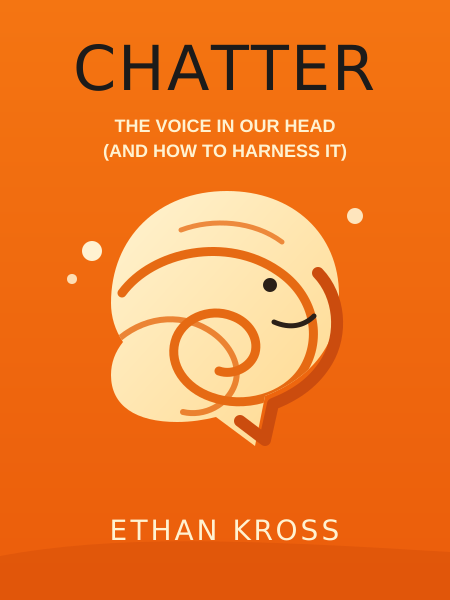
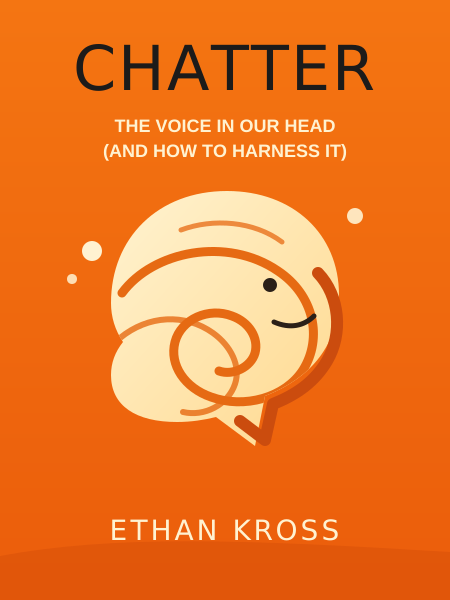
Chatter
Ethan Kross · 2021
Editorial rating
- Evidence
- 9/10
- Actionability
- 9/10
- Originality
- 8/10
The thesis
The inner voice becomes destructive when reflection collapses into repetitive self-immersion, and the best remedy is psychological distance rather than forced silence.
Who this is for
Leaders replaying difficult meetings, performers spiraling before high-stakes work, and anyone whose attempt to solve a problem keeps turning into rumination.
My favorite quote
If you think of your inner voice as an inner tormentor, then it's natural to fantasize about permanently muting it.
Why it matters
The goal is not an empty mind but a more flexible relationship with the mental tool used for planning, memory, and self-control.
Do this
Describe one current problem using your own name and advise yourself as though you were coaching someone else.
Start here
Create distance before trying to solve the thought. Use your own name, picture the situation from across the room, or ask how you will view it one year from now, then decide what deserves action.
Critical summary
Ethan Kross directs the Emotion and Self Control Laboratory at the University of Michigan, and he starts from a useful distinction: the inner voice is not the problem. Silent language helps people remember, plan, rehearse, regulate behavior, and construct identity. Chatter begins when that tool becomes repetitive, negative, and self-immersed, narrowing attention until a person can see the threat but not the wider context. Kross organizes the remedy as a toolbox rather than a single method. Distanced self-talk uses your own name or second-person language. Temporal distancing asks how the problem will look later. Visual perspective, expressive writing, rituals, orderly surroundings, nature, and awe all reduce self-focus in different ways. Social support works best when another person validates emotion and then helps broaden perspective instead of joining an endless venting loop.
What it gets right
- Rejects the unrealistic goal of silencing thought and focuses on changing perspective instead
- Converts laboratory findings into small interventions that can be tested during an actual spiral
- Treats language, relationships, physical spaces, and cultural rituals as parts of one regulation system
What it overstates or misses
- The toolbox format can make modest effects sound interchangeable or universally reliable
- Severe anxiety, depression, trauma, and obsessive symptoms need more than self-distancing techniques
- Anecdotes sometimes carry the narrative farther than the underlying study can support
The evidence is stronger than in most self-help books because many techniques come from experimental emotion-regulation research, including Kross's own work on self-distancing. Effect sizes and personal fit vary, and the book is more convincing about interrupting ordinary rumination than treating clinical disorders. Its practical advantage is redundancy: when one tool fails, another may fit the person or situation. The verdict: one of the best field guides for getting out of your own head without pretending you can switch it off.
Key concepts
Chatter
Repetitive negative self-talk traps attention on a threat without producing useful action; name the loop before trying to solve its content.
Distanced Self-Talk
Use your own name or second-person language to create psychological space; coach yourself as you would coach a capable friend.
Temporal Distancing
View the problem from a future point in time; ask what will still matter in one week, one year, or ten years.
Invisible Support
Help someone quietly through practical action when overt reassurance might threaten autonomy or intensify self-focus.
Awe and Ritual
Vast experiences and structured sequences reduce self-immersion; use nature, music, ceremony, or a repeatable routine before stressful moments.
Core insights
-
Self-Immersion Narrows the Lens
Chatter zooms in until the problem fills the frame, so perspective change should come before analysis.
-
Names Create Useful Distance
Addressing yourself by name makes advice less emotionally fused and often improves control under pressure.
-
Venting Can Feed the Loop
Emotional validation helps, but repeatedly retelling the same story without reframing can strengthen rumination.
-
Order Restores Agency
Organizing a small physical space can supply a sense of control when the larger situation feels uncontrollable.
-
Use a Toolbox, Not a Favorite Trick
Regulation is context-dependent, so combine language, time, relationships, environment, and bodily action.
Implementation steps
Today
- Rewrite one recurring thought using your own name and give yourself one concrete instruction.
- Clear and organize one small area you can see while working or resting.
This week
- Test three distancing tools on separate episodes and record which reduces emotional intensity fastest.
- Build a two-person support list: one person for empathy and one for practical perspective.
This month
- Design a short pre-performance ritual for meetings, presentations, workouts, or difficult conversations.
- Schedule four experiences of nature, art, music, or scale that reliably create awe.
Ongoing
- Notice when reflection stops generating new information and switch from analysis to distance or action.
- Support others by validating feelings briefly, then helping them widen the frame and choose a next step.
Suggested 30-day practice plan
An editorial application plan created by Monolithic Vault - an interpretation of the book's ideas, not part of the original book.
- Day 1
Use distanced self-talk on one live concern and rate the emotional shift.
- Day 3
Write about the concern from an observer's perspective for ten minutes.
- Day 7
Compare the effect of temporal distance, physical order, and a short walk.
- Day 14
Ask a trusted person for perspective rather than permission to keep venting.
- Day 21
Complete your pre-performance ritual three times and refine the sequence.
- Day 30
Create a personal chatter toolbox with five ranked methods and clear triggers for each.
Free PDF summary
Take this analysis with you: a designed two-page field-notes sheet with the thesis, my favorite quote, the key concepts and core insights, and the full 30-day checklist. Print it or keep it - free, no signup.
Go deeper
If this analysis earned your attention, the full book goes further than any summary can. The original is always the primary source.