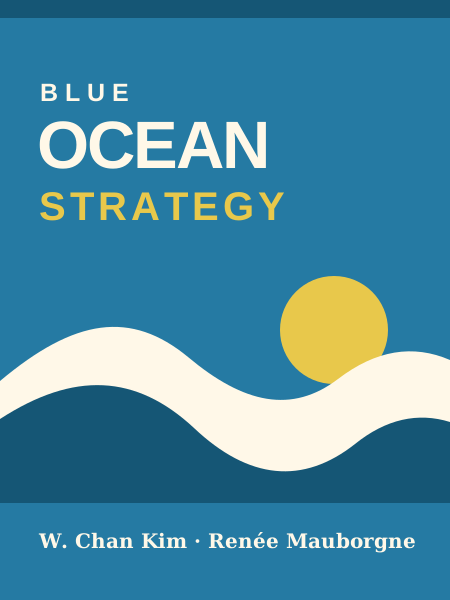
Blue Ocean Strategy
W. Chan Kim & Renée Mauborgne · 2005
Editorial rating
- Evidence
- 6/10
- Actionability
- 7/10
- Originality
- 8/10
The thesis
Stop competing in bloody "red oceans" of existing market space where rivals fight over shrinking profits. Instead, create "blue oceans" of uncontested market space by simultaneously pursuing differentiation and low cost through value innovation.
Who this is for
Strategy consultants developing growth plans, executives in commoditized industries seeking differentiation, and product managers trying to escape feature wars and price competition.
My favorite quote
The only way to beat the competition is to stop trying to beat the competition.
Why it matters
This single sentence demolishes the default assumption that strategy equals outmaneuvering rivals. It reframes the entire competitive mindset.
Do this
List your three main competitors. Now list three industries or customer groups they completely ignore. That's where your blue ocean might be.
Start here
Use the Four Actions Framework: For any product or service, ask (1) What factors can we eliminate that the industry takes for granted? (2) What factors can we reduce well below standard? (3) What factors can we raise well above standard? (4) What factors can we create that the industry has never offered? This forces you to break the value-cost trade-off.
Critical summary
Kim and Mauborgne, INSEAD professors, present a framework for escaping cutthroat competition by creating new market space. The central concept is "value innovation" - the simultaneous pursuit of differentiation and low cost, which they argue makes competition irrelevant.
The framework includes useful analytical tools: the Strategy Canvas (a visual curve comparing your offering against competitors across key factors), the Four Actions Framework (eliminate-reduce-raise-create), and the Six Paths Framework (looking across alternative industries, strategic groups, buyer chains, complementary offerings, functional-emotional appeal, and time).
What it gets right
- The core insight that obsessive competitor focus often leads to incremental imitation rather than breakthrough value creation
- The Cirque du Soleil case study brilliantly illustrates eliminating circus animals while adding theatrical elements to create a new entertainment category
- Practical visualization tools that help teams align on strategy
What it misses
- The theory is unfalsifiable - there's no control group, and the authors retroactively analyze success stories through their lens. We never see how many blue ocean attempts failed.
- "Blue oceans" often turn red quickly as competitors imitate (Nintendo's Wii example notwithstanding)
- The metaphor itself is confused - blue ocean is a naval term meaning deep water far from shore, not the opposite of "bloody"
- Limited guidance on execution and the organizational challenges of actually making the shift
Evidence quality is weak. The 150 strategic moves studied across 100 years lack rigorous methodology. Critics have called this descriptive rather than prescriptive - the authors explain past success but can't reliably predict future success.
Key concepts
Value Innovation
Pursue differentiation AND low cost simultaneously rather than choosing one. Apply by listing what competitors overspend on that customers don't value.
Strategy Canvas
Visual curve showing how you compete on key factors. Draw yours against competitors to spot imitation versus differentiation.
Four Actions Framework
Eliminate-Reduce-Raise-Create grid for systematic value innovation. Use it in your next product planning session.
Six Paths Framework
Six dimensions to explore for new market space (industries, groups, buyers, scope, appeal, time). Pick one path to explore this quarter.
Three Tiers of Noncustomers
Soon-to-be, refusing, and unexplored noncustomers. Interview one person from each tier about why they don't buy.
Tipping Point Leadership
Overcome cognitive, resource, motivational, and political hurdles to execute strategy shifts. Identify your biggest hurdle first.
Core insights
-
Competition obsession causes convergence
When everyone benchmarks against each other, strategies become identical. The alternative is to benchmark against alternatives and noncustomers.
-
Industries aren't fixed
Market boundaries are mental constructs that can be reconstructed. Cirque du Soleil didn't improve the circus - it created a new category between circus and theater.
-
Buyer utility beats technology
Innovations fail when they emphasize technology over buyer value. Map the buyer experience cycle before investing in R&D.
-
Noncustomers reveal opportunity
The biggest growth often comes from people who don't buy your category at all, not from stealing competitors' customers.
-
Fair process enables execution
People care as much about how decisions are made as what decisions are made. Involve stakeholders in strategy creation.
Implementation steps
Today
- Draw a quick Strategy Canvas comparing your offering to two competitors on 5-7 factors
- List 3 things your industry assumes are necessary that customers might not actually value
This week
- Complete the Four Actions Framework for your core product (eliminate, reduce, raise, create)
- Interview 2-3 "noncustomers" about why they don't buy your category
This month
- Apply one of the Six Paths to identify a potential blue ocean opportunity
- Present the Strategy Canvas to your team and identify where you're competing versus differentiating
Ongoing
- Review competitive moves monthly - are you innovating or imitating?
- Track what percentage of effort goes to red ocean competition versus blue ocean creation
Suggested 30-day practice plan
An editorial application plan created by Monolithic Vault - an interpretation of the book's ideas, not part of the original book.
- Day 1
Read the Cirque du Soleil case study as a mental model for value innovation
- Day 2
Draw your current Strategy Canvas - where do you match competitors exactly?
- Day 3
Complete the Four Actions Framework for one product line
- Day 7
Interview 3 noncustomers - document why they don't buy your category
- Day 14
Present findings to stakeholders; identify one blue ocean hypothesis to test
- Day 21
Create a prototype or pitch for the blue ocean opportunity
- Day 30
Review results; decide whether to invest further or pivot
Free PDF summary
Take this analysis with you: a designed two-page field-notes sheet with the thesis, my favorite quote, the key concepts and core insights, and the full 30-day checklist. Print it or keep it - free, no signup.
Go deeper
If this analysis earned your attention, the full book goes further than any summary can. The original is always the primary source.