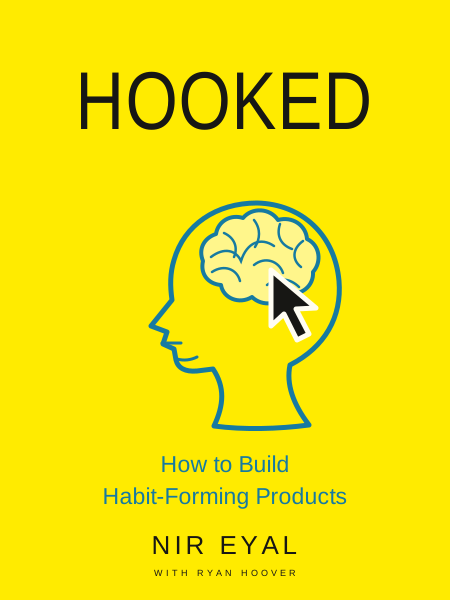
Hooked
Nir Eyal · 2014
Editorial rating
- Evidence
- 6/10
- Actionability
- 8/10
- Originality
- 7/10
The thesis
Products become habits through a four-step "Hook" cycle: trigger, action, variable reward, and investment. Master this loop and you can design products users return to without expensive marketing or aggressive messaging.
Who this is for
Product managers, startup founders, and UX designers building consumer apps who need frameworks for user engagement and retention. Also valuable for consumers seeking to understand how apps manipulate their behavior.
My favorite quote
Habits are one of the ways the brain learns complex behaviors. Neuroscientists believe habits give us the ability to focus our attention on other things by storing automatic responses in the basal ganglia.
Why it matters
Understanding that habits are neurological shortcuts - not character flaws - reframes product design as behavior architecture rather than manipulation.
Do this
Map your product's current hook cycle and identify which phase is weakest: trigger, action, reward, or investment.
Start here
Variable Rewards are the engine of habit formation. When outcomes are unpredictable - like slot machines or social media feeds - the brain releases more dopamine than with predictable rewards. Design rewards that vary in type, intensity, or timing to create craving without conscious thought.
Critical summary
Eyal synthesizes behavioral psychology research into a four-step product design framework. The Hook Model (Trigger → Action → Variable Reward → Investment) explains why some products become daily habits while others are forgotten after download.
The framework draws on BJ Fogg's behavior model and operant conditioning research, translating academic concepts into product vocabulary. Eyal provides clear definitions and numerous tech examples: Pinterest's infinite scroll, Twitter's variable social validation, Facebook's notification triggers.
What it gets right
- Variable reward principle is genuinely powerful and well-documented
- Investment phase explains switching costs and data lock-in elegantly
- Distinction between external and internal triggers clarifies habit formation stages
- Actionable framework with clear steps and self-assessment tools
What it misses
- The model doesn't actually predict success - many products that follow it fail, many that violate it succeed (Uber, Google Maps, Dropbox work without variable rewards)
- Examples are post-facto rationalizations, not evidence the framework caused success
- Ethics chapter feels tacked on, insufficient for the power of techniques described
- Limited discussion of when habits harm users versus help them
- Irony: Eyal later wrote "Indistractable" to help people escape habit-forming products
Evidence quality is mixed. Research citations are solid, but application claims are anecdotal. The book reads like a how-to manual for addiction design, which some critics find troubling.
Key concepts
Trigger
External (notifications, emails) or internal (emotions, situations) cues that prompt action. Audit your product's trigger strategy this week.
Action
The simplest behavior in anticipation of reward. Reduce friction using Fogg's formula: Motivation + Ability + Trigger.
Variable Reward
Unpredictable outcomes that create craving. Test adding randomness to your product's reward delivery.
Investment
User effort that increases likelihood of return (data, content, followers). Identify what users invest that makes leaving painful.
Internal Trigger
The holy grail - when users think of your product automatically when bored, lonely, or anxious. Map emotions your product addresses.
Manipulation Matrix
Ethical framework distinguishing dealers (exploiters) from facilitators (helpers). Use to gut-check your product's impact.
Core insights
-
Habits bypass deliberation
Once formed, habits require no conscious decision - users return automatically. This is why breaking into established categories is so hard.
-
Pain drives engagement
Products don't just deliver pleasure; they relieve discomfort. LinkedIn reduces career anxiety; Instagram relieves boredom. Identify your product's negative emotion.
-
Investment creates lock-in
The more users customize, store, or build, the harder leaving becomes. This isn't manipulation - it's genuine value accrual.
-
Variable beats fixed
A slot machine is more addictive than a salary because uncertainty triggers dopamine. Apply sparingly and ethically.
-
External triggers graduate to internal
The goal is becoming a thought reflex. Email notifications are training wheels; internal association is the destination.
Implementation steps
Today
- Draw your product's current hook cycle on paper
- Identify your weakest phase: trigger, action, reward, or investment
This week
- Interview 5 users about what emotion or situation triggers product use
- List all external triggers (notifications, emails) and measure their click-through
This month
- Run one experiment adding variability to rewards
- Implement one "investment" feature that stores user value
Ongoing
- Track internal trigger development through user research
- Apply Manipulation Matrix to new features before building
Suggested 30-day practice plan
An editorial application plan created by Monolithic Vault - an interpretation of the book's ideas, not part of the original book.
- Day 1
Read book, map your product's hook cycle
- Day 2
List all current external triggers
- Day 3
Interview 3 users about why and when they use product
- Day 7
Identify primary internal trigger (emotion) your product addresses
- Day 14
Prototype one variable reward experiment
- Day 21
Implement one investment feature; measure impact
- Day 30
Complete Manipulation Matrix for all major features; document ethics guidelines
Free PDF summary
Take this analysis with you: a designed two-page field-notes sheet with the thesis, my favorite quote, the key concepts and core insights, and the full 30-day checklist. Print it or keep it - free, no signup.
Go deeper
If this analysis earned your attention, the full book goes further than any summary can. The original is always the primary source.