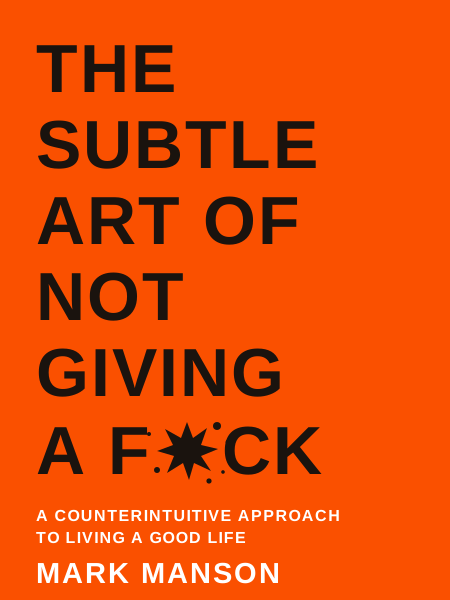
The Subtle Art of Not Giving a F*ck
Mark Manson · 2016
Editorial rating
- Evidence
- 4/10
- Actionability
- 5/10
- Originality
- 6/10
The thesis
Happiness comes not from avoiding problems or chasing positivity, but from choosing which problems are worth suffering for. Stop giving a fuck about everything and focus your limited fucks on values you actually control - not popularity, wealth, or external validation.
Who this is for
People drowning in self-help platitudes who need a blunt wake-up call, millennials caught in comparison culture, and anyone exhausted by the pressure to be happy all the time.
My favorite quote
Who you are is defined by what you're willing to struggle for.
Why it matters
Most people chase outcomes (money, status, happiness) but ignore that every outcome requires specific suffering - the real question is which suffering you'll choose.
Do this
List three goals you claim to want. For each, write the daily struggle required. Cross off any where the struggle repels you - you don't actually want those goals.
Start here
Identify your top 3-5 values - things within your control like honesty, curiosity, or standing up for others. Everything that aligns with these gets your emotional investment. Everything else gets zero fucks. When something doesn't make the list, practice actively not caring. This ruthless prioritization is the book's core contribution.
Critical summary
Manson, a blogger turned author, packages Eastern philosophy and Stoicism in profanity-laden millennial vernacular. The book is a reaction against toxic positivity and the "you can have it all" self-help industry.
What it gets right
- The anti-positivity message is refreshing and needed: struggling is normal, not a sign of failure
- "Choose your struggles" is genuinely useful reframing for career and life decisions
- Fault vs. responsibility distinction is clarifying: you may not cause your problems but you're responsible for solving them
- The Buddhism-lite "accept suffering" message is ancient wisdom made accessible
What it misses or overstates
- Very thin on practical implementation - lots of philosophy, few tools
- The edgy tone wears thin; the profanity is marketing, not substance
- Manson has no credentials in psychology - this is opinion dressed as insight
- Some advice can be misread as license to ignore legitimate problems or others' feelings
- The "you're not special" message, while true, lacks nuance about structural barriers
- Much of it is repackaged Stoicism and Buddhism without attribution
- Privilege blind spot: "You're responsible for your response to everything" sounds great until you consider systemic oppression, trauma, mental illness, poverty
Evidence quality: Essentially non-existent. Manson tells anecdotes and makes assertions. There's no research, no studies, no data. The book succeeds on vibes and relatability, not rigor. Think of it as one articulate friend's philosophy, not a scientifically validated framework. Reviewers consistently say: "This should've been a TED Talk."
Key concepts
Fucks are finite
You have limited time, energy, attention. Every "yes" is a "no" to something else. Stop giving fucks indiscriminately - reserve them for what truly matters.
The Feedback Loop from Hell
Feeling bad → feeling bad about feeling bad → feeling bad about feeling bad about feeling bad. Break the loop by accepting negative emotions without judgment.
Good Values vs. Bad Values
Good values are process-oriented and within your control (honesty, creativity, standing up for others). Bad values are outcome-oriented and external (wealth, fame, being liked). Swap bad for good.
Fault vs. Responsibility
You're not at fault for everything that happens to you, but you're responsible for your response to it. Separate the two to stop feeling victimized.
The Backwards Law
The more you pursue happiness, the more you highlight its absence. Accept negative emotions and they lose their power.
Healthy Uncertainty
Certainty is the enemy of growth. Embrace being wrong as the prerequisite for learning.
Core insights
-
Toxic positivity makes you miserable
Constant pressure to "think positive" and "be happy" creates anxiety when you're not. Accepting that life includes suffering is paradoxically freeing.
-
You're not special - and that's liberating
The self-esteem movement convinced everyone they're extraordinary. Most aren't. Accepting ordinariness frees you from exceptionalism anxiety and lets you focus on meaningful action.
-
Problems never go away - they just upgrade
Solving problems creates new problems. Happiness isn't problem-free; it's having problems you enjoy solving.
-
Choose your struggle
Don't ask what you want. Ask what pain you're willing to sustain. Everyone wants the result; not everyone wants the process.
-
Certainty is the enemy
Dogmatic beliefs - about yourself, others, or the world - prevent growth. The person who assumes they're always right never learns anything.
Implementation steps
Today
- Write down 5 things you currently "give a fuck" about. Circle the 2 that actually align with your values. Draw a line through the rest.
- Identify one thing you're anxious about. Say out loud: "I feel anxious about X, and that's okay." Notice if the meta-anxiety decreases.
This week
- Catch yourself in a Feedback Loop from Hell at least once. Label it: "I'm feeling bad about feeling bad." The labeling often breaks the loop.
- List your top 5 values. For each, write one sentence explaining why it matters to you and one action that expresses it.
This month
- Audit your "fucks budget." Track what triggers emotional reactions for one week. At the end, ask: "Did this deserve my energy?"
- Practice saying "I don't know" or "I might be wrong" in at least three conversations where you'd normally assert certainty.
Ongoing
- Weekly review: What did I give fucks about this week? Were they fuckworthy?
- When upset, ask: "Is this about my values or my ego?" Ego-driven reactions rarely deserve your energy.
- Default to "What struggle am I choosing?" instead of "What outcome do I want?"
Suggested 30-day practice plan
An editorial application plan created by Monolithic Vault - an interpretation of the book's ideas, not part of the original book.
- Day 1
List everything you currently give a fuck about. Be honest - status, likes, others' opinions, money, approval. No judgment.
- Day 2
Identify your top 5 controllable values (honesty, growth, creativity, etc.). These are now your "fuckworthy" criteria.
- Day 3
Compare the two lists. Highlight mismatches - things you care about that don't align with your values.
- Day 7
Week 1 check: Catch yourself giving a fuck about something off-list. Pause. Ask: "Does this align with my values?" If no, consciously let it go.
- Day 14
Journal on "What struggle am I willing to choose?" for your career, relationships, and health. Get specific.
- Day 21
Audit the past week. How many emotional reactions were about ego vs. values? Ego reactions get less energy going forward.
- Day 30
Rewrite your values list. Has it changed? Commit to reviewing quarterly. Your fucks budget evolves as you do.
Free PDF summary
Take this analysis with you: a designed two-page field-notes sheet with the thesis, my favorite quote, the key concepts and core insights, and the full 30-day checklist. Print it or keep it - free, no signup.
Go deeper
If this analysis earned your attention, the full book goes further than any summary can. The original is always the primary source.