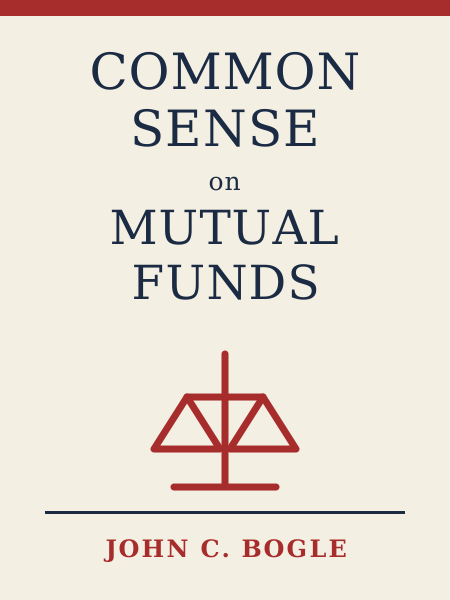
Common Sense on Mutual Funds
John C. Bogle · 1999
Editorial rating
- Evidence
- 10/10
- Actionability
- 9/10
- Originality
- 10/10
The thesis
The mutual fund industry is designed to maximize profits for fund companies, not returns for investors. Costs, taxes, and active management fees silently destroy wealth. The solution is brutally simple: buy low-cost total market index funds, hold forever, ignore the noise.
Who this is for
Individual investors drowning in fund choices, financial advisors seeking evidence-based guidance, and anyone paying more than 0.20% expense ratios on their investments.
My favorite quote
Don't look for the needle in the haystack. Just buy the haystack!
Why it matters
Most investors waste time and money trying to pick winning funds. Bogle's insight: own the entire market at minimal cost and you're guaranteed to beat 80%+ of active managers long-term.
Do this
Check your current investment expense ratios today. If any fund charges over 0.50%, you're likely being ripped off. Calculate how much you'll lose to fees over 30 years.
Start here
"The simple fact is that costs matter. And costs matter a lot." A 2% annual fee on a mutual fund doesn't sound devastating - until you realize it compounds to consume 63% of your returns over 50 years. Bogle founded Vanguard to prove a better way exists: index funds that track the market, charge 0.04-0.20%, and consistently outperform 80%+ of actively managed funds. This isn't theory - it's arithmetic. The only question is whether you'll accept the math and act on it.
Critical summary
Bogle, founder of Vanguard and creator of the first retail index fund (1975), wrote this as the definitive case for passive investing. The book is 22 standalone essays covering asset allocation, fund selection, costs, taxes, retirement planning, and industry structure. It's data-heavy, chart-filled, and relentlessly focused on evidence over emotion.
Core arguments: (1) Active fund management is a zero-sum game before costs, negative-sum after costs, (2) Costs compound brutally against investors, (3) Tax inefficiency of active funds further destroys returns, (4) Past performance predicts nothing, (5) Index funds are the only rational choice for most investors, (6) The mutual fund industry has conflicting interests - they profit when you lose.
The book compares actively managed funds against index benchmarks across decades. Spoiler: active managers lose. The few winners in one period become losers in the next (regression to the mean). Only costs persist.
What it gets right
- Data abundance: Decades of performance data, expense ratio analysis, tax impact calculations. Overwhelming empirical evidence.
- Structural critique: Exposes how fund companies profit from high turnover, excessive fees, and investor ignorance. Industry insiders hated this book.
- Timeless principles: Written 1999 (revised 2010), but core thesis remains unassailable. Bogle won this argument - index funds now dominate.
- Honest about limitations: Bonds have different considerations, international exposure matters, some active strategies (value, small-cap) occasionally work.
- Actionable: Clear guidance on portfolio construction - age in bonds, rest in total stock index, rebalance annually, done.
What it misses or overstates
- Dense, repetitive: 600+ pages across editions. Could be 200 pages without losing substance. Bogleheads forum consensus: "Great content, brutal to read."
- U.S.-centric: Primarily focused on American markets and tax code. International investors need to adapt.
- Rigid ideology: Bogle has zero patience for active management. Some tactical allocation or value investing has merit in specific contexts, but Bogle dismisses it entirely.
- Light on behavioral finance: Acknowledges emotions matter but doesn't provide much help managing fear/greed during crashes.
Evidence quality: Ironclad. Decades of S&P 500 performance, expense ratio data from Morningstar, tax impact studies, and historical return comparisons. This isn't opinion - it's arithmetic. The data has only gotten stronger since publication.
Critical reception: Classic. Goodreads 4.13/5 (7,000+ ratings). Financial advisors either love it (evidence-based) or hate it (threatens their fees). Warren Buffett endorses Bogle's approach. Jim Cramer admitted: "Bogle's arguments have me thinking of joining him rather than trying to beat him." Every serious investor has either read this or should.
Key concepts
"Costs matter. And costs matter a lot."
A 2% expense ratio vs. 0.05% costs you 63% of your returns over 50 years due to compounding. Check every fund you own - anything above 0.50% is theft. Switch to Vanguard/Fidelity/Schwab total market funds immediately.
The Arithmetic of Investing
Before costs, active management is zero-sum (for every winner, a loser). After costs (fees, taxes, trading), it's negative-sum. Index funds guarantee market returns minus tiny costs. Math wins.
Past Performance Is Worthless
Morningstar 5-star funds frequently become 1-star funds. Hot managers regress to the mean. Chasing performance guarantees underperformance. Ignore rankings, focus on costs.
Tax Inefficiency Kills Returns
Active funds turnover 80-100% annually, triggering capital gains taxes. Index funds turn over 3-7% annually. Over decades, tax drag adds another 1-2% annual cost to active funds.
"The mutual fund industry is built on witchcraft"
Fund companies profit from high fees and frequent trading. Your losses are their gains. Never trust fund marketing - they're salesmen, not fiduciaries.
Compounding Works Both Ways
Small cost differences (1% vs. 2%) seem trivial annually but compound catastrophically over decades. A $10,000 investment at 8% vs. 6% (2% fee) = $46,610 vs. $32,071 after 30 years. Fees stole $14,539.
Asset Allocation > Stock Picking
Your bond/stock ratio matters more than which stocks/funds you pick. Simple rule: age in bonds (30 years old = 30% bonds), rest in total stock index.
Core insights
-
"Buying funds based purely on past performance is one of the stupidest things an investor can do"
Yet it's the most common strategy. Performance chasing destroys wealth systematically.
-
"The two greatest enemies of the equity fund investor are expenses and emotions"
Expenses silently compound against you. Emotions (panic selling, FOMO buying) destroy returns acutely. Index funds solve expenses; discipline solves emotions.
-
"Don't look for the needle - buy the haystack"
Trying to pick winning stocks/funds is futile. Own the entire market via index and you're guaranteed to capture all the needles inside.
-
"For investors, you get what you don't pay for"
Low costs = more returns kept. High costs = returns siphoned to fund companies. Invert the typical consumer logic: cheapest is best in investing.
-
"At the party given by a billionaire on Shelter Island, Kurt Vonnegut informs Joseph Heller that their host made more money in a day than Heller earned from *Catch-22* over its whole history. Heller responds: 'Yes, but I have something he will never have - enough.'"
Bogle's philosophy - pursue sufficiency, not endless wealth. Index, live below means, retire comfortably.
-
"Time is your friend, impulse is your enemy"
Long-term holding compounds returns. Frequent trading, market timing, and fund-hopping destroy them.
-
Bond funds are predictable in ways stock funds never are
Current bond yields predict future returns with 90%+ accuracy. Stock predictions are noise. Use bonds for stability, stocks for growth.
Implementation steps
Today
- Log into every investment account. List every fund's expense ratio (look for "ER" or "expense ratio").
- Calculate total annual fees: Sum (balance × expense ratio) across all funds. Multiply by 30 years to see lifetime cost.
- Identify the highest-fee fund. That's your first target to replace.
This week
- Open a Vanguard, Fidelity, or Schwab account if you don't have one (they have the lowest-cost index funds)
- Research three funds: Total Stock Market Index, Total International Stock Index, Total Bond Market Index
- Read Vanguard's fund prospectuses - see the cost difference between index (0.04-0.15%) vs. active funds (0.50-2.00%)
This month
- Execute the switch: Sell high-fee active funds, buy low-cost index funds
- Set asset allocation: Age in bonds, rest split 70% U.S. stocks, 30% international stocks (adjust based on risk tolerance)
- Automate: Set up monthly contributions to index funds. Set annual rebalancing reminder.
Ongoing
- Resist FOMO: When friends brag about hot stock picks or crypto gains, remember - market returns are free, chasing alpha is expensive
- Annual rebalancing only: Check portfolio once per year, rebalance to target allocation, ignore daily noise
- Never buy an actively managed fund again unless expense ratio < 0.30% (spoiler: they don't exist)
Suggested 30-day practice plan
An editorial application plan created by Monolithic Vault - an interpretation of the book's ideas, not part of the original book.
- Day 1
Read Common Sense on Mutual Funds (or summary/key chapters: On Indexing, On Costs, On Asset Allocation)
- Day 3
Audit your portfolio - list every fund, expense ratio, turnover rate, tax efficiency
- Day 5
Calculate your lifetime fee burden: current fees × 30 years. Feel the pain. Get motivated.
- Day 7
Open a Vanguard/Fidelity/Schwab account. Comparison-shop total market index funds. Vanguard wins on costs.
- Day 10
Decide your asset allocation: age in bonds, rest in stocks. Example: 35 years old = 35% bonds, 45% U.S. stocks, 20% international.
- Day 14
Execute the migration - sell high-fee funds (watch for tax implications - use tax-loss harvesting if possible), buy index funds
- Day 21
Set up automatic monthly investments - $X to total stock, $Y to bonds. Automate rebalancing annually.
- Day 30
Write a "never again" list: Never buy actively managed funds, never chase performance, never pay >0.30% expense ratio, never panic sell.
Free PDF summary
Take this analysis with you: a designed two-page field-notes sheet with the thesis, my favorite quote, the key concepts and core insights, and the full 30-day checklist. Print it or keep it - free, no signup.
Go deeper
If this analysis earned your attention, the full book goes further than any summary can. The original is always the primary source.