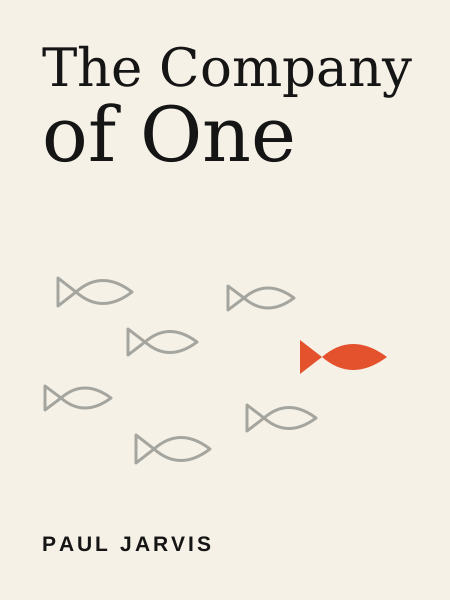
Company of One
Paul Jarvis · 2019
Editorial rating
- Evidence
- 6/10
- Actionability
- 7/10
- Originality
- 7/10
The thesis
Growth isn't the only measure of business success. A "company of one" questions expansion by default, stays small intentionally, and optimizes for autonomy, sustainability, and quality of life rather than scale.
Who this is for
Freelancers, solopreneurs, and small business owners who feel pressure to grow but suspect that bigger isn't actually better for them - people who want a sustainable business that serves their life, not consumes it.
My favorite quote
A company of one questions growth and stays small on purpose.
Why it matters
This directly challenges the default assumption in business culture that more is always better. It gives permission to define success on your own terms.
Do this
Define your "enough" - write down the specific revenue number at which you'd stop actively trying to grow and focus purely on maintaining.
Start here
Define your Minimum Viable Profit (MVP) - the smallest amount of money your business needs to generate for you to sustain your desired lifestyle. Work backward from this number rather than chasing arbitrary growth. Everything else is optional.
Critical summary
Paul Jarvis, a web designer turned course creator, writes the anti-growth manifesto for an era of unicorn worship and VC obsession. The core argument is simple: growth creates complexity, complexity creates problems, and problems consume the freedom you started a business to achieve.
A "company of one" isn't necessarily a solo operation - it's a mindset that questions whether growth is the right answer to every business challenge. Instead of asking "How can I get more customers?", a company of one asks "How can I serve existing customers better?" and "How can I become more efficient?"
What it gets right
- Validates an alternative path that many entrepreneurs secretly want
- Challenges the "grow or die" narrative with practical counterexamples
- Emphasizes resilience, autonomy, and sustainability over scale
- Good frameworks for thinking about customer relationships and trust
What it misses
- Light on specific tactics - more philosophy than playbook
- Examples skew heavily toward knowledge workers, online businesses, and the tech-adjacent
- Doesn't adequately address businesses where scale genuinely matters (manufacturing, some services)
- Some readers find it repetitive - could be 60% shorter
- The "staying small is the future of business" claims feel overstated
Evidence is primarily interviews with small business owners and Jarvis's own experience. No research studies, but the anecdotes are relevant and well-chosen.
Key concepts
Company of One Mindset
Question growth by default. Ask "why grow?" before "how to grow?"
Minimum Viable Profit (MVP)
The smallest revenue that sustains your desired lifestyle. Calculate this and work backward.
Upper Bound
Set a maximum size for your business, not just revenue goals. Know when "enough" arrives.
Scalable Systems
Invest in automation and processes that let you serve more customers without adding complexity.
Resilience Over Growth
Build a business that survives downturns rather than one that requires constant expansion.
Relationship-Driven Revenue
Profit from trust and repeat customers, not endless new customer acquisition.
Core insights
-
Growth is a choice, not an obligation
Most businesses can stay small and be highly profitable. Growth often destroys the freedom you started the business to achieve.
-
Profit beats revenue
A $300K business with 40% margins beats a $1M business with 5% margins - and with far less stress.
-
Your customer is your growth strategy
Serving existing customers exceptionally generates referrals and retention that outperform paid acquisition.
-
Complexity compounds
Every new hire, product, or market adds overhead that requires more growth to sustain.
-
Autonomy has a price
Staying small means saying no to opportunities. Know what you're trading and be at peace with it.
Implementation steps
Today
- Calculate your personal Minimum Viable Profit (monthly expenses × 12 + buffer)
- Write down why you started your business - was growth part of that original vision?
This week
- Audit your current offerings: which are complex to deliver? Which are simple and profitable?
- Identify one thing you could automate or systematize this week
This month
- Set an "upper bound" - a maximum revenue or team size you won't exceed intentionally
- Contact 3 existing customers for feedback on how to serve them better
Ongoing
- Before any expansion decision, ask: "Does this add complexity? Is it reversible? Does it serve my MVP?"
- Quarterly review: Is your business serving your life, or consuming it?
Suggested 30-day practice plan
An editorial application plan created by Monolithic Vault - an interpretation of the book's ideas, not part of the original book.
- Day 1
Calculate your Minimum Viable Profit number
- Day 2
Write your "why I started this business" statement
- Day 3
List all revenue streams, rank by profit margin and simplicity
- Day 7
Identify your top 3 customers by lifetime value - how can you deepen those relationships?
- Day 14
Automate one repetitive process (email sequences, invoicing, scheduling)
- Day 21
Set your upper bound - revenue cap, team size limit, or hours worked maximum
- Day 30
Create a "company of one" decision framework: questions to ask before any growth decision
Free PDF summary
Take this analysis with you: a designed two-page field-notes sheet with the thesis, my favorite quote, the key concepts and core insights, and the full 30-day checklist. Print it or keep it - free, no signup.
Go deeper
If this analysis earned your attention, the full book goes further than any summary can. The original is always the primary source.