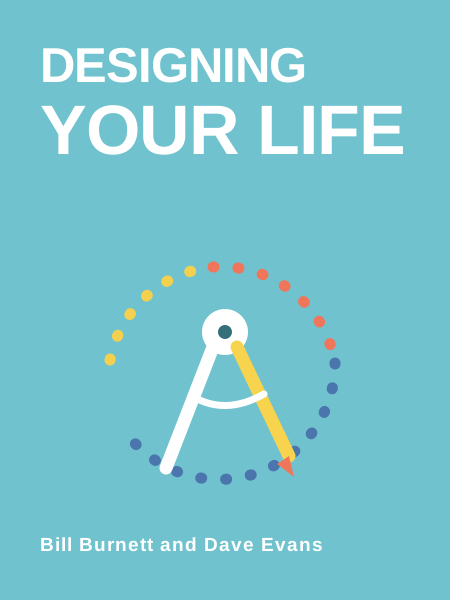
Designing Your Life
Bill Burnett & Dave Evans · 2016
Editorial rating
- Evidence
- 7/10
- Actionability
- 9/10
- Originality
- 8/10
The thesis
Life isn't a problem to be solved - it's a design project. Using the same design thinking principles that create great products, you can prototype multiple possible futures, test them cheaply, and iterate toward a fulfilling life rather than searching for the one "right" answer.
Who this is for
Mid-career professionals feeling stuck, recent graduates unsure of their path, and anyone facing a transition who's paralyzed by the question "What should I do with my life?"
My favorite quote
You can't know what you want until you know what you might want, so you are going to have to generate a lot of ideas and possibilities.
Why it matters
Most career advice assumes you should know what you want. This reframes uncertainty as normal and solvable through exploration, not introspection.
Do this
Instead of asking "What's my passion?", ask "What are three different lives I could live in the next five years?" Write rough sketches of each.
Start here
Create three Odyssey Plans - radically different five-year life scenarios you could pursue. Not slight variations, but genuinely distinct paths. This exercise breaks the paralysis of searching for the "one right answer" and opens up possibility space. Rate each on resources, confidence, and coherence.
Critical summary
Burnett and Evans, Stanford design professors, translate the design thinking methodology into life and career planning. Their course was Stanford's most popular elective, and the book captures its core exercises and philosophy.
The key insight is that "life design" is fundamentally different from "life planning." Planning assumes you know the destination and just need to map the route. Design assumes uncertainty - you're not sure what you want, you have multiple options, and the best way forward is rapid prototyping and iteration.
What it gets right
- Practical exercises that actually produce clarity (Odyssey Plans, Good Time Journal)
- Challenges the "follow your passion" dogma with research-backed alternatives
- Frames setbacks as "prototype failures," reducing shame around career experiments
- The workview/lifeview coherence concept helps identify value misalignments
What it misses
- Exercises require significant time investment - not everyone will complete them
- Stanford-centric worldview: assumes career flexibility and financial cushion most people don't have
- "Prototyping" life decisions works better for some careers than others (try "prototyping" medical school)
- Some concepts feel stretched from product design to life decisions
- Light on dealing with external constraints (family obligations, visa restrictions, financial pressures)
Evidence comes from their Stanford course experience with thousands of students, plus design thinking research. Not peer-reviewed, but grounded in established methodology.
Key concepts
Odyssey Plans
Three radically different 5-year life scenarios. Create them to break binary thinking about your future.
Good Time Journal
Track activities for energy and engagement (not just time). Reveals what actually energizes you versus what you think should.
Workview & Lifeview
Your philosophy of work and life. When these align, you have coherence. When they clash, you have a design problem.
Prototyping Conversations
Low-stakes ways to test a possible direction - informational interviews, shadowing, small experiments.
Reframing
The designer's tool for getting unstuck. "I don't have a good career" becomes "I haven't yet designed a career that fits."
Gravity Problems
Things you can't change (laws, physics, your age). Stop trying to solve them; accept and design around them.
Core insights
-
There is no "best" life waiting to be discovered
You don't find your life; you design it. Multiple good lives are possible.
-
Action precedes clarity
You can't think your way to an answer. Small experiments generate more insight than endless reflection.
-
Dysfunctional beliefs block progress
"I should know my passion by now" and "If I choose wrong I'll be stuck forever" are design blockers, not truths.
-
Energy engagement trumps hypothetical passion
Track what actually energizes you, not what you think should.
-
Failure is data, not disaster
Failed prototypes teach you what doesn't work, making the next iteration smarter.
Implementation steps
Today
- Draw a simple Work/Play/Love/Health dashboard (four gauges, each 0-100%). Where are you full? Where empty?
- Identify one "gravity problem" you've been trying to solve that you should accept and design around
This week
- Keep a Good Time Journal: track activities and note energy/engagement levels
- Write a draft of your Workview (why you work) and Lifeview (why you live)
This month
- Complete three Odyssey Plans - genuinely different 5-year scenarios
- Have 3 "prototyping conversations" (informational interviews) for your most intriguing Odyssey Plan
Ongoing
- Review and iterate your Odyssey Plans quarterly
- Default to "bias toward action" - when stuck, prototype rather than analyze
Suggested 30-day practice plan
An editorial application plan created by Monolithic Vault - an interpretation of the book's ideas, not part of the original book.
- Day 1
Complete the Work/Play/Love/Health dashboard assessment
- Day 2
Begin Good Time Journal - track activities and energy levels daily
- Day 3
Write first draft of your Workview (250 words on why you work, what work means)
- Day 7
Write your Lifeview; compare with Workview - where do they align or clash?
- Day 14
Create three Odyssey Plans (5-year life scenarios, with resource/confidence/coherence ratings)
- Day 21
Schedule and complete first prototyping conversation for your favorite Odyssey Plan
- Day 30
Reflect on learnings, identify next prototype to test, update Odyssey Plans based on new data
Free PDF summary
Take this analysis with you: a designed two-page field-notes sheet with the thesis, my favorite quote, the key concepts and core insights, and the full 30-day checklist. Print it or keep it - free, no signup.
Go deeper
If this analysis earned your attention, the full book goes further than any summary can. The original is always the primary source.