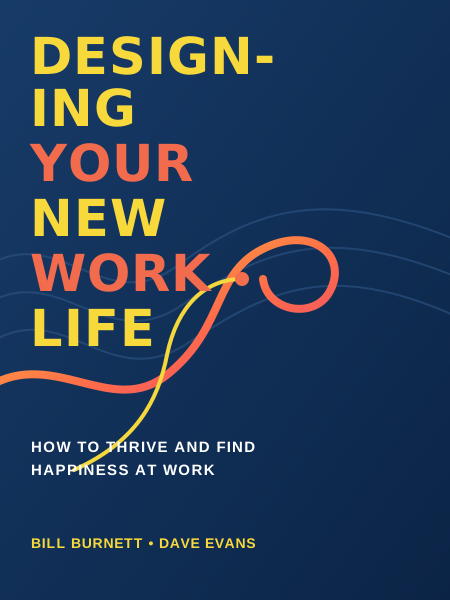
Designing Your Work Life
Bill Burnett, Dave Evans · 2020
Editorial rating
- Evidence
- 5/10
- Actionability
- 9/10
- Originality
- 6/10
The thesis
You don't have to quit your job to love your work. Using design thinking - curiosity, reframing, prototyping - you can transform your current job into something more meaningful. Stop analyzing and complaining; start building your way forward through small experiments.
Who this is for
Professionals who are frustrated with their current job but not ready (or able) to quit. Anyone who read "Designing Your Life" but found it assumed a blank slate they don't have.
My favorite quote
Designers don't analyze, worry, think, complain their way forward; they build their way forward.
Why it matters
This captures the core shift: from passive rumination to active experimentation. Most career advice stops at "figure out what you want." Design thinking starts with "try something and learn."
Do this
Identify one thing bothering you at work. Instead of analyzing why, design a small experiment to change it this week.
Start here
"Good enough for now": Stop waiting for the perfect job or the perfect moment to be happy. Reframe your current situation as "good enough for now" - this isn't settling, it's creating the emotional space to experiment. From that platform, you can prototype your way to something better without the pressure of needing everything to change immediately.
Critical summary
Burnett and Evans, Stanford design professors and authors of the bestselling "Designing Your Life," wrote this sequel for people already in jobs. Where the first book assumed you could redesign everything, this one works within constraints: your current employer, your financial obligations, your life stage.
The core framework applies design thinking to work satisfaction. Five mindsets - Curiosity, Reframing, Radical Collaboration, Awareness, Bias to Action - drive the approach. The book provides tools for diagnosing dissatisfaction, reframing problems, and prototyping improvements.
What it gets right
- Addresses the gap left by the first book (what if you can't start over?)
- "Good enough for now" is a genuinely powerful reframe
- Practical exercises throughout
- Acknowledges workplace politics and power dynamics
What it misses
- Ideas aren't revolutionary - reframing and prototyping are well-established
- Some situations genuinely require quitting, not redesigning
- Silicon Valley privilege shows through in some examples
- Can feel repetitive if you've read similar books
Evidence is primarily from their Stanford course and consulting experience. Well-tested but not rigorously researched.
Key concepts
Good Enough for Now (GEFN)
Accepting your current situation as workable - not ideal, but sufficient to experiment from. Creates space for change rather than desperation.
Workview + Lifeview Coherence
Your beliefs about work should align with your beliefs about life. Incoherence creates persistent dissatisfaction.
Minimum Actionable Problem (MAP)
Reframe overwhelming situations into the smallest problem you can actually do something about.
Designer Mindsets
Curiosity, Reframing, Radical Collaboration, Awareness, Bias to Action, Storytelling. Mental postures that enable creative problem-solving.
Good Work Journal
Daily tracking of what energizes and drains you. Data for redesigning your role.
Odyssey Plans
Three alternative five-year visions of your life. Forces you to see options you're ignoring.
Core insights
-
You can redesign your job without quitting
Most people assume change requires leaving. Often, the same role can be reshaped through conversations, experiments, and reframes.
-
"Good enough" is a starting point, not surrender
From a stable platform, you can take risks. From desperation, every experiment feels like life or death.
-
Problems are often misdiagnosed
The thing bothering you might not be the actual problem. Reframing to find the Minimum Actionable Problem prevents wasted effort.
-
Autonomy is designable
Even in constrained environments, there are usually more degrees of freedom than you realize. Find them and use them.
-
The art of quitting matters
If you do leave, do it well. Leave the campsite better than you found it. Your reputation travels with you.
Implementation steps
Today
- Start a Good Work Journal: note one energizing moment and one draining moment from today
- Identify your biggest work complaint and reframe it as a MAP
This week
- Write your Workview (what work is for) and Lifeview (what makes life worthwhile) - are they coherent?
- Design one small experiment to test a change in your current role
This month
- Create three Odyssey Plans: current path extrapolated, radical alternative, wild card
- Have a "radical collaboration" conversation with a trusted colleague about redesigning your role
Ongoing
- Weekly Good Work Journal review: what patterns are emerging?
- When frustrated, ask: what's the smallest thing I could change?
Suggested 30-day practice plan
An editorial application plan created by Monolithic Vault - an interpretation of the book's ideas, not part of the original book.
- Day 1
Start Good Work Journal - track energy highs and lows
- Day 2
Write your Workview (one paragraph on what work means to you)
- Day 3
Write your Lifeview (one paragraph on what makes life worthwhile)
- Day 7
Identify incoherence between Workview and Lifeview; note where they conflict
- Day 14
Create three Odyssey Plans (current path, alternative, wild card)
- Day 21
Design and run one small experiment to improve your current role
- Day 30
Review journal and experiments; decide next moves
Free PDF summary
Take this analysis with you: a designed two-page field-notes sheet with the thesis, my favorite quote, the key concepts and core insights, and the full 30-day checklist. Print it or keep it - free, no signup.
Go deeper
If this analysis earned your attention, the full book goes further than any summary can. The original is always the primary source.