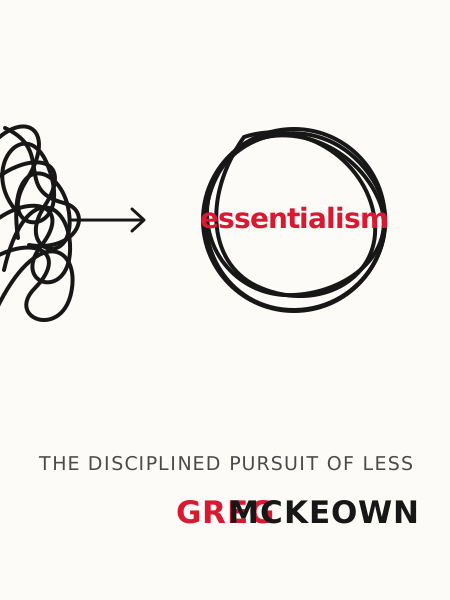
Essentialism
Greg McKeown · 2014
Editorial rating
- Evidence
- 7/10
- Actionability
- 9/10
- Originality
- 9/10
The thesis
Most people are drowning in the "undisciplined pursuit of more," leading to dispersed energy and minimal progress. Essentialism is the disciplined pursuit of "less but better" - systematically rejecting the "trivial many" to make the highest possible contribution to the "vital few" things that truly matter.
Who this is for
High performers who feel "stretched too thin" but not productive. Managers who struggle to say "no" to new projects. Anyone whose day is hijacked by other people's agendas because they fear missing out or disappointing others.
My favorite quote
If you don't prioritize your life, someone else will.
Why it matters
It reveals the hidden cost of passivity; your time will be filled regardless, either by your design or by others' demands.
Do this
Look at your calendar for next week and delete one commitment that you agreed to out of guilt, not purpose.
Start here
Apply the 90% Rule to every decision. When evaluating an opportunity (a project, a client, a social event), rate it from 0 to 100. If it falls below 90, it is a zero. Reject it. There is no "70 out of 100." By eliminating the "good" opportunities, you free up massive resources for the "great" ones.
Critical summary
McKeown attacks the modern assumption that "I can do it all" is a badge of honor. He argues this mindset leads to the "Paradox of Success": success leads to more options, which leads to diffused effort, which undermines the very focus that created the success in the first place.
The framework is built on three phases:
- Explore: Distinguish the vital few from the trivial many. (You must create space to think).
- Eliminate: Cut the non-essentials. (You must dare to say "no" gracefully).
- Execute: Remove obstacles so the essential things happen effortlessly. (You must build routines).
What it gets right
- The Trade-off Reality: He forces readers to admit that "I can do both" is usually a lie. Every "yes" is a "no" to something else.
- The "Sunk Cost" Trap: He provides tools for uncommitting from projects that no longer make sense, a rare skill in business.
- JOMO: He championed the "Joy of Missing Out" before it was trendy, reframing "No" as a leadership tool rather than a weakness.
What it misses
- Privilege Blindness: The advice to "just say no" assumes a level of career autonomy that junior employees or gig workers often don't have.
- Implementation Friction: It underestimates the social cost of being an Essentialist in a "Non-Essentialist" corporate culture (e.g., refusing meetings can get you fired).
- Repetitive Examples: Relies heavily on familiar anecdotes (Rosa Parks, Warren Buffett) that sometimes feel retrofitted to the theory.
Key concepts
The Paradox of Success
The more successful you become, the more opportunities you get, which distracts you from what made you successful.
The 90% Rule
If it’s not a clear YES (90+), then it’s a clear NO. Eliminate "good" to make room for "great."
The Quarter-Life Audit
A regular review to check if your current ladder is leaning against the right wall.
Buffer
The practice of adding 50% to your time estimates. Non-essentialists assume best-case scenarios; Essentialists prepare for the worst.
Reverse Pilot
Testing whether you can remove a recurring commitment (like a meeting) by stopping it quietly and seeing if anyone notices.
Graceful "No"
Techniques to decline without burning bridges (e.g., "I can't do this, but I can do [smaller offer]").
Core insights
-
Choice is an action, not a thing
You cannot "have" options; you "exercise" choice. When you forget you have a choice, you learn helplessness.
-
"Priority" was singular for 500 years
The word meant "the very first thing." Only in the 1900s did we pluralize it to "priorities," deluding ourselves that multiple things can be "first."
-
To influence, you must be unavailable
If you are always accessible, your time has no value. Scarcity drives respect.
-
Sleep is an asset, not a liability
Essentialists treat sleep as a productivity tool (protecting the asset) rather than a barrier to getting things done.
-
Clarity equals speed
When a team doesn't know exactly what the goal is, they waste energy on politics and "looking busy." Clarity cuts the waste.
Implementation steps
Today
- The "Hell Yeah" Audit: Look at your to-do list. Mark anything that isn't a "Hell Yeah!" (90/100). Cross them out or delegate them immediately.
- Calendar Block: Schedule 1 hour this week for "Thinking Time" with zero agenda.
This week
- The "Reverse Pilot": Pick one recurring meeting or report. Stop doing it / attending it. See if anyone complains. If not, kill it permanently.
- Implement a Buffer: Add 50% buffer time to your 3 most important tasks.
This month
- The Social Edit: Identify one social obligation you do out of guilt. Send a polite "No" for the next invite using the "Soft No" script ("I'm heads-down on a project right now, but thanks for thinking of me").
- Sleep Protection: Set a "reverse alarm clock" for bedtime to ensure 8 hours of sleep for 7 days straight.
Ongoing
- Quarterly Personal Offsite: Take one day every 90 days to review your "Essential Intent" for the next quarter.
- The "One In, One Out" Rule: Never take on a new project without explicitly killing an old one.
Suggested 30-day practice plan
An editorial application plan created by Monolithic Vault - an interpretation of the book's ideas, not part of the original book.
- Day 1
Define your "Essential Intent" (one single goal for the next 3 months).
- Day 2
Conduct a "Hell Yeah" audit of your calendar commitments.
- Day 3
Send your first "Graceful No" to a request.
- Day 7
Review your "Thinking Time" block - did you protect it?
- Day 14
Execute a "Reverse Pilot" on a low-value work meeting.
- Day 21
Create a "No" email template library to make declining easier.
- Day 30
Evaluate your "Essential Intent" progress. Did cutting the noise increase your signal?
Free PDF summary
Take this analysis with you: a designed two-page field-notes sheet with the thesis, my favorite quote, the key concepts and core insights, and the full 30-day checklist. Print it or keep it - free, no signup.
Go deeper
If this analysis earned your attention, the full book goes further than any summary can. The original is always the primary source.