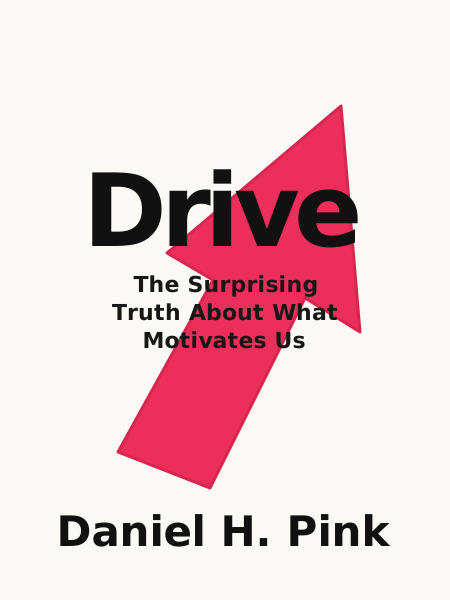
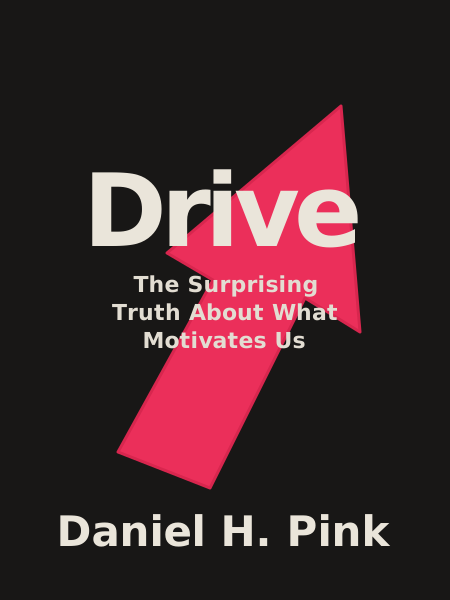
Drive
Daniel Pink · 2009
Editorial rating
- Evidence
- 8/10
- Actionability
- 7/10
- Originality
- 7/10
The thesis
Carrots and sticks are obsolete for 21st-century work. For creative, cognitive tasks, extrinsic rewards (money, bonuses) often backfire - diminishing performance, crushing creativity, and crowding out intrinsic motivation. What actually drives high performance is autonomy (control over your work), mastery (getting better at something that matters), and purpose (contributing to something larger than yourself).
Who this is for
Managers still relying on bonuses to motivate knowledge workers, leaders wondering why their incentive programs aren't working, and individuals trying to understand why they feel unmotivated despite good pay.
My favorite quote
The secret to high performance isn't rewards and punishments, but that unseen intrinsic drive - the drive to do things for their own sake. The drive to do things because they matter.
Why it matters
This reframes motivation from something you impose on people to something you unlock within them.
Do this
Identify one task you're dreading. Ask: What would make this inherently interesting? Can you add autonomy, a learning goal, or connect it to purpose?
Start here
Pay enough to take money off the table, then focus on autonomy: Once compensation is fair and comparable, more money doesn't improve performance for cognitive work - it can actually hurt it. Instead, give people autonomy over the four T's: Task (what they do), Time (when they do it), Technique (how they do it), and Team (who they do it with). Google's 20% time produced Gmail and Google News.
Critical summary
Pink synthesizes decades of motivation research - particularly Edward Deci and Richard Ryan's Self-Determination Theory - into an accessible business book. The core argument: extrinsic motivation works for routine, algorithmic tasks, but backfires for creative, heuristic work.
What it gets right
- Clear distinction between algorithmic vs. heuristic work
- Seven deadly flaws of carrots and sticks are well-documented
- Autonomy, Mastery, Purpose framework is memorable and actionable
- Extensive toolkit at the end with practical exercises
- RSA Animate video is one of the best book summaries ever made
What it misses
- Type I/Type X terminology feels forced and gimmicky
- Less guidance on hybrid organizations (routine AND creative work)
- Some examples (Google 20% time) have since been scaled back or abandoned
- Doesn't adequately address the "relatedness" aspect from original SDT research
- Can feel like an extended magazine article - core ideas could be shorter
Evidence is solid - draws on peer-reviewed psychology research, MIT studies, and business case studies. But some critics note Pink oversimplifies SDT.
Key concepts
Motivation 2.0
Carrot-and-stick, extrinsic rewards. Works for routine tasks, fails for creative work.
Motivation 3.0
Intrinsic motivation powered by autonomy, mastery, and purpose.
Algorithmic vs. Heuristic Tasks
Algorithmic = follow instructions. Heuristic = figure it out. Different motivation strategies for each.
Type I vs. Type X
Type I = intrinsically motivated. Type X = extrinsically motivated. (Terminology critics find gimmicky.)
Flow
Csikszentmihalyi's concept of optimal experience - when challenge matches skill.
ROWE
Results-Only Work Environment - judge by output, not hours.
Core insights
-
Rewards narrow focus
Good for simple tasks, bad for creative ones. The "reward" makes you focus on getting the reward, not solving the problem.
-
Autonomy is not independence
It's having choice within constraints. You can have autonomy while working closely with others.
-
Mastery is a mindset
Believing intelligence is fixed vs. growable predicts whether you pursue mastery or avoid challenges.
-
Purpose is the context
Autonomy and mastery need purpose to make sense. "Why does this matter?"
-
If-then rewards work for boring tasks
The key is knowing which type of work you're dealing with.
-
Money motivates - up to a point
Once baseline needs are met, more money has diminishing returns for cognitive work.
Implementation steps
Today
- Identify one task where you could give yourself (or your team) more autonomy over how it's done
- Ask yourself: What part of my work puts me in flow?
This week
- Give someone a "now that" reward (unexpected bonus after good work) instead of "if-then" (promised bonus for hitting target)
- Set a learning goal instead of a performance goal for one project
This month
- Experiment with 20% time (or even 10%) for one project or team member
- Connect one tedious task to a larger purpose
Ongoing
- Default to autonomy unless there's a specific reason to control
- Ask regularly: Is this work algorithmic or heuristic? Adjust motivation strategy accordingly.
Suggested 30-day practice plan
An editorial application plan created by Monolithic Vault - an interpretation of the book's ideas, not part of the original book.
- Day 1
Audit your current motivation tactics. How many are extrinsic?
- Day 2
Identify one area where you can increase autonomy (task, time, technique, or team)
- Day 3
Set a learning goal instead of a performance goal
- Day 7
Experiment: Remove one "if-then" reward. What happens?
- Day 14
Connect a routine task to a larger purpose. Does engagement change?
- Day 21
Create a "flow-friendly" block in your calendar - uninterrupted time for challenging work
- Day 30
Reflect: What changed? What motivates you that you weren't acknowledging?
Free PDF summary
Take this analysis with you: a designed two-page field-notes sheet with the thesis, my favorite quote, the key concepts and core insights, and the full 30-day checklist. Print it or keep it - free, no signup.
Go deeper
If this analysis earned your attention, the full book goes further than any summary can. The original is always the primary source.