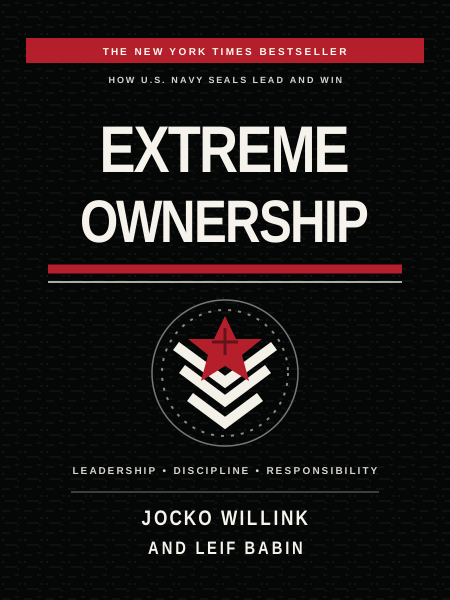
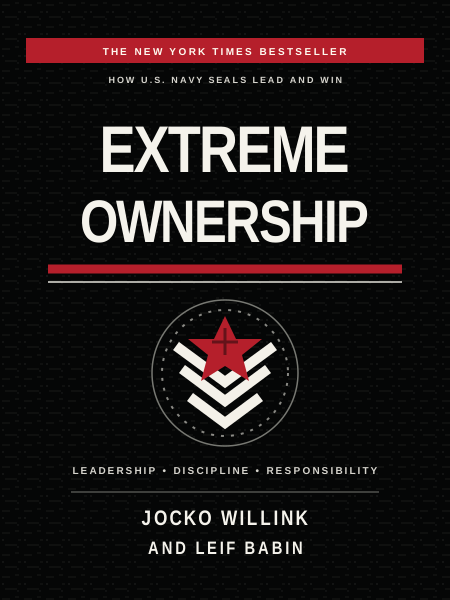
Extreme Ownership
Jocko Willink & Leif Babin · 2015
Editorial rating
- Evidence
- 6/10
- Actionability
- 9/10
- Originality
- 6/10
The thesis
There are no bad teams, only bad leaders. Leaders must own everything in their world - every failure, every setback, every excuse their team might make. When you take 100% responsibility for outcomes, you gain 100% power to change them.
Who this is for
Leaders frustrated by underperforming teams, managers struggling with accountability cultures, and anyone who finds themselves blaming circumstances or other people for their results.
My favorite quote
The leader is truly and ultimately responsible for everything. That is Extreme Ownership.
Why it matters
Most leaders share blame, make excuses, or point to circumstances. This reframes leadership as total accountability - uncomfortable but liberating.
Do this
Think of your biggest current challenge. Ask: "What could I have done differently to prevent this?" Own it.
Start here
There are no bad teams, only bad leaders: When a team underperforms, the leader's job is not to blame the team - it's to examine what they failed to communicate, train, or align. The moment you take full ownership of outcomes, you gain the power to change them. No more waiting for circumstances to improve.
Critical summary
Willink and Babin, former Navy SEAL commanders who led Task Unit Bruiser during the Battle of Ramadi, translate combat leadership lessons into business principles. Each chapter pairs a war story with a business application.
What it gets right
- Radical accountability creates agency - blaming kills it
- "Cover and Move" teamwork as a universal principle
- Decentralized command: push decisions down to where information lives
- Simple, memorable frameworks (Check the Ego, Prioritize and Execute)
- Visceral, engaging war stories that make principles stick
What it misses
- Military context doesn't fully translate (higher compliance baseline, clearer hierarchy)
- SEALs are elite, highly trained - most business teams aren't
- "Extreme" ownership can veer into martyrdom or burnout
- Limited discussion of systemic issues leaders genuinely can't control
- The Iraq War context is controversial - "winning" is debatable
Evidence is primarily Willink and Babin's personal experience. Combat-tested but not experimentally validated in business contexts.
Key concepts
Extreme Ownership
Take 100% responsibility for everything in your domain. No excuses, no blame. In your next failure, ask "What could I have done differently?"
No Bad Teams, Only Bad Leaders
Team performance is a leadership outcome. If they're failing, look in the mirror.
Cover and Move
Teams must support each other. Your success depends on others' success. Never operate in isolation.
Decentralized Command
Push decisions down. Leaders can't be everywhere - empower people with the "why" and let them execute.
Prioritize and Execute
When overwhelmed, prioritize the most critical issue. Execute. Then move to the next. Don't try to do everything at once.
Leading Up and Down the Chain
Leadership isn't just down - you must also influence upward, keeping superiors informed and aligned.
Core insights
-
Blame destroys power
The moment you blame someone else, you've given away your ability to fix the problem.
-
Ego is the enemy
Combat has no room for ego. Business shouldn't either. Check it before it undermines the team.
-
Belief must come first
If you don't believe in the mission, you can't lead others to execute it. Get clarity before acting.
-
Simplicity wins
Complex plans fail in chaos. Keep plans simple and communicate them clearly.
-
Discipline equals freedom
Rigid discipline in fundamentals creates freedom to adapt when situations change.
-
Default aggressive
Take initiative. Waiting for permission or perfect information often costs more than acting.
Implementation steps
Today
- Identify one failure you've blamed on others. Reframe: What could YOU have done differently?
- Ask yourself: "What one thing, if I took ownership of it, would most change my results?"
This week
- In a team meeting, own a recent failure publicly - model accountability
- Identify where you need to "lead up" - what does your boss need from you that you're not providing?
This month
- Audit decision-making: Where are you the bottleneck? What can you push down?
- Simplify one process or plan that's become too complex
Ongoing
- After every setback, ask: "What's my ownership here?"
- When overwhelmed: Prioritize the most critical issue, execute, move to the next
Suggested 30-day practice plan
An editorial application plan created by Monolithic Vault - an interpretation of the book's ideas, not part of the original book.
- Day 1
List three recent failures. For each, write what you could have done differently.
- Day 2
Identify one decision you make that someone else could make with proper context
- Day 3
Delegate that decision - provide the "why" and let them execute
- Day 7
Own one mistake publicly with your team
- Day 14
Simplify one plan or process - remove complexity
- Day 21
Review where you've blamed circumstances. Reframe to ownership.
- Day 30
Reflect: Has your sense of control increased? What's still hard to own?
Free PDF summary
Take this analysis with you: a designed two-page field-notes sheet with the thesis, my favorite quote, the key concepts and core insights, and the full 30-day checklist. Print it or keep it - free, no signup.
Go deeper
If this analysis earned your attention, the full book goes further than any summary can. The original is always the primary source.