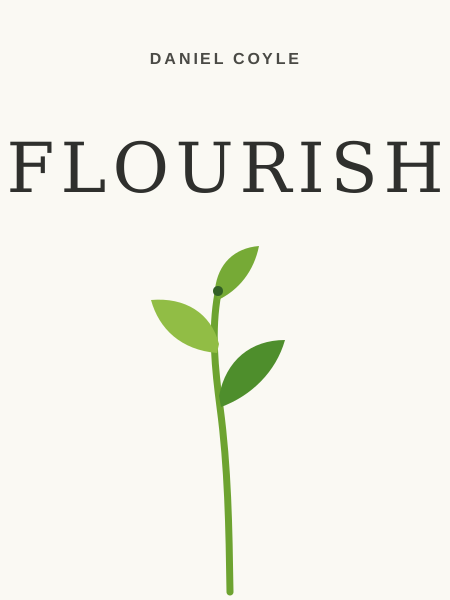
Flourish
Daniel Coyle · 2026
Editorial rating
- Evidence
- 5/10
- Actionability
- 6/10
- Originality
- 5/10
The thesis
Flourishing groups and individuals share two behaviors: they make meaning through deep, present-moment connection, and they build community by channeling those connections into shared action.
Who this is for
Leaders and consultants trying to build genuine team cohesion beyond superficial culture initiatives, and anyone successful on paper but privately asking "is this it?"
My favorite quote
Flourishing isn't something we find, it's something we create.
Why it matters
It reframes fulfillment as a practice you build rather than a state you stumble into, useful language when a client team feels burnt out despite strong results.
Do this
Identify one recurring group interaction (a standup, a client kickoff) and add one deliberate moment of "presence," full attention, no phones, before moving to the agenda.
Start here
Practice "presence" before "productivity" in group settings. Coyle's research suggests that groups which pause to genuinely notice and attend to each other, before jumping into tasks, build the kind of connection that later translates into what he calls "group flow." Skipping straight to the agenda is the default mistake.
Critical summary
Coyle, known for "The Culture Code" and "The Talent Code," turns his attention from talent and team performance to a broader question: what makes a life, relationship, or community actually flourish. He spent five years reporting on groups that demonstrate exceptional connectivity, thirty-three Chilean miners trapped underground for 33 days, a small Michigan deli that grew into a $90 million business ecosystem, a Dutch soccer team, a Paris neighborhood, and distills two recurring dynamics: presence (open, responsive attention) and group flow (channeling relationships into shared action toward a common good).
What the book does well: Coyle is one of the more skilled narrative nonfiction writers in this space, the Chilean miners and the Michigan deli stories are genuinely compelling and retellable in a client workshop. Endorsements from Charles Duhigg, Daniel Pink, and Sheila Heen point to a book that lands emotionally, and the "presence, then group flow" framing is simple enough to actually apply in a team setting without extensive training.
Where it falls short: an early, thoughtful Goodreads reviewer puts it precisely, the book's attempt to break down the components of flourishing "end up with rather indistinct concepts," and it doesn't seriously interrogate why these examples of flourishing aren't more easily replicated. If a close-knit, supportive community really were the main ingredient behind a small town producing world-class athletes, or an unconventional lab environment reliably sparking cross-disciplinary breakthroughs, you'd expect to see many more of both. The book doesn't grapple with this survivorship-bias problem, it selects for groups that already flourished and works backward to a tidy two-factor explanation, rather than testing the theory against groups that had similar conditions but didn't flourish. It's also worth noting the book leans heavily on a personal loss and reckoning as its narrative frame, which makes for compelling reading but blurs the line between memoir and evidence-based framework more than "The Culture Code" did.
Key concepts
Presence
Open, responsive attention to others in the moment, the foundation dynamic behind flourishing groups. Build a deliberate presence check-in before diving into a meeting agenda.
Group Flow
Channeling genuine connection into shared, purposeful action toward a common good. Distinct from simple collaboration, it requires presence first.
Awakening Cues
Moments that shift attention toward something larger than routine, creating openness to uncertainty and connection. Identify what naturally creates these moments in your own team or client relationships.
Attentional Space Design
Some organizations (like the Michigan deli in the book) grow not through business plans but by deliberately shaping how people show up, listen, and engage. Worth testing in client culture work, but treat as a hypothesis, not a proven mechanism.
The Replicability Gap
The book's own unexamined weakness, if presence and group flow were sufficient explanations, similar conditions should reliably reproduce similar results, and they don't. Use this as a check on your own enthusiasm before recommending the framework wholesale to a client.
Core insights
-
Presence before productivity
Groups that pause to genuinely attend to each other before tasking up build deeper trust. Consequence: build a short presence ritual into recurring team or client meetings.
-
Meaning-making is relational, not individual
Flourishing happens in connection, not in isolated self-improvement. Relevant when a client's wellness initiatives focus only on individuals rather than group dynamics.
-
Shared action, not shared feeling, is what sustains community
Group flow requires channeling connection into concrete common goals, not just bonding for its own sake.
-
The book doesn't explain the exceptions
For every flourishing example, there are unexamined cases with similar conditions that didn't flourish. Don't present the framework to clients as a guaranteed formula.
-
Personal narrative and evidence are blended here more than usual
Useful for engagement and storytelling, but keep a clear line in your own use of the material between "compelling story" and "tested mechanism."
Implementation steps
Today
- Add one deliberate presence moment, no phones, full attention, before your next team meeting's agenda starts.
- Identify one relationship or team where connection has been reduced to pure task-coordination.
This week
- Test an "awakening cue" in a client workshop, something that shifts attention beyond routine before diving into content.
- Notice whether presence-first meetings change the quality of decisions made afterward.
This month
- Design one recurring ritual that channels team connection into shared action (group flow), not just bonding.
- Discuss the replicability gap explicitly with a client considering a "culture flourishing" initiative, what conditions are actually unique to their situation?
Ongoing
- Track whether presence-based practices sustain themselves once the novelty wears off, or whether they require ongoing facilitation to work.
Suggested 30-day practice plan
An editorial application plan created by Monolithic Vault - an interpretation of the book's ideas, not part of the original book.
- Day 1
Read the chapters on presence and group flow, and identify one team to test the concepts with.
- Day 3
Add a presence ritual to one recurring meeting.
- Day 7
Test an awakening cue in a workshop or client session.
- Day 14
Design a shared-action ritual that channels connection into a common goal.
- Day 21
Discuss the replicability gap with a client or colleague before scaling the approach.
- Day 30
Evaluate whether the practices changed team dynamics, or mainly changed how people described the team.
Free PDF summary
Take this analysis with you: a designed two-page field-notes sheet with the thesis, my favorite quote, the key concepts and core insights, and the full 30-day checklist. Print it or keep it - free, no signup.
Go deeper
If this analysis earned your attention, the full book goes further than any summary can. The original is always the primary source.