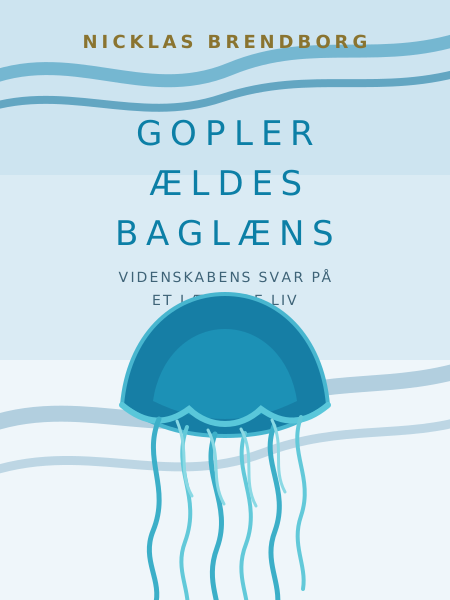

Gopler ældes baglæns
Nicklas Brendborg · 2021
Editorial rating
- Evidence
- 8/10
- Actionability
- 7/10
- Originality
- 8/10
The thesis
Aging is a biological process with mechanisms that can be influenced, not a single clock that simply runs down. Nature and laboratory research reveal real levers, but the safest human gains still come mostly from ordinary health behaviors rather than experimental anti-aging tricks.
Who this is for
Readers curious about longevity science, health professionals wanting an entertaining field overview, biohackers tempted by premature interventions, and people who want to separate useful prevention from immortality marketing.
My favorite quote
Særligt for træer findes aldring faktisk slet ikke.
Why it matters
Human aging feels universal only because we judge biology from one unusually narrow example: ourselves.
Do this
Replace one anti-aging purchase with a proven health action such as exercise, vaccination, sleep, or stopping smoking.
Start here
Separate fascinating mechanisms from decisions you should make now. Treat animal longevity, cellular rejuvenation, fasting, blood donation, and anti-aging drugs as different evidence classes, then give priority to interventions with strong human outcome data and low downside.
Critical summary
Nicklas Brendborg wrote Gopler ældes baglæns while trained in molecular biomedicine and biotechnology, using comparative biology to make aging research feel less inevitable and less human-centered. The book moves through three layers. First come organisms that challenge ordinary assumptions: trees that show negligible senescence, Greenland sharks living for centuries, naked mole rats resisting several age-related failures, and Turritopsis jellyfish returning from an adult stage to a juvenile one. Second come mechanisms and experiments. Brendborg explains how evolution trades maintenance against reproduction, how cellular damage accumulates, why senescent zombie cells can harm surrounding tissue, and how stress responses such as hormesis and nutrient sensing may influence longevity. Calorie restriction, fasting, rapamycin, metformin, blood factors, genetic interventions, and senolytics enter as clues rather than settled cures. Third comes the personal layer, where a longer healthy life rests on less exotic choices: avoid smoking, exercise, maintain social relationships, protect oral health, use vaccines, eat reasonably, and avoid turning optimization into a new disease. The result is part natural history, part laboratory tour, and part health guide.
What it gets right
- Uses long-lived and unusual organisms to show that aging is biologically variable rather than a simple universal countdown
- Explains difficult molecular ideas through memorable stories without pretending that one mechanism explains the entire process
- Distinguishes established lifestyle basics from the speculative frontier more carefully than the anti-aging industry usually does
What it overstates or misses
- Animal lifespan extensions and cellular results can sound closer to useful human treatments than the evidence currently permits
- Practical recommendations mix strong causal evidence with weaker observational links and plausible but unsettled interventions
- The costs, inequality, ageism, population effects, and existential consequences of radical life extension receive limited attention
The scientific foundation is substantial for popular science, and the book was praised by medical reviewers for its breadth and clarity. Still, aging research is full of surrogate markers, model organisms, short trials, and commercial incentives, so a compelling mechanism is not the same as longer human life. The strongest lesson is epistemic: sort evidence before sorting supplements. The verdict: an excellent map of longevity science that becomes dangerous only when a reader mistakes the frontier for a pharmacy.
Key concepts
Negligible Senescence
Some organisms show little increase in mortality or functional decline with age, proving that human-style aging is not biologically universal.
Cellular Senescence
Damaged cells can stop dividing yet remain active, releasing inflammatory signals that harm nearby tissue and contribute to disease.
Hormesis
Limited stress from exercise, fasting, heat, cold, or other challenges can activate protective repair systems, while excessive stress causes damage.
Nutrient Sensing
Pathways involving insulin, AMPK, sirtuins, and mTOR connect available energy with growth, repair, reproduction, and aging.
Healthspan
The useful target is more years with physical and cognitive function, not merely extending the period a body remains alive.
Core insights
-
Aging Is Not One Mechanism
Damage, metabolism, inflammation, cellular communication, and evolution interact, so a single miracle target is unlikely.
-
Nature Expands the Possible
Long-lived species reveal biological solutions worth studying, but copying one trait across species is rarely straightforward.
-
Mechanisms Are Not Recommendations
A molecule that extends mouse life does not automatically justify a healthy person taking it.
-
Ordinary Prevention Still Dominates
Smoking, inactivity, infection, poor metabolic health, and isolation matter more today than most experimental longevity tools.
-
Optimization Can Consume the Life It Protects
A longer life has little value if fear, restriction, and constant measurement make the present one smaller.
Implementation steps
Today
- List every longevity practice or supplement you use and mark whether its support comes from human outcomes, biomarkers, animal studies, or anecdotes.
- Choose one proven action to perform today, such as vigorous walking, strength work, vaccination booking, flossing, or calling a friend.
This week
- Build a simple health baseline covering smoking, movement, sleep, blood pressure, social connection, diet quality, and preventive care.
- Remove one expensive or risky intervention whose expected benefit depends mainly on animal or laboratory evidence.
This month
- Create a sustainable exercise plan combining aerobic activity and strength work, adjusted for health status and professional guidance where needed.
- Arrange overdue preventive care such as dental treatment, vaccination, blood pressure measurement, or a clinician-recommended screening.
Ongoing
- Reassess longevity claims by evidence level, effect size, human relevance, cost, and potential harm before changing behavior.
- Protect healthspan without sacrificing relationships, pleasure, and meaning to an endless project of avoiding age.
Suggested 30-day practice plan
An editorial application plan created by Monolithic Vault - an interpretation of the book's ideas, not part of the original book.
- Day 1
Audit current longevity habits and label the evidence behind each one.
- Day 3
Choose two high-confidence basics and schedule them repeatedly for the next four weeks.
- Day 7
Measure a useful baseline such as weekly activity, resting blood pressure, sleep regularity, or smoking exposure.
- Day 14
Review one tempting experimental intervention and write the strongest evidence against using it now.
- Day 21
Complete one preventive health action that has been delayed, including dental or vaccination care where relevant.
- Day 30
Keep the few practices that improved health without making daily life narrower, anxious, or needlessly expensive.
Free PDF summary
Take this analysis with you: a designed two-page field-notes sheet with the thesis, my favorite quote, the key concepts and core insights, and the full 30-day checklist. Print it or keep it - free, no signup.
Go deeper
If this analysis earned your attention, the full book goes further than any summary can. The original is always the primary source.