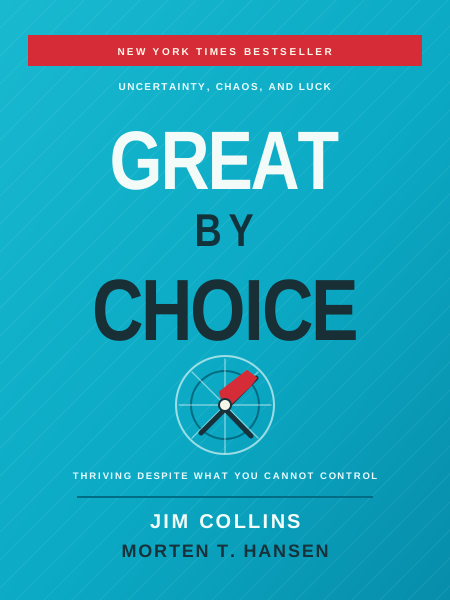
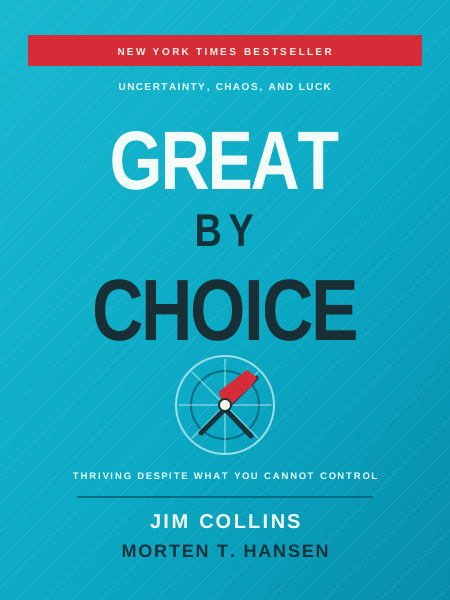
Great by Choice
Jim Collins & Morten Hansen · 2011
Editorial rating
- Evidence
- 7/10
- Actionability
- 8/10
- Originality
- 7/10
The thesis
Thriving in chaos isn't about being bolder, more visionary, or more innovative than competitors - it's about fanatic discipline, empirical creativity, and productive paranoia. Companies that beat their industry by 10X don't take more risks; they prepare relentlessly, march consistently, and test before betting big.
Who this is for
Leaders navigating volatile industries or uncertain environments, executives who assume innovation and boldness are the keys to success, and anyone who wants research-backed principles for building durable companies in turbulent times.
My favorite quote
The signature of mediocrity is not an unwillingness to change; the signature of mediocrity is chronic inconsistency.
Why it matters
Most failures aren't from lack of ambition but from lurching between strategies. Consistency in execution beats brilliance in conception.
Do this
Define your "20-Mile March" - a specific performance target you'll hit consistently, regardless of conditions.
Start here
Practice the 20-Mile March: Set a specific, measurable performance target and hit it consistently - in good times and bad. When conditions are favorable, don't overextend. When conditions are harsh, don't retreat. Amundsen reached the South Pole by marching 15-20 miles daily regardless of weather. Scott's team pushed hard on good days and rested on bad ones - and died. Consistency beats intensity.
Critical summary
Jim Collins and Morten Hansen spent nine years studying companies that beat their industry index by at least 10X over 15+ years in turbulent environments. They compared these "10Xers" (Southwest Airlines, Intel, Microsoft, Amgen) against similar companies that faced the same conditions but failed to thrive.
The central finding challenges conventional wisdom: 10X companies weren't more innovative, risk-taking, or visionary than their peers. They were more disciplined, more empirical, and more paranoid. The book introduces three core behaviors: fanatic discipline (the 20-Mile March), empirical creativity (fire bullets, then cannonballs), and productive paranoia (prepare for what can go wrong).
What it gets right
- The 20-Mile March concept is immediately actionable and counterintuitive
- "Fire bullets, then cannonballs" is a useful framework for testing before scaling
- Strong on the dangers of overreaching in good times (most failures aren't from lack of ambition)
- Return on Luck analysis demolishes the "they were just lucky" excuse
What it misses
- Study period ended in 2002 - some "10X" companies have stumbled since
- Microsoft's inclusion during Apple's "wilderness years" aged poorly
- Less novel than Collins' earlier work - feels like Good to Great extended
- Survivorship bias concerns: we don't see the disciplined companies that failed anyway
Evidence is based on rigorous comparative analysis, though the sample size (7 companies) is small. The methodology is transparent, but the conclusions are drawn from specific historical contexts that may not fully transfer.
Key concepts
10Xers
Companies that beat their industry by 10X+ over 15 years in turbulent environments. Study their behaviors, not their luck.
20-Mile March
A specific performance target hit consistently regardless of conditions. Define yours and never violate it.
Fire Bullets, Then Cannonballs
Test ideas with low-cost experiments before making big bets. Empirical validation, not bold prediction.
Productive Paranoia
Prepare obsessively for what can go wrong while remaining calm in execution. Build cash reserves, avoid catastrophic risk.
SMaC Recipe
Specific, Methodical, and Consistent operating practices that remain stable over time. Create yours and rarely change it.
Return on Luck
Everyone gets luck - good and bad. Winners maximize returns on luck events through preparation and intensity.
Core insights
-
Discipline beats innovation
10X companies weren't more innovative; they were more disciplined about what innovations to pursue and when.
-
Hold back in good times
The temptation to overextend during favorable conditions is as dangerous as panic during bad times.
-
Paranoia is productive
The best leaders assume disaster is coming and prepare accordingly - then remain calm when it arrives.
-
Luck doesn't explain success
Both winners and losers get similar amounts of luck. Winners get higher returns on their luck.
-
Consistency compounds
Chronic inconsistency is the signature of mediocrity. Small, consistent progress beats occasional brilliance.
Implementation steps
Today
- Define your 20-Mile March: What's the specific metric you'll hit every quarter, regardless of conditions?
- Identify one "bullet" you could fire - a low-cost experiment to test before betting big
This week
- List the catastrophic risks your organization faces. What preparations exist for each?
- Review your cash reserves. Are they sufficient for 6-12 months of disruption?
This month
- Document your SMaC recipe: What are the 10-15 operating practices you'll hold consistent?
- Audit recent decisions: Were any "cannonballs" fired without bullet testing?
Ongoing
- Track your 20-Mile March monthly. Did you hit it? If not, what broke discipline?
- Maintain productive paranoia: Regularly update risk assessments and preparations
Suggested 30-day practice plan
An editorial application plan created by Monolithic Vault - an interpretation of the book's ideas, not part of the original book.
- Day 1
Read the Amundsen vs. Scott story. Internalize the 20-Mile March concept.
- Day 2
Define your personal and organizational 20-Mile March with specific metrics.
- Day 3
Identify 3 "bullets" you could fire this quarter - low-cost experiments.
- Day 7
Map your SMaC recipe - what operating practices do you hold constant?
- Day 14
Conduct a "productive paranoia" exercise - what could go catastrophically wrong?
- Day 21
Review: Have you maintained your 20-Mile March discipline?
- Day 30
Assess one "cannonball" decision: Was it validated by bullets first?
Free PDF summary
Take this analysis with you: a designed two-page field-notes sheet with the thesis, my favorite quote, the key concepts and core insights, and the full 30-day checklist. Print it or keep it - free, no signup.
Go deeper
If this analysis earned your attention, the full book goes further than any summary can. The original is always the primary source.