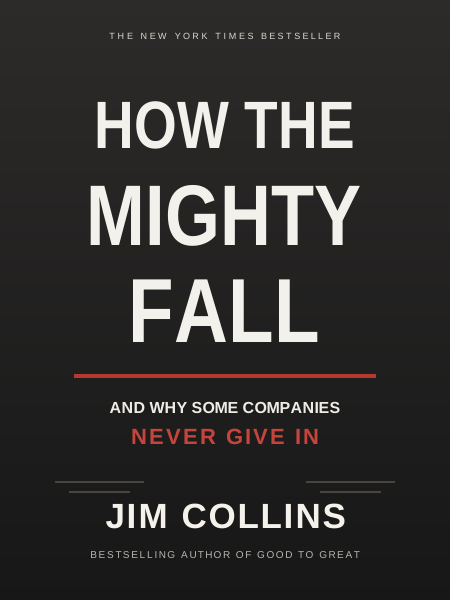
How the Mighty Fall
Jim Collins · 2009
Editorial rating
- Evidence
- 7/10
- Actionability
- 7/10
- Originality
- 8/10
The thesis
Decline is a disease - hard to detect early but easy to cure; easy to detect late but hard to cure. Great companies fall through five predictable stages: hubris, undisciplined pursuit of more, denial, grasping for salvation, and capitulation. Recognizing the stage you're in is the first step to recovery.
Who this is for
Leaders of successful organizations who worry about complacency, executives noticing warning signs they can't quite articulate, and anyone who wants to learn from failure rather than just study success.
My favorite quote
Every institution is vulnerable to decline, no matter how great. There is no law of nature that the most powerful will inevitably remain at the top.
Why it matters
Success breeds entitlement. No company is too big to fail - history proves this repeatedly.
Do this
Ask yourself: What made us successful, and are we still doing it? Or have we substituted rhetoric for understanding?
Start here
Diagnose which stage of decline you're in - the treatment differs dramatically. In Stages 1-3, the company can still look healthy externally while rotting internally. Stage 4 decline is visible to all; Stage 5 is usually fatal. The key insight: decline is largely self-inflicted, and recovery is largely within your control - but only if you catch it early and avoid the panicked "grasping for salvation" that accelerates the fall.
Critical summary
After decades of studying what makes companies great, Jim Collins turned to the dark side: why do great companies fail? His research analyzed 11 companies that demonstrated the rise-and-fall phenomenon (Motorola, Circuit City, Rubbermaid, etc.) against comparison companies that thrived in the same conditions.
The core finding: decline isn't caused by complacency (only one case showed clear complacency). It's caused by overreaching - hubris leading to undisciplined expansion, which leads to denial when problems emerge, which leads to panicked silver-bullet solutions that accelerate the death spiral.
What it gets right
- The five-stage model is intuitive and diagnostic - you can assess where you are
- "Grasping for salvation" is a devastating insight about how leaders accelerate decline
- Emphasizes that decline is self-inflicted - you have agency to stop it
- The HP vs. IBM comparison (Fiorina's rushed "transformation" vs. Gerstner's patient rebuild) is instructive
What it misses
- Small sample size with some selection bias
- Doesn't adequately address external disruption (Nokia didn't just make bad choices; the smartphone changed everything)
- Some cases feel like hindsight rationalization
- Less actionable than Collins' other books - it's more diagnostic than prescriptive
Evidence is comparative case-based, consistent with Collins' methodology. The stage model is descriptive rather than predictive - it helps you recognize decline but doesn't guarantee you can stop it.
Key concepts
Stage 1 - Hubris Born of Success
Arrogance replaces understanding. Success is seen as entitlement. Ask: Do we still know WHY we succeeded?
Stage 2 - Undisciplined Pursuit of More
Overreaching into areas where you can't be great, or growing faster than you can staff with the right people.
Stage 3 - Denial of Risk and Peril
External results still look good while internal warning signs mount. Leaders explain away bad news.
Stage 4 - Grasping for Salvation
Decline becomes visible. Leaders panic and lurch toward silver bullets - savior CEOs, bold acquisitions, dramatic transformations.
Stage 5 - Capitulation to Irrelevance or Death
Financial resources and organizational spirit exhausted. Game over.
The Waterline Principle
Take risks above the waterline (mistakes you can recover from), never below it (fatal errors).
Core insights
-
You can look healthy and be dying
Stages 1-3 are invisible from outside. Decline sneaks up, then accelerates suddenly.
-
Overreaching, not complacency, kills
Most failures aren't from standing still but from undisciplined expansion into areas where you can't be great.
-
Grasping for salvation accelerates the fall
Panicked silver-bullet solutions - savior CEOs, game-changing acquisitions - usually make things worse.
-
Recovery requires patient rebuilding
IBM under Gerstner recovered; HP under Fiorina didn't. The difference was discipline vs. drama.
-
Stage 4 is recoverable; Stage 5 is not
As long as you haven't capitulated, you can rebuild - but it requires returning to fundamentals, not seeking miracles.
Implementation steps
Today
- Honestly assess: Which stage are you in? Look for the markers Collins describes.
- Ask: What made us successful? Are we still doing those things, or have we substituted rhetoric for understanding?
This week
- Review recent expansions: Were they disciplined (clear how-to-win) or undisciplined (opportunistic, outside competence)?
- Identify any "explaining away" of bad news. What warnings are you ignoring?
This month
- Audit your key seats: Are they filled with the right people, or have you grown faster than talent?
- Assess risk posture: Are you taking risks above or below the waterline?
Ongoing
- Maintain "productive paranoia" - assume decline is possible and watch for early markers
- If in Stage 4, resist the temptation to grasp for silver bullets. Return to fundamentals.
Suggested 30-day practice plan
An editorial application plan created by Monolithic Vault - an interpretation of the book's ideas, not part of the original book.
- Day 1
Read the five stages. Honestly diagnose where your organization sits.
- Day 2
Review the Stage 1 markers - is there hubris in your culture?
- Day 3
Review Stage 2 markers - any undisciplined pursuit of "more"?
- Day 7
Conduct a "denial audit" - what bad news is being explained away?
- Day 14
Map your key risks. Which are above vs. below the waterline?
- Day 21
If you see Stage 4 markers, identify what fundamentals you need to return to
- Day 30
Share the five-stage model with your leadership team. Discuss honestly.
Free PDF summary
Take this analysis with you: a designed two-page field-notes sheet with the thesis, my favorite quote, the key concepts and core insights, and the full 30-day checklist. Print it or keep it - free, no signup.
Go deeper
If this analysis earned your attention, the full book goes further than any summary can. The original is always the primary source.