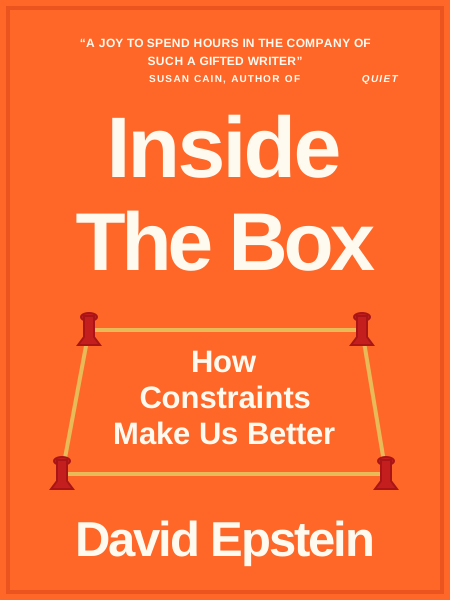
Inside the Box
David Epstein · 2026
Editorial rating
- Evidence
- 6/10
- Actionability
- 7/10
- Originality
- 6/10
The thesis
Total freedom paralyzes us. Epstein argues that well-chosen constraints, not unlimited freedom, are what create creativity, focus, and satisfaction, both for individuals and organizations.
Who this is for
Consultants and managers drowning in "anything is possible" projects with no direction, and anyone who confuses more options with better decisions.
My favorite quote
It's never been easier to do too much.
Why it matters
The line captures the core problem of modern knowledge work, where unlimited tools and options often produce less, not more.
Do this
Pick one project today and put an artificial, tight deadline or resource limit on it before moving forward.
Start here
Set your own constraints before someone else does it for you. Epstein's point isn't that freedom is bad, it's that unmanaged freedom sends the brain down the path of least resistance (scrolling, endless research, no decision). A deliberate constraint, time, budget, number of options, forces focus.
Critical summary
Epstein, known for "Range", flips the argument and claims that constraints rather than breadth are the key to breakthroughs. The book is structured around four themes, creativity, completion, collaboration, and contentment, and draws on cases like Dr. Seuss's 50-word bet, General Magic's collapse under unlimited funding, and Herbert Simon's theory of "satisficing".
What the book does well: it's a counterweight to a decade of "think outside the box" rhetoric, and the cases (UPS route planning, Bach's compositional rules, Michelangelo's marble block) are concrete enough to retell in a client meeting. The blurbs from Gladwell, Grant, and Godin aren't random, the book taps into a real pain point of choice overload in knowledge work.
What it doesn't deliver: several reviews (including on Goodreads) note that the book "stacks anecdote on anecdote" without building an actual framework for when constraints help and when they hurt. There's no clear decision tool for judging whether a given constraint is productive or just an excuse not to act. Part IV, on collaboration and contentment, is according to several reviewers the weakest, the argument drifts from science toward looser philosophy. The core concept also isn't new, Theory of Constraints (Goldratt), the Sprint methodology, and limited WIP in agile are already established variants of the same idea.
The evidence is predominantly narrative and case-based rather than controlled research. Use the book for inspiration and language in client work, not as scientific proof.
Key concepts
Path of Least Resistance
The brain automatically defaults to the easiest option, not the best one. Use it to spot where your team is "scrolling" instead of deciding.
Satisficing vs. Maximizing
Choosing "good enough" over "the best possible" often produces higher satisfaction. Put a time limit on your next decision instead of hunting for the perfect option.
Self-Imposed Constraints
Artificial constraints (deadline, budget, number of ideas) set by yourself work just as well as external ones. Give your next project an artificial deadline one week before the real one.
The General Magic Trap
Unlimited funding and freedom without structure led a team of superstars to never ship anything. Use it as a warning example next time a project gets "free rein" with no milestones.
Extreme Users
Designing for the most constrained users often reveals solutions that benefit everyone. Ask: who has the least time, budget, or access in this task, and design for them first.
Core insights
-
Freedom without a frame isn't free
Unlimited choice costs energy and decision fatigue. Consequence: set fewer, but clearer constraints on client projects from the start.
-
Deadlines are a creative tool, not just pressure
A tight deadline forces prioritization that would otherwise take weeks. Use it deliberately when facilitating workshops.
-
Constraints build trust in collaboration
Norms and rules (even uncomfortable ones) are what let strangers trust each other in a team or market. Relevant when designing governance for a client.
-
Total optimization makes people less satisfied
According to Epstein, people who "maximize" everything are less satisfied than those who accept "good enough". A useful counterweight to your own tendency to over-optimize BI solutions.
-
The book lacks a filter
It doesn't tell you when a constraint becomes counterproductive (micromanagement, overly tight deadlines). Setting that line is your job as a consultant, not the book's.
Implementation steps
Today
- Pick one ongoing task and cut the number of options down to three.
- Set an artificial deadline on an unstructured project.
This week
- Run a meeting or workshop with a hard time limit per agenda item, and observe the difference in decision speed.
- Identify one place in a client project where "unlimited options" is actually slowing progress.
This month
- Design a "constraints-first" template for project kickoffs: fixed number of deliverables, fixed timeframe, fixed budget, before the solution is discussed.
- Test the satisficing principle on a decision you'd normally spend a long time optimizing.
Ongoing
- Make it a standard question at kickoff meetings: "What constraint are we deliberately setting here?"
Suggested 30-day practice plan
An editorial application plan created by Monolithic Vault - an interpretation of the book's ideas, not part of the original book.
- Day 1
Read chapters 1-3, note three places in your work with too much freedom of choice.
- Day 3
Set an artificial deadline on one task and observe the effect.
- Day 7
Run your first meeting with time-boxed agenda items.
- Day 14
Design a constraints-first template for the next client kickoff.
- Day 21
Test the principle on a team collaboration, not just individual work.
- Day 30
Evaluate where constraints helped and where they became counterproductive.
Free PDF summary
Take this analysis with you: a designed two-page field-notes sheet with the thesis, my favorite quote, the key concepts and core insights, and the full 30-day checklist. Print it or keep it - free, no signup.
Go deeper
If this analysis earned your attention, the full book goes further than any summary can. The original is always the primary source.