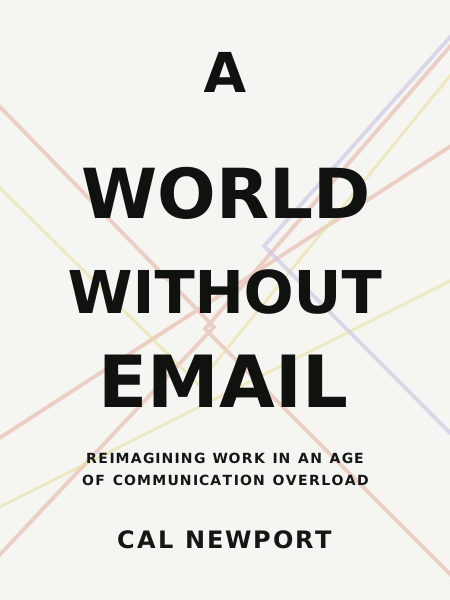
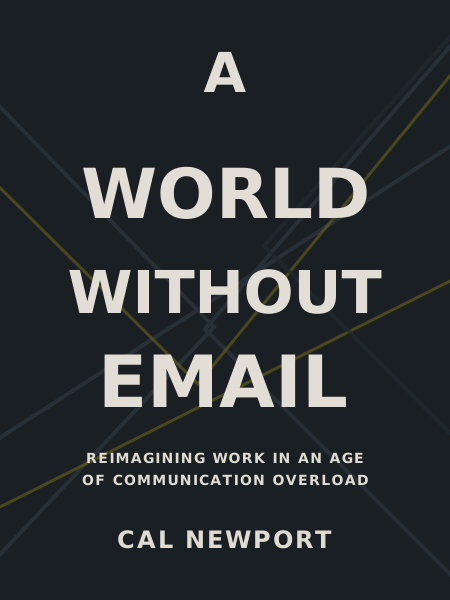
A World Without Email
Cal Newport · 2021
Editorial rating
- Evidence
- 8/10
- Actionability
- 6/10
- Originality
- 7/10
The thesis
Email isn't the problem - the hyperactive hive mind workflow it enables is. The constant back-and-forth messaging that defines modern knowledge work destroys cognitive capacity and makes deep work nearly impossible. We need structured protocols, not better inbox management.
Who this is for
Knowledge workers drowning in email and Slack, team leads who control workflow processes, and executives who want to improve organizational productivity. Less useful for individual contributors who can't change their company's communication culture.
My favorite quote
No one had ever stopped to wonder about whether the way we're working was actually working.
Why it matters
This captures the core insight - we adopted email reflexively and never questioned whether unstructured communication was optimal for knowledge work.
Do this
Track how many times you check email/Slack today. Each check costs 23 minutes of refocusing time. Know your number before trying to change it.
Start here
Distinguish between the stressor and the stress response. Email and Slack create constant context-switching, which triggers stress hormones. But eliminating the tool won't work - you need to replace the workflow. Create explicit protocols for recurring interactions (scheduling, status updates, project coordination) that don't require unscheduled back-and-forth messaging.
Critical summary
Newport, a Georgetown computer science professor and author of Deep Work, expands his focus from individual productivity to organizational workflow design. The book argues that the "hyperactive hive mind" - constant unstructured digital communication - is a productivity disaster that emerged by accident, not design.
The first half builds the case against email as a primary collaboration tool, drawing on research about context-switching costs, the evolution of communication technology, and case studies of companies that have abandoned traditional email workflows. This section is well-researched but repetitive for readers familiar with Newport's earlier work.
What it gets right
- Correctly identifies that the problem is workflow design, not individual discipline
- Provides concrete examples of alternative protocols (Trello boards, office hours, scheduled check-ins)
- Acknowledges his privileged position as a tenured professor while suggesting adaptations for others
What it misses
- Solutions skew toward small teams and privileged workers with schedule autonomy
- Status meetings as a solution contradicts his own anti-meeting stance in Deep Work
- Limited discussion of power dynamics - most workers can't unilaterally change communication norms
- Pre-pandemic writing means no engagement with remote work realities
- The "world without email" framing is misleading - the book advocates for structured email, not elimination
Evidence is strong on the problems (psychology research, case studies) but weaker on solutions (mostly anecdotes from small companies). The gap between diagnosis and prescription is notable.
Key concepts
Hyperactive Hive Mind
The workflow where ongoing conversations happen via unstructured back-and-forth messaging. Replace with explicit protocols.
Context Residue
When you switch tasks, attention remains on the previous task for 20+ minutes. Each email check creates residue.
Process Protocols
Explicit rules for how recurring types of work get coordinated. Define once, follow consistently.
Office Hours
Scheduled blocks when you're available for ad-hoc questions. Outside these hours, asynchronous only.
Task Boards
Visual systems (Trello, Kanban) that make project status visible without requiring status update emails.
Short Email Rule
If an email thread exceeds 3 messages, move to a scheduled call. Prevents endless back-and-forth.
Core insights
-
Tools don't create workflows
Email was adopted because it was convenient, not because it was optimal. Convenience isn't the same as productivity.
-
Checking email is not work
The feeling of productivity from clearing your inbox is an illusion. Real work requires sustained attention.
-
Autonomy requires structure
Paradoxically, strict communication protocols create more freedom for deep work than "open door" availability.
-
Synchronous beats asynchronous for complexity
Quick calls resolve in 10 minutes what takes 20 emails over 3 days.
-
The admin tax is real
Every worker now does their own scheduling, filing, and correspondence - work that used to be delegated. This isn't efficient.
Implementation steps
Today
- Count your email/Slack checks. Set a baseline before attempting to reduce.
- Identify one recurring coordination task (scheduling, status updates) that could use a protocol
This week
- Block 2-hour deep work periods on your calendar; treat them as non-negotiable meetings
- Draft office hours: 30-60 minutes daily when you're available for real-time questions
This month
- Propose one process protocol to your team (e.g., all status updates via weekly 15-minute standup, not email)
- Set up a task board for one project and migrate all status requests there
Ongoing
- Audit communication friction quarterly: which recurring interactions still require excessive back-and-forth?
- Protect deep work time as fiercely as you protect important meetings
Suggested 30-day practice plan
An editorial application plan created by Monolithic Vault - an interpretation of the book's ideas, not part of the original book.
- Day 1
Track every email/Slack check for one day. Calculate total time lost to context switching.
- Day 2
Identify your top 3 sources of email volume (specific senders, types of requests)
- Day 3
Block 2 hours of "deep work" time on tomorrow's calendar
- Day 7
Implement a short-email rule for yourself: 3 messages max before scheduling a call
- Day 14
Propose office hours to your team or manager; trial for one week
- Day 21
Set up a shared task board for one project; redirect all "what's the status?" emails there
- Day 30
Review: How many deep work hours did you protect this month vs. last month?
Free PDF summary
Take this analysis with you: a designed two-page field-notes sheet with the thesis, my favorite quote, the key concepts and core insights, and the full 30-day checklist. Print it or keep it - free, no signup.
Go deeper
If this analysis earned your attention, the full book goes further than any summary can. The original is always the primary source.