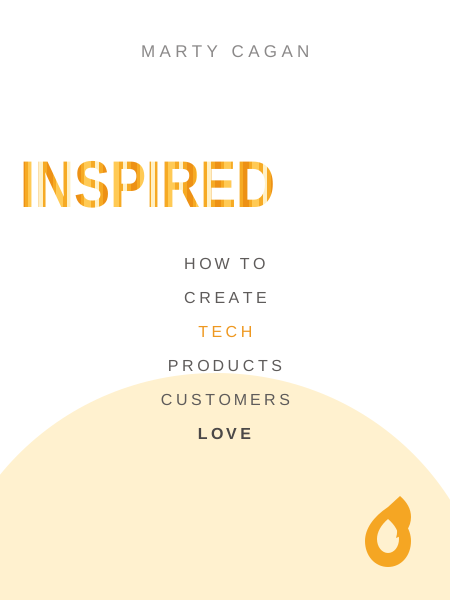
Inspired
Marty Cagan · 2018
Editorial rating
- Evidence
- 7/10
- Actionability
- 8/10
- Originality
- 7/10
The thesis
Most product teams are "feature factories" building what stakeholders request, not discovering what customers need. True product teams are empowered to solve problems, own outcomes (not outputs), and continuously discover solutions through rapid prototyping and testing.
Who this is for
Product managers at tech companies frustrated by roadmaps full of stakeholder requests. Also engineering and design leads who want to understand how world-class product organizations actually work versus the waterfall theater most companies practice.
My favorite quote
It doesn't matter how good your engineering team is if they are not given something worthwhile to build.
Why it matters
This crystallizes why so many talented teams ship products nobody wants - the problem isn't execution, it's discovery.
Do this
Ask yourself: When did you last talk directly to a customer about their problems (not your solution)?
Start here
Continuous Discovery: Great product teams don't build what's on a roadmap - they continuously discover solutions to problems. Spend at least 2 hours per week with real customers. Test ideas with prototypes before writing production code. Your job is to validate risk (value, usability, feasibility, viability) before engineering invests.
Critical summary
Cagan distills decades of experience leading product at eBay, AOL, and Netscape - plus consulting to Google, Netflix, and Airbnb - into a comprehensive framework for product management. The book is part encyclopedia, part manifesto against "waterfall" product development.
The core argument: most companies do product wrong. They use roadmaps as feature contracts, treat product managers as project managers, and build what stakeholders request rather than what customers need. Top companies instead empower cross-functional teams to solve problems and own outcomes.
What it gets right
- Distinction between "output" (features shipped) and "outcome" (customer value) is clarifying
- Discovery vs. delivery framework provides vocabulary for what often feels fuzzy
- Four types of risk (value, usability, feasibility, viability) offer a practical checklist
- Reference customer concept (6 for B2B, 15-50 for B2C) gives concrete validation targets
What it misses
- Written abstractly through principles, not stories - can feel dry and lecture-like
- Silicon Valley jargon-heavy (discovery coach, feasibility prototype, story map)
- Prescriptions without explanations - tells what to do, not always why
- Idealistic about PM empowerment; ignores political realities most PMs face
- SVPG books have significant overlap; reading all feels repetitive
Evidence is experiential rather than research-based, but Cagan's credentials are strong. The book has become canonical in product circles for good reason.
Key concepts
Empowered Product Teams
Small, cross-functional teams (PM, design, engineering) given problems to solve, not features to build. Audit your team's autonomy level.
Continuous Discovery
Parallel to delivery, always testing ideas with customers. Schedule weekly customer interviews.
Four Risks
Value (will they buy?), Usability (can they use it?), Feasibility (can we build it?), Viability (does it work for business?). Address before engineering.
Reference Customers
Real customers using production product, paying money, willing to recommend. Find 6 for B2B before claiming product-market fit.
Opportunity Assessment
Before building, answer: What problem? Who has it? How big? What alternatives exist? Why us? Why now?
Story Mapping
Visual technique arranging user stories by journey (horizontal) and priority (vertical). Use to align team on scope.
Core insights
-
Roadmaps are lies
Traditional roadmaps with features and dates pretend we know solutions before discovering them. Replace with outcome-based objectives.
-
Customers can't tell you what to build
They know problems, not solutions. Your job is uncovering problems then inventing solutions they didn't imagine.
-
Prototype before you code
High-fidelity prototypes answer risk questions in days, not months. Build the smallest thing that tests your hypothesis.
-
Engineers belong in discovery
Including engineers in customer conversations improves feasibility assessments and often generates better solutions.
-
Stakeholder management isn't selling
Good product managers bring stakeholders into the process early, not just the results. Surprise stakeholders become blockers.
Implementation steps
Today
- List your team's current work: How much is stakeholder request vs. customer problem?
- Schedule one customer interview this week
This week
- Complete an Opportunity Assessment for your current major initiative
- Run one usability test with a prototype (even paper sketches count)
This month
- Establish weekly customer interview rhythm (minimum 2 hours/week)
- Identify your reference customer targets and current progress
Ongoing
- Protect discovery time from delivery pressure
- Report outcomes to stakeholders, not just output
Suggested 30-day practice plan
An editorial application plan created by Monolithic Vault - an interpretation of the book's ideas, not part of the original book.
- Day 1
Audit current team structure against empowered team model
- Day 2
Complete Opportunity Assessment for active project
- Day 3
Schedule 3 customer discovery interviews
- Day 7
Conduct first interview; document problems discovered
- Day 14
Create prototype addressing one customer problem; test with users
- Day 21
Pitch outcome-based objective to leadership instead of feature roadmap
- Day 30
Review: What risks did you retire through discovery vs. learning in production?
Free PDF summary
Take this analysis with you: a designed two-page field-notes sheet with the thesis, my favorite quote, the key concepts and core insights, and the full 30-day checklist. Print it or keep it - free, no signup.
Go deeper
If this analysis earned your attention, the full book goes further than any summary can. The original is always the primary source.