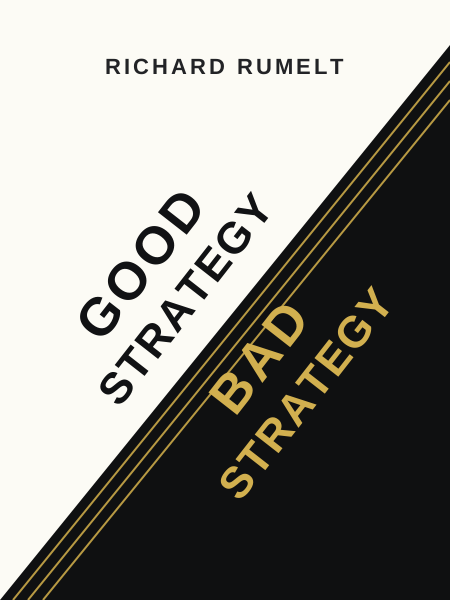
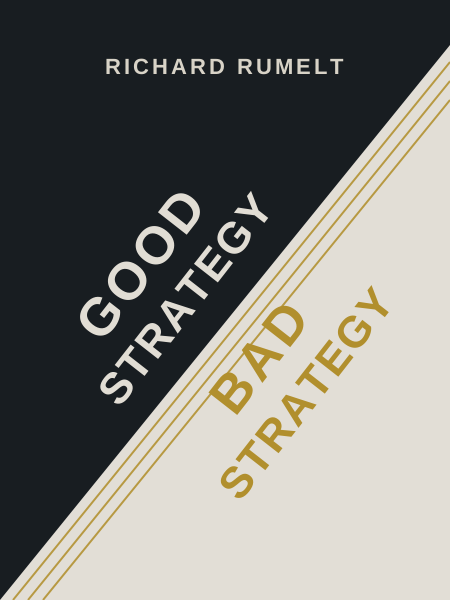
Good Strategy Bad Strategy
Richard Rumelt · 2011
Editorial rating
- Evidence
- 8/10
- Actionability
- 8/10
- Originality
- 9/10
The thesis
Strategy is problem-solving, not goal-setting. Good strategy is a coherent response to a critical challenge - diagnosis, guiding policy, and coordinated action - while bad strategy is fluff, goals masquerading as strategy, and a refusal to make hard choices.
Who this is for
Executives frustrated with vapid "strategic plans," consultants tired of facilitating vision-statement workshops, and anyone responsible for moving an organization forward who suspects that most strategy is theater.
My favorite quote
Bad strategy is not the absence of strategy. It is the presence of bad strategy.
Why it matters
Most organizations don't lack strategy - they're drowning in bad strategy disguised as good strategy, making diagnosis harder.
Do this
Review your current "strategy" document. If it doesn't name a specific problem and a focused approach to solving it, you have bad strategy.
Start here
The Kernel of Good Strategy has three elements: (1) Diagnosis - naming the critical challenge, (2) Guiding Policy - the overall approach to overcome it, and (3) Coherent Actions - coordinated steps that implement the policy. If your "strategy" lacks any of these, it's not strategy. Most corporate strategies are lists of goals with no diagnosis or coherent action plan.
Critical summary
Richard Rumelt, UCLA strategy professor and advisor to major corporations and governments, wrote what many consider the definitive book on strategy. His central argument is devastatingly simple: most organizations confuse goals, aspirations, and values with strategy, producing documents that are functionally useless.
Rumelt identifies four hallmarks of bad strategy: (1) Fluff - buzzword-laden pseudo-strategic babble, (2) Failure to face the challenge - strategies that don't identify the problem, (3) Mistaking goals for strategy - "our strategy is to grow revenue 20%," and (4) Bad strategic objectives - incoherent or impractical wish lists.
What it gets right
- The kernel framework (diagnosis → guiding policy → coherent action) is genuinely original and immediately applicable
- Ruthless takedown of corporate planning theater that passes for strategy
- Excellent on "proximate objectives" - goals close enough to be achievable that unlock progress
- Case studies span military history, business, and public policy without feeling scattered
What it misses
- Better at diagnosing bad strategy than prescribing how to create good strategy
- The "no formula" stance is intellectually honest but leaves practitioners wanting more structure
- Some examples feel dated (written pre-2011)
- Writing can be dense and academic in places
Evidence quality is strong - Rumelt draws on decades of consulting experience and academic research, though it's more case-based than empirically rigorous. The book's real power is conceptual clarity, not scientific proof.
Key concepts
The Kernel
The three-part core of any strategy - diagnosis, guiding policy, coherent actions. Use it to audit any strategic document.
Proximate Objectives
Goals achievable enough to be meaningful targets. Replace "become market leader" with something you can actually execute on next quarter.
Chain-Link Systems
Systems where improvement requires fixing every weak link, not just one. Identify whether you're in a chain-link situation before investing.
Focus
Concentrating resources on a few objectives rather than spreading thin. Count your strategic priorities - if you have more than three, you have none.
Leverage
Finding points where applied effort produces outsized results. Map where small investments could yield disproportionate returns.
Bad Strategy Hallmarks
Fluff, no diagnosis, goals-as-strategy, incoherent objectives. Use as a checklist to kill bad strategy before it spreads.
Core insights
-
Strategy is problem-solving, not goal-setting
The single biggest strategic error is treating "what we want to achieve" as a strategy. Strategy is "how we will overcome the obstacle."
-
Diagnosis is 80% of strategy
Correctly naming the challenge is most of the work. A good diagnosis makes the guiding policy almost obvious.
-
Coherent actions beat comprehensive plans
A few coordinated moves trump a long list of initiatives. Coherence means actions reinforce each other.
-
Bad strategy is a choice, not an accident
Organizations create bad strategy because it avoids hard choices, conflict, and the work of analysis.
-
Proximate objectives unlock progress
The best strategies set objectives that are challenging but achievable, creating momentum through success.
-
Focus requires saying no
Strategy is as much about what you won't do. Every addition to your priority list dilutes focus.
Implementation steps
Today
- Pull out your organization's strategic plan and identify: Is there a diagnosis? A guiding policy? Coherent actions?
- List your current "strategic priorities" - if more than 3, you have a focus problem
This week
- Write a one-paragraph diagnosis of your biggest challenge - what makes it difficult?
- Draft a guiding policy: one sentence describing your overall approach to the challenge
This month
- Identify 3-5 coherent actions that implement your guiding policy - do they reinforce each other?
- Test for bad strategy hallmarks: Is there fluff? Are goals masquerading as strategy?
Ongoing
- Review strategy quarterly using the kernel framework
- Kill initiatives that don't connect to the guiding policy
Suggested 30-day practice plan
An editorial application plan created by Monolithic Vault - an interpretation of the book's ideas, not part of the original book.
- Day 1
Read chapters 1-3 on bad strategy hallmarks
- Day 2
Audit your current strategic documents for fluff and goals-as-strategy
- Day 3
Write your diagnosis - what is the critical challenge?
- Day 7
Draft guiding policy and test with trusted colleagues
- Day 14
Map coherent actions to the guiding policy; cut what doesn't connect
- Day 21
Identify your proximate objective - the achievable goal that unlocks progress
- Day 30
Present revised strategy using the kernel framework; gather feedback
Free PDF summary
Take this analysis with you: a designed two-page field-notes sheet with the thesis, my favorite quote, the key concepts and core insights, and the full 30-day checklist. Print it or keep it - free, no signup.
Go deeper
If this analysis earned your attention, the full book goes further than any summary can. The original is always the primary source.