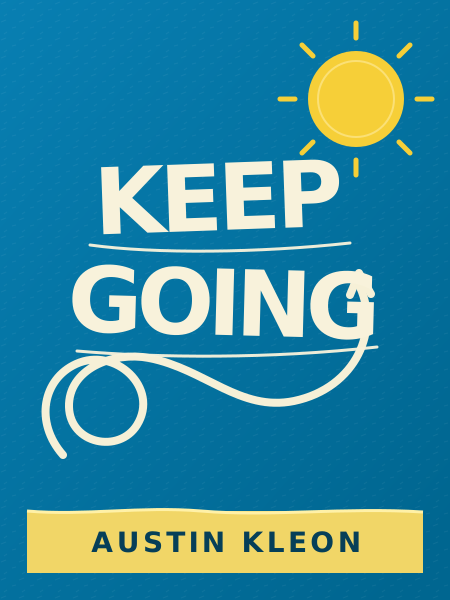
Keep Going
Austin Kleon · 2019
Editorial rating
- Evidence
- 4/10
- Actionability
- 7/10
- Originality
- 5/10
The thesis
Creative work isn't a linear journey to a finish line - it's a loop. You never "arrive." The goal isn't to produce one masterpiece but to sustain a practice that lets you keep making things, day after day, regardless of external recognition, cultural chaos, or personal doubt. The process is the point.
Who this is for
Creatives battling burnout and social media comparison, professionals whose output depends on sustained motivation, anyone struggling to maintain creative practice amid life's demands, and those who've achieved some success but feel lost about what comes next.
My favorite quote
Every day is like a blank page: when you're finished filling it, you can save it, take what you need from it, and let the rest be.
Why it matters
This reframes creativity as daily practice rather than career trajectory. Each day is its own complete unit - you don't carry yesterday's failures or successes.
Do this
At the end of today, write one sentence about what you made or learned. Then close that page and start fresh tomorrow.
Start here
Establish a daily routine - not because routine produces genius, but because it produces work. The schedule itself doesn't matter; what matters is that you show up consistently. On good days, the routine produces great work. On bad days, the routine keeps you going until good days return. "What your daily routine consists of is not that important... stick to it most days, break from it once in a while for fun, and modify it as necessary."
Critical summary
Kleon, author of Steal Like an Artist and Show Your Work!, completes his trilogy with a book about creative sustainability. Where his first book addressed how to start and his second addressed how to share, Keep Going tackles how to continue - especially when the world feels chaotic, social media is demoralizing, and initial motivation fades.
The book is designed for quick consumption: short chapters, blackout poetry illustrations, hand-drawn diagrams, and pithy advice. It's more manifesto than manual, more comfort than curriculum.
What it gets right
- Disconnecting to connect: You need solitude and breaks from the internet to do deep creative work
- "Airplane mode" as creative strategy - deliberately removing distractions
- The distinction between being "the noun" (a writer) and "doing the verb" (writing) - focus on the action
- Practical acknowledgment that most people aren't full-time artists; advice accounts for day jobs and family
What it misses or overstates
- Very light on substance - feels like a blog post stretched to book length (a recurring critique of the series)
- Many insights are things you already know, just organized nicely
- Limited practical frameworks; mostly inspirational reminders
- Doesn't engage with the harder questions of creative sustainability (financial survival, burnout recovery, etc.)
- Some advice is nearly contradictory without guidance on when to apply which principle
- The "zine aesthetic" works for some but feels unsubstantial for others seeking depth
This is comfort food for creatives, not a nutritional guide. Read it when you need encouragement, not when you need strategy.
Key concepts
Every Day is Groundhog Day
Creativity is cyclical. You return to the blank page daily regardless of yesterday's triumph or failure. Embrace repetition.
Build a Bliss Station
Create a physical or temporal space that's exclusively for creative work. Protect it from the world.
Forget the Noun, Do the Verb
Stop worrying about whether you're "a writer" and just write. Identity follows action, not the reverse.
The Ordinary + Extra Attention = Extraordinary
You don't need an extraordinary life to make extraordinary work. Pay attention to what's around you.
Airplane Mode
Deliberately disconnect from the internet and notifications to connect with yourself and your work.
Slay the Art Monsters
Reject the myth that great artists must be terrible people. Art should make life better, not excuse bad behavior.
Core insights
-
Disconnection enables connection
You must retreat from the world to bring something worth sharing back to it. Schedule time offline.
-
The demons hate fresh air
When stuck, change your environment. Walk outside. The mind works on problems in the background.
-
Plant your garden regardless of the world
External chaos is permanent. If you wait for calm, you'll never create. Make things anyway.
-
Keep your overhead low for creative freedom
The less money you need, the more creative risks you can take. Don't let lifestyle inflation trap you.
-
"Like" is not the goal
If you make art to please algorithms, you'll lose yourself. Make what you like; let others find it.
Implementation steps
Today
- Put your phone in airplane mode for one hour and make something - anything
- Write down what you want to create this week (not what you think will perform well)
This week
- Establish a 30-minute daily creative appointment and keep it 5 of 7 days
- Designate a "bliss station" - even if it's just a corner or a time of day that's yours
This month
- Take a "media fast" from social platforms for one full week; note how it affects your work
- Start a logbook: one sentence per day about what you made or learned
Ongoing
- Protect your routine; modify it seasonally but don't abandon it
- Before sharing work, ask: "Do I like this?" If not, don't post it for validation
- Walk daily. Movement unlocks ideas that sitting cannot.
Suggested 30-day practice plan
An editorial application plan created by Monolithic Vault - an interpretation of the book's ideas, not part of the original book.
- Day 1
Define your daily creative time block (even 20 minutes counts)
- Day 2
Create or designate your bliss station; remove distractions from it
- Day 3
Practice airplane mode for your creative session; note the difference
- Day 7
Review week one - did you show up? Adjust the routine if needed
- Day 14
Take inventory: what's draining creative energy? (social comparison, news, etc.)
- Day 21
Implement one "demons hate fresh air" practice - walking, nature, change of scene
- Day 30
Write a one-page reflection: what helped you keep going? What almost stopped you?
Free PDF summary
Take this analysis with you: a designed two-page field-notes sheet with the thesis, my favorite quote, the key concepts and core insights, and the full 30-day checklist. Print it or keep it - free, no signup.
Go deeper
If this analysis earned your attention, the full book goes further than any summary can. The original is always the primary source.