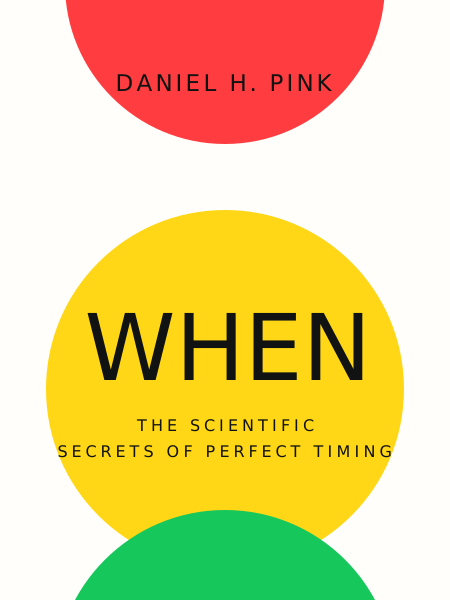
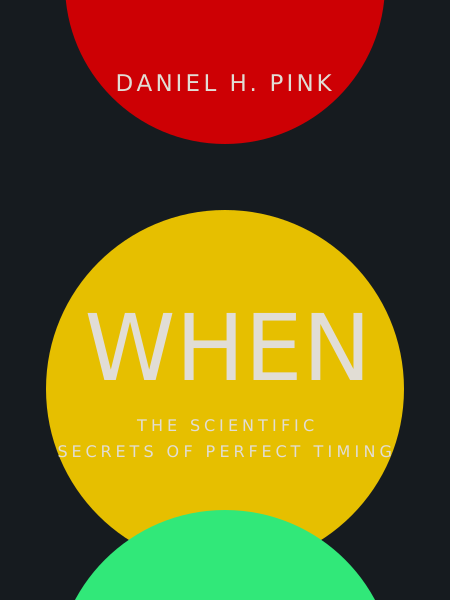
When
Daniel H. Pink · 2018
Editorial rating
- Evidence
- 7/10
- Actionability
- 8/10
- Originality
- 7/10
The thesis
Timing isn't an art - it's a science. When you do something matters as much as what you do, and understanding chronobiology can boost performance, health, and decision-making by 20% or more.
Who this is for
Knowledge workers optimizing their daily schedules, managers designing meeting cadences, and anyone who suspects they're doing important work at the wrong time of day.
My favorite quote
We believe we're rational beings, but our decisions are often shaped by the time of day.
Why it matters
Most productivity advice ignores timing entirely - this reframes schedule design as a performance lever.
Do this
Track your energy for three days, noting peak, trough, and rebound periods, then move your most important work to match.
Start here
Identify your chronotype (lark, owl, or third bird) and protect your peak hours for analytical work. Most people hit a trough around 2-4 PM - never schedule important decisions, creative reviews, or complex analysis during that window. The wrong timing can swing cognitive performance by 20%.
Critical summary
Pink synthesizes research from chronobiology, economics, and psychology to argue that timing is a hidden force in human behavior. The book covers three temporal domains: the day (peaks, troughs, rebounds), beginnings and endings (fresh starts, deadlines), and midpoints (the "uh-oh effect" vs. slump).
What it gets right
- Strong research foundation - Danish school study showing 20% test score variance from timing
- Practical implications for scheduling analytical vs. creative work
- Midpoint research is genuinely interesting (teams either slump or activate at halfway points)
- Naps and breaks presented with scientific backing, not just productivity hacks
What it misses
- Individual variation gets acknowledged but underexplored - advice assumes you can control your schedule
- Some claims extrapolate broadly from narrow studies
- The "fresh start effect" section feels padded - could be a chapter, takes three
- Doesn't address hybrid/remote work realities where timing flexibility varies
The core insight - match task type to energy phase - is valuable but not revolutionary. Pink's contribution is making timing visible as a variable worth optimizing. Evidence quality is solid for the headline claims but gets thinner in later chapters.
Key concepts
Chronotype
Your biological tendency toward morning or evening alertness. Take the Munich Chronotype Questionnaire to identify yours, then schedule accordingly.
Peak-Trough-Rebound
The daily pattern most people follow. Use peak for analytical work, rebound for creative/insight work, avoid important decisions in trough.
Vigilance vs. Insight Tasks
Analytical tasks require vigilance (peak hours); creative tasks benefit from lower inhibition (rebound). Match task to phase.
The Nappuccino
Drink coffee, nap 20 minutes, wake as caffeine kicks in. Use during trough when you can't avoid afternoon work.
Fresh Start Effect
Temporal landmarks (new year, Monday, birthdays) create psychological permission to begin anew. Use them to start new habits.
Midpoint Crisis/Catalyst
Teams either slump or surge at halfway points. Make midpoints visible to trigger the "uh-oh effect" that motivates finishing.
Core insights
-
20% of performance is timing
Danish students tested in morning vs. afternoon showed score differences equivalent to missing two weeks of school. Your schedule is a performance variable.
-
Troughs are treacherous
Hospital errors increase in afternoon, judges grant fewer paroles after lunch. Protect yourself from making important decisions during low-energy windows.
-
Breaks are not indulgent
Short breaks every 52-90 minutes restore attention. Walking breaks outdoors work better than stationary indoor breaks.
-
Endings energize (sometimes)
Runners speed up in final kilometer. Teams near deadlines often outperform. Use endings to create urgency.
-
Synchronization builds trust
Groups that move together (walking, singing, rowing) develop greater cooperation. Timing affects relationships, not just productivity.
Implementation steps
Today
- Note your energy at 9 AM, 12 PM, 3 PM, and 6 PM - identify your personal peak and trough
- Move your hardest analytical task to your highest-energy window tomorrow
This week
- Take the Munich Chronotype Questionnaire (free online) to confirm your type
- Schedule one "protected peak" block daily - no meetings, no email, only deep work
- Try one "walking break" during your afternoon trough
This month
- Audit your recurring meetings - move any requiring sharp thinking away from collective trough (typically 2-4 PM)
- Experiment with the Nappuccino if you have a consistent afternoon slump
- Identify an upcoming "fresh start" date and attach one habit change to it
Ongoing
- Batch shallow tasks (email, admin) for trough periods
- Review important decisions for timing bias - were you in peak or trough?
- Use midpoint check-ins on projects to trigger the "uh-oh effect"
Suggested 30-day practice plan
An editorial application plan created by Monolithic Vault - an interpretation of the book's ideas, not part of the original book.
- Day 1
Track energy levels at four intervals; identify patterns
- Day 2
Take chronotype assessment; schedule tomorrow's deep work for peak
- Day 3
Implement first "protected peak" block
- Day 7
Review week - how did timing affect work quality? Adjust blocks
- Day 14
Audit meeting schedule; propose one timing change
- Day 21
Try one "fresh start" experiment (new habit tied to temporal landmark)
- Day 30
Document your optimized daily schedule template; share with team
Free PDF summary
Take this analysis with you: a designed two-page field-notes sheet with the thesis, my favorite quote, the key concepts and core insights, and the full 30-day checklist. Print it or keep it - free, no signup.
Go deeper
If this analysis earned your attention, the full book goes further than any summary can. The original is always the primary source.