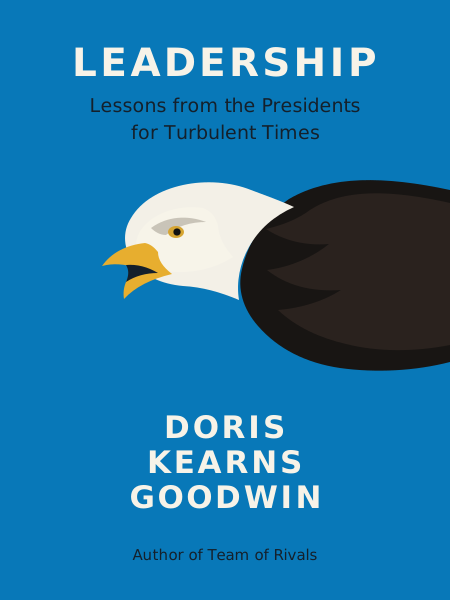
Leadership: In Turbulent Times
Doris Kearns Goodwin · 2018
Editorial rating
- Evidence
- 8/10
- Actionability
- 7/10
- Originality
- 6/10
The thesis
Leaders are not finished products discovered in calm periods. Ambition, severe setbacks, reflection, and a purpose larger than personal advancement prepare them to meet the particular crisis their abilities fit.
Who this is for
Executives leading through disruption, public-sector managers balancing competing constituencies, and emerging leaders trying to turn a professional setback into better judgment rather than permanent caution.
My favorite quote
With public sentiment, nothing can fail; without it, nothing can succeed.
Why it matters
Durable leadership requires reading, shaping, and respecting the people whose cooperation turns authority into real capacity.
Do this
Before your next major decision, write what each affected group currently fears, wants, and believes is fair.
Start here
Treat adversity as material for leadership development rather than proof that you lack it. Lincoln, Theodore Roosevelt, Franklin Roosevelt, and Lyndon Johnson each suffered a reversal that forced reflection, adaptation, and renewed purpose before a national crisis demanded their best work. The useful question is not whether hardship automatically improves leaders, but whether they process it honestly enough to change.
Critical summary
Doris Kearns Goodwin draws on decades spent researching Abraham Lincoln, Theodore Roosevelt, Franklin Roosevelt, and Lyndon Johnson, including her own early work with Johnson. She arranges their lives in three movements: the rise of ambition, a dramatic reversal, and a presidential crisis that revealed a distinct leadership pattern. Lincoln's political defeats and depression precede transformational leadership around emancipation. Theodore Roosevelt's grief and retreat precede crisis management during the coal strike. Franklin Roosevelt's polio precedes turnaround leadership in the first hundred days of the Depression. Johnson's Senate setback and later accession after Kennedy's assassination precede visionary leadership on civil rights. Across the cases, Goodwin emphasizes empathy, resilience, self-reflection, storytelling, team construction, timing, public sentiment, and ambition attached to collective purpose rather than personal status.
What it gets right
- Shows leadership development as a long interaction between temperament, experience, relationships, failure, and opportunity
- Connects broad virtues to specific decisions, including coalition building, communication, sequencing, and use of executive authority
- Makes historical cases accessible without pretending the four presidents shared one personality or one method
What it overstates or misses
- Distills complex political struggles into bold leadership lessons that can sound more obvious than the history supporting them
- Centers celebrated presidents while giving less agency to movements, organizers, institutions, opponents, and citizens who constrained their choices
- Selects successful crisis episodes, creating a cleaner developmental arc than the presidents' failures and contradictions warrant
The historical base is rich because Goodwin has studied these figures across multiple major biographies and works closely with speeches, letters, diaries, advisers, and political context. The comparative structure surfaces useful patterns, but four selected men cannot establish general laws of leadership, and the final case studies sometimes compress causality into executive virtue. Johnson's Vietnam escalation and the moral limits of each administration complicate any simple celebration. The verdict: excellent history for reflection, but too selective to function as leadership science.
Key concepts
Ambition for Collective Purpose
Redirect personal drive toward an outcome that improves other people's lives and gives authority a reason beyond status.
Adversity and Growth
Use setbacks to examine temperament, blind spots, and priorities instead of merely restoring the old path.
Transformational Leadership
Combine practical bargaining with a moral direction that changes what followers believe is possible and worth supporting.
Crisis Management
Gather facts, control pace, understand every constituency, and preserve legitimacy while moving adversaries toward a workable settlement.
Public Sentiment
Read the population's readiness and shape it through explanation, stories, sequencing, and visible proof rather than command alone.
Core insights
-
Readiness meets circumstance
Crisis creates an opening, but only leaders who have developed judgment, resilience, and relationships can use it well.
-
Setbacks can widen empathy
Personal suffering does not guarantee compassion, but reflection can make leaders more attentive to fear, exclusion, and dependence.
-
Timing is part of courage
Acting too early can destroy a coalition, while waiting too long can turn prudence into avoidance.
-
Stories organize public action
Leaders connect present sacrifice to shared history and future meaning so people understand why change deserves support.
-
Teams compensate for temperament
Strong leaders recruit people with different knowledge and dispositions instead of surrounding themselves with emotional copies.
Implementation steps
Today
- Write a brief account of one career setback, separating what happened from the story you still tell yourself about it.
- Map the fears, interests, and sources of influence of three groups affected by your next major decision.
This week
- Ask two trusted colleagues what behavior appears when you are under pressure and what consequence it creates for others.
- Draft a crisis narrative explaining the facts, shared purpose, immediate action, and realistic basis for hope.
This month
- Build a small advisory group containing expertise, temperament, and viewpoints that your normal inner circle lacks.
- Sequence one difficult change into steps that match stakeholder readiness without abandoning the final objective.
Ongoing
- Keep a decision journal linking setbacks, emotional reactions, advisers, public response, and lessons applied later.
- Review whether your ambition is producing broader value or merely protecting position, reputation, and control.
Suggested 30-day practice plan
An editorial application plan created by Monolithic Vault - an interpretation of the book's ideas, not part of the original book.
- Day 1
Select one setback and identify the belief, habit, or relationship it should force you to reconsider.
- Day 3
Interview one colleague who experienced the event differently and record where your account is incomplete.
- Day 7
Define a collective purpose for one current challenge and remove language centered on your own success.
- Day 14
Build a stakeholder map covering interests, fears, influence, readiness, and credible messengers.
- Day 21
Test your narrative and action sequence with supporters, skeptics, and one person who bears the downside.
- Day 30
Document the leadership practices you will keep for reflection, team construction, communication, timing, and accountability.
Free PDF summary
Take this analysis with you: a designed two-page field-notes sheet with the thesis, my favorite quote, the key concepts and core insights, and the full 30-day checklist. Print it or keep it - free, no signup.
Go deeper
If this analysis earned your attention, the full book goes further than any summary can. The original is always the primary source.