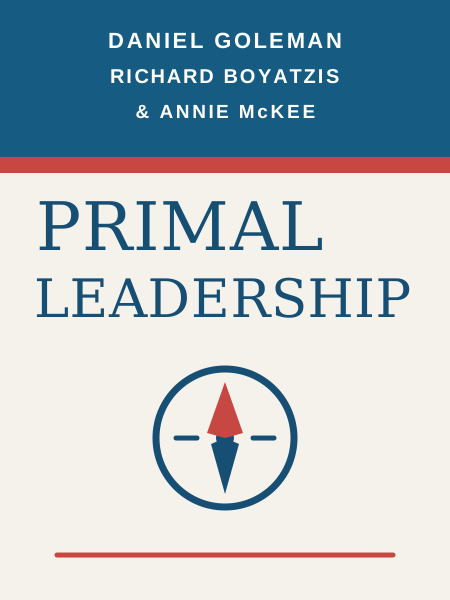
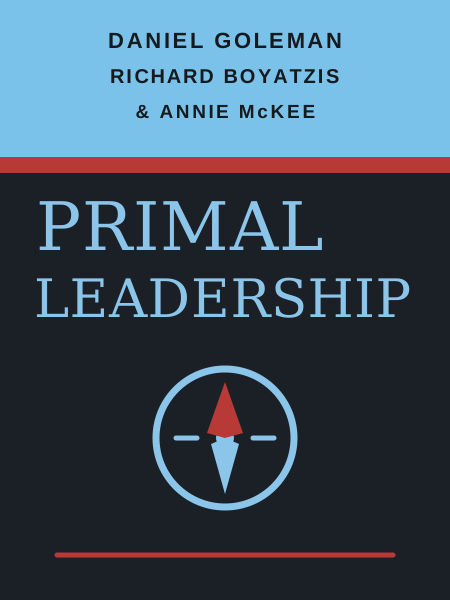
Primal Leadership
Daniel Goleman, Richard Boyatzis, Annie McKee · 2002
Editorial rating
- Evidence
- 6/10
- Actionability
- 6/10
- Originality
- 7/10
The thesis
A leader's primary job is emotional - managing the mood of the organization. Emotions are contagious (spreading top-down faster than bottom-up), and emotionally intelligent leaders create "resonance" that amplifies team performance, while emotionally tone-deaf leaders create "dissonance" that undermines everything else they do.
Who this is for
Executives who've been told they need to work on "soft skills," technically competent managers struggling to inspire teams, and leaders who've achieved results through intimidation but wonder about the long-term costs.
My favorite quote
The leader's mood is quite literally contagious, spreading quickly and inexorably throughout the business.
Why it matters
Most leaders underestimate how much their emotional state affects everyone around them. Your anxiety becomes everyone's anxiety.
Do this
Before your next meeting, take two minutes to consciously set your emotional state. Your team will absorb whatever you bring.
Start here
Master the six leadership styles and know when to use each: Visionary (change direction), Coaching (develop people), Affiliative (heal rifts), Democratic (build buy-in), Pacesetting (quick results), and Commanding (crisis). The first four create resonance; the last two should be used sparingly. Leaders who can deploy multiple styles flexibly outperform one-style leaders.
Critical summary
Daniel Goleman, who popularized "emotional intelligence" (EQ), teams with leadership development experts to apply EQ specifically to leadership. Their central claim: leaders set the emotional tone of organizations, and that tone directly impacts bottom-line results. The book draws on brain science (the limbic system's "open loop" nature) to explain why emotions are contagious and why the leader's emotions matter most.
The six leadership styles framework provides useful vocabulary for discussing leadership approaches. Research cited suggests organizations with more "resonant" leadership show better financial performance, though causation is difficult to establish.
What it gets right
- Emotional contagion is real - leaders do disproportionately set organizational mood
- The six styles framework gives concrete behavioral options
- EQ can be developed (it's not fixed like IQ)
- The "CEO disease" concept - leaders getting filtered feedback - is important
What it misses
- Emotional intelligence as a construct remains scientifically contested; Goleman makes stronger claims than academic research supports
- The book conflates many different competencies under the EQ umbrella, making it hard to know what to develop
- Examples focus heavily on CEOs of major corporations - less helpful for middle managers or small business owners
- Some sections read like cut-and-paste from PowerPoint presentations, lacking depth
- The path from "understand EQ" to "develop EQ" remains vague; rewiring limbic responses takes more than reading a book
Evidence is largely case studies and consulting experience. The brain science framing, while compelling, can overstate what we actually know about leadership and neuroscience.
Key concepts
Resonance
The positive emotional synchronization that happens when leaders are attuned to their team's feelings. Notice when your team is energized vs. depleted after meetings with you.
Dissonance
The emotional discord created by leaders who ignore or suppress emotions. Watch for eye-rolls, disengagement, or compliance without commitment.
The Open Loop
The limbic system's responsiveness to external emotional signals explains why emotions spread. Use this deliberately by managing your own state.
Six Leadership Styles
Visionary, Coaching, Affiliative, Democratic, Pacesetting, Commanding. Audit which styles you overuse and underuse.
CEO Disease
Leaders get increasingly filtered feedback as they rise. Seek out truth-tellers who will give you honest emotional intelligence feedback.
Self-Directed Learning
EQ development requires identifying your ideal self, understanding your real self, creating a learning plan, and practicing in real contexts.
Core insights
-
Your mood is the first domino
In any interaction, the person with more power has more emotional influence. As a leader, you're always setting tone whether you mean to or not.
-
Pacesetting and Commanding are overused
High-achievers who become leaders often default to the styles that made them individual contributors - and these styles create dissonance at scale.
-
Feedback flows down, not up
As you gain power, you get less honest feedback. Build systems to counteract this.
-
EQ beats IQ at the top
Technical competence gets you promoted; emotional competence determines your ceiling. The higher you rise, the more EQ matters.
-
Resonance requires range
Leaders who can only use one or two styles create dissonance in situations requiring different approaches.
Implementation steps
Today
- Identify which of the six leadership styles you use most often
- Notice your emotional state before your next meeting - and how it affects others
This week
- Seek feedback from 2-3 trusted colleagues: "How do people feel after meetings with me?"
- Practice one leadership style you typically avoid
- Pause before responding in emotional situations - count to five
This month
- Complete a 360-degree assessment of your emotional intelligence competencies
- Identify your "emotional triggers" and develop response strategies
- Schedule one-on-ones focused entirely on team members' development (Coaching style)
Ongoing
- Build a "truth-teller network" who will give you unfiltered feedback
- Practice reading emotional undercurrents in meetings
- Consciously vary your leadership style based on situation needs
Suggested 30-day practice plan
An editorial application plan created by Monolithic Vault - an interpretation of the book's ideas, not part of the original book.
- Day 1
Self-assess: Which of the six styles do you default to? Which do you avoid?
- Day 2
Track your emotional state before/during/after three meetings
- Day 3
Ask two trusted colleagues for honest feedback on your leadership presence
- Day 7
Practice a non-default leadership style in a low-stakes situation
- Day 14
Identify one "emotional trigger" and develop a response strategy
- Day 21
Assess team mood over the past two weeks - what patterns do you notice?
- Day 30
Create a personal EQ development plan focusing on one specific competency
Free PDF summary
Take this analysis with you: a designed two-page field-notes sheet with the thesis, my favorite quote, the key concepts and core insights, and the full 30-day checklist. Print it or keep it - free, no signup.
Go deeper
If this analysis earned your attention, the full book goes further than any summary can. The original is always the primary source.